Water Got Inside Your Watch? What to Do Immediately (First 30 Minutes)
If water gets inside your watch, stop the movement, avoid heat, and get it professionally dried ASAP. The biggest mistake is using a hair dryer or hot air—heat can warp seals, push moisture deeper, and accelerate corrosion. Follow the steps below in the first 30 minutes to reduce damage.
 Step-by-step: The first 30 minutes (Emergency plan)
0–2 minutes: Stop making it worse
-
Get out of water immediately and dry the outside with a clean cloth.
-
Do not press any pushers (chronograph buttons) and do not turn the crown if you suspect it’s not sealed.
-
If your watch has a screw-down crown and you are sure it’s fully screwed down, leave it alone for now.
If you want a quick refresher on what your rating actually allows, see:
Water ratings explained → Water Resistance Explained: What Watch Depth Ratings Really Mean (2026)
2–10 minutes: Decide how serious it is
Check these signs:
High-risk signs (act fast):
-
Visible droplets under the crystal
-
Heavy fogging that doesn’t clear
-
The watch stops / stutters / seconds hand jumps oddly
-
Saltwater or pool water exposure (chlorine/salt accelerates corrosion)
If the watch was exposed to pool water, read this next (it changes urgency):
→ Does Chlorine Damage Watches? What Pool Water Really Does (anchor text: “chlorine damage watches”)
If it was ocean/saltwater, read this next:
→ Does Salt Water Damage Watches? Ocean Exposure Explained (anchor text: “salt water damage watches”)
10–20 minutes: Safe actions you can take at home
These steps are low-risk and help until a watchmaker can open the case.
-
Remove the strap/bracelet if it’s soaked
-
Leather straps trap moisture—remove it to avoid mold and odor.
-
Keep the watch at room temperature
-
Put it in a dry place with good airflow.
-
Do not put it in direct sun, on a radiator, or near a heater.
-
If the crown is already pulled out (and you can safely do so), leave it pulled
-
Some people pull the crown to stop the movement and reduce wear while wet.
-
But if you’re not sure about sealing or you might force water inward, don’t touch it.
-
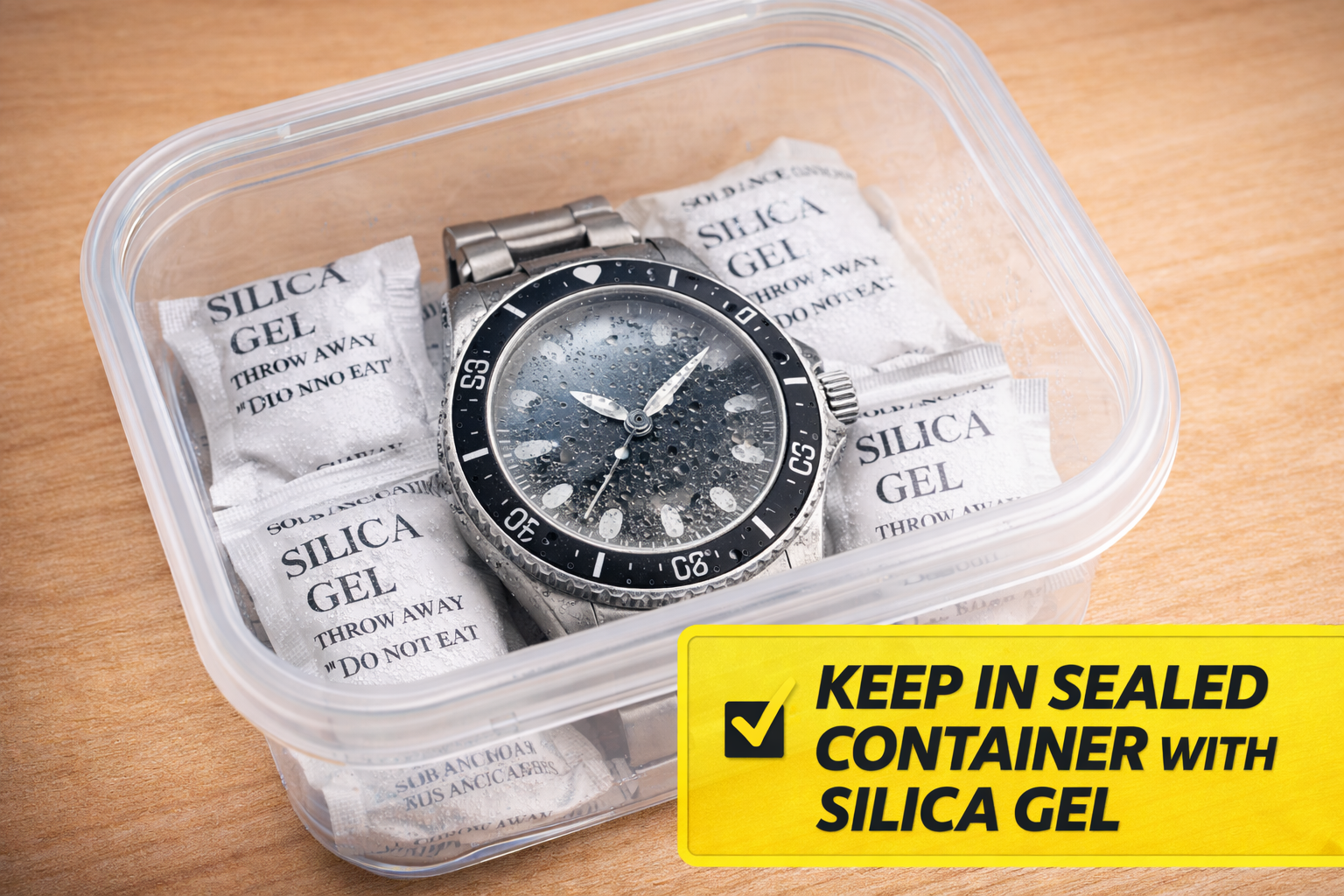
Use a sealed container with a drying agent (optional)
-
If you have silica gel packs: place the watch in a sealed container with multiple packs.
-
Avoid raw rice as a “magic fix”—it’s inconsistent and can leave dust.
20–30 minutes: The decision — when to go to a watchmaker
Go to a watchmaker the same day if:
-
You see droplets under the crystal
-
The fogging persists
-
It’s saltwater/pool water
-
The watch is valuable or mechanical/automatic
-
The watch shows any accuracy problems after drying
Even if it “seems fine,” moisture can sit under the dial and start corrosion.
If you want the maintenance timeline and what a proper service includes:
→ How Often Should You Service a Mechanical Watch? A Practical Maintenance Timeline (2026) (anchor text: “service a mechanical watch”)
What NOT to do (Most common mistakes)
❌ Don’t use a hair dryer, oven, or hot air
Heat can:
-
warp gaskets and seals
-
expand air inside the case and push moisture deeper
-
speed up corrosion
❌ Don’t shake the watch
Shaking can move water onto the dial, hands, and movement where damage is worse.
❌ Don’t keep wearing it “to see if it dries”
Body heat and motion won’t fix internal moisture—often it makes it worse.
Why fogging happens (and why it matters)
Fogging means moisture is inside the case and condensing on the crystal due to temperature changes. It’s not just cosmetic—over time it can damage:
-
dial finish and lume
-
hands
-
movement oils and steel parts
If this is your main symptom, read:
→ Why Is My Watch Fogging Under the Crystal? Causes & Fixes (anchor text: “watch fogging under the crystal”)
Quick reference table: Risk level by water type
| Exposure | Risk Level | Why | What to do |
|---|---|---|---|
| Fresh water splash | Medium | may enter via crown/gaskets | dry outside + monitor fogging |
| Shower/steam | High | heat/steam penetrates seals | stop using + same-day check |
| Pool water (chlorine) | Very High | chemicals attack gaskets/metal | rinse outside + urgent service |
| Ocean (salt) | Very High | salt crystallizes + corrosion | urgent service, don’t delay |
For the shower/steam scenario, see:
→ Is It Safe to Wear a Watch in the Shower? The Truth About Water, Steam & Soap (2026) (anchor text: “wear a watch in the shower”)
FAQ (for Google long-tail coverage)
1) Can a watch survive if water got inside once?
Sometimes, yes—if it’s opened and dried quickly. The real threat is corrosion over the next hours/days.
2) How long can water sit inside before damage?
Corrosion can start quickly, especially with salt/chlorine. Same-day service is the safest rule.
3) Should I pull the crown out to dry the watch?
Only if it’s already loose and you can do it without forcing water inward. If unsure, don’t touch it—get professional help.
4) Will silica gel dry a wet watch completely?
It can reduce moisture, but it won’t replace opening the case and drying the movement if water has entered.
5) My watch fogged then cleared—am I safe?
Not necessarily. Clearing can just mean the moisture moved or redistributed. If it happened once, you should still inspect seals.
6) Does “100m water resistance” mean it can’t get water inside?
No. Ratings assume ideal conditions and intact seals. Real-world use (steam, crown not fully secured, aging gaskets) changes everything.
→ Read: Water Resistance Explained: What Watch Depth Ratings Really Mean (2026)
Related Guides