Watch Winder vs Letting It Rest: Which Is Better for Your Automatic Watch?
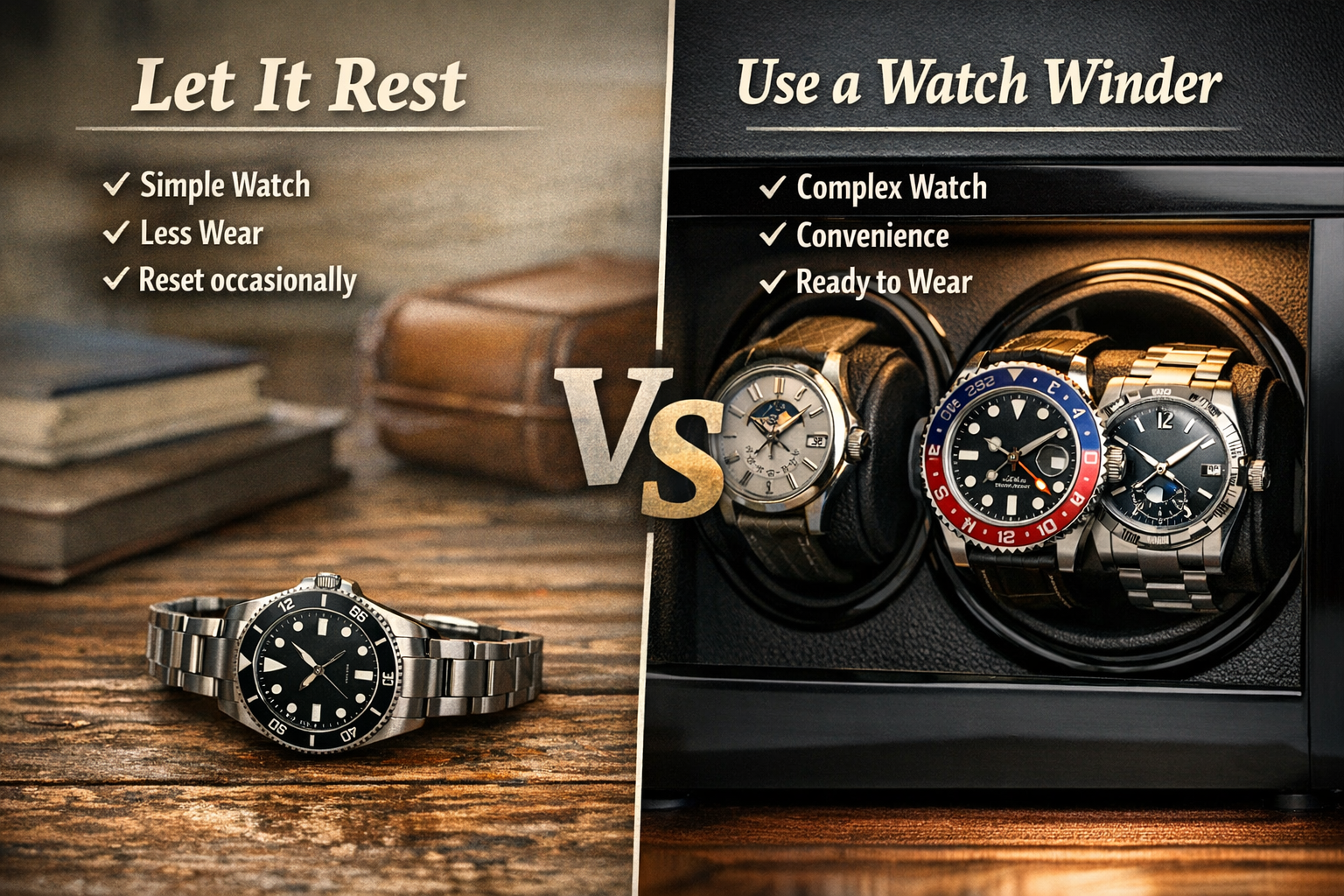
A lot of automatic watch owners end up asking the same question sooner or later:
Is it better to keep the watch running on a winder, or let it stop when I’m not wearing it?
The answer is not as dramatic as people make it sound.
A watch winder is not automatically bad. Letting a watch rest is not automatically better. The right choice depends on what kind of watch you own, how often you rotate it, and whether keeping it running actually solves a real problem or just creates extra runtime for no real benefit.
So here is the honest short answer:
For a simple automatic watch, letting it rest is usually the better choice.
For a complication-heavy watch that is annoying to reset, a winder can be the better choice.
That is the real dividing line.
This is not really a debate about “good” vs “bad.”
It is a debate about convenience vs unnecessary running.
Who this guide is for
This article is for you if:
- you own an automatic watch and are not sure whether to keep it running between wears,
- you already have a watch winder and wonder if you are using it too much,
- you rotate several watches during the week,
- or you are trying to balance convenience, wear, and maintenance.
If you are still deciding whether you need a winder at all, this article also pairs naturally with your overall ownership habits, especially articles like How to Wind a Mechanical Watch Properly (Manual vs Automatic + Mistakes to Avoid), Power Reserve Explained: Why Your Watch Stops Early (and How to Fix It), and How Often Should You Service a Mechanical Watch? A Practical Maintenance Timeline.
The short answer
Choose a watch winder when:
- you rotate several automatic watches,
- the watch has complications that are annoying to reset,
- you wear it often enough that keeping it running genuinely adds convenience,
- and the winder is set correctly.
Let the watch rest and stop when:
- it is a simple three-hand or date-only automatic,
- you only wear it occasionally,
- you do not mind resetting it,
- or you want to avoid unnecessary runtime.
In plain English:
If resetting the watch takes one minute, let it rest.
If resetting it is genuinely annoying, a winder may be worth it.
What this decision is really about
Many owners think this question is about “protecting the movement.”
That is only partly true.
The real decision is about four things:
- convenience,
- unnecessary movement runtime,
- how easy the watch is to reset,
- and how the watch fits into your actual life.
A lot of automatic watches are easy to restart. Pull the crown, wind a little, set the time, and you are done.
But some are not so simple.
A moonphase, day-date, GMT, annual calendar, or other complication-heavy watch can become annoying fast if it stops often. That is where the winder argument starts making sense.
For those watches, keeping them alive can reduce friction enough that you actually wear them more.
That is a meaningful benefit.
What happens when you let an automatic watch rest?
Not much. And that is the point.
An automatic watch that is not being worn will eventually run down and stop. That is normal. It is not a sign of failure. It is simply the mainspring reaching the end of its stored energy.
When the watch is resting:
- the movement is not running,
- the escapement is not in continuous action,
- and the watch is not going through extra operating time that it does not need.
That is why many owners prefer to let simple watches rest.
They would rather:
- save the runtime,
- reset the watch when needed,
- and avoid keeping the movement in motion just for the sake of seeing it alive in a box.
Real-world example
Imagine a basic automatic dive watch with a date window.
You wear it Monday to Friday, then switch to something else over the weekend. By Monday morning, it has stopped.
Should you worry?
No.
Should you automatically buy a winder?
Also no.
In this case, letting the watch rest is often the more sensible choice. Resetting one simple date watch is usually quick and painless.
What happens when you keep it on a winder?
A winder keeps the automatic watch moving enough to maintain usable power reserve.
That means:
- the watch stays running,
- the time remains set,
- and complications may stay current depending on how long it remains on the machine.
The benefit is convenience.
The cost is more runtime.
That does not mean a winder is “damaging” a healthy modern automatic watch in some dramatic way. But it does mean the watch is continuing to run when it otherwise could be resting.
This is the part many people ignore because a winder feels elegant, technical, and collector-friendly.
But every extra hour of operation is still operation.
That is why the smartest way to think about a winder is this:
It is a convenience tool, not a free benefit.
Which is better for movement wear?
This is the question owners usually care about most.
And the honest answer is:
Letting a watch rest generally means less total runtime. Less runtime generally means less cumulative movement activity.
That is the simple logic.
A watch on a winder may remain at a practical running state, but it is still running. The oils, gears, pivots, and escapement are all still doing their job. That is not automatically bad — it is what the watch is made to do — but it is still more activity than a resting watch.
So if your question is purely:
Which option reduces unnecessary operation?
The answer is:
Letting the watch rest.
But that is not the only relevant question.
Because a watch is not only a machine. It is also something you want to enjoy wearing.
Which is better for convenience?
This is where the winder wins.
A watch on a properly set winder is ready to go.
A watch that has rested needs your attention before wear.
For a simple automatic, that attention is minor.
For a complication-heavy watch, it can be tedious.
Watches that benefit most from a winder
A winder makes the most sense for watches like:
- day-date models,
- triple calendar watches,
- moonphase watches,
- GMTs you wear regularly,
- and anything that is annoying enough to reset that you begin avoiding it.
That is why these articles matter so much if you own more complicated automatics:
- Day-Date & Triple Calendar Setting Guide: Safe Order, Danger Zone & Common Mistakes
- Moonphase Setting Guide: How to Set a Moonphase Watch Safely (Avoid Common Damage)
- GMT Watch Explained: How to Set & Use a GMT Hand (2nd & 3rd Time Zone Guide)
Those guides also reveal why some owners decide a winder is worth it: not because the watch must stay running, but because resetting it is a chore.
The best answer depends on what kind of automatic watch you own
This is where the decision becomes much easier.
Simple three-hand automatic
Let it rest.
That is usually the best balance of practicality and restraint.
Date-only automatic
Usually let it rest, unless you wear it often enough that it barely stops anyway.
Day-date or triple calendar
A winder starts making more sense if you rotate often and dislike resetting.
Moonphase automatic
A winder is often more justifiable here, especially if the watch is worn regularly enough to make the convenience meaningful.
GMT automatic
Depends on how often you wear it. If it is part of a regular rotation, a winder can be useful. If it is occasional, letting it rest is often fine.
Vintage automatic
Usually lean toward letting it rest unless the watch has been checked recently and you know exactly why it is on a winder.
A common mistake: using a winder to hide a different problem
This happens more often than people admit.
A watch stops sooner than expected. The owner assumes it “needs a winder.” But the real problem may be:
- the watch was never fully wound,
- the owner’s lifestyle is too desk-bound for efficient rotor winding,
- the watch is magnetized,
- or the watch may need attention.
A winder can make the symptom disappear without solving the reason it existed.
That is why these articles matter before you decide that a winder is the answer:
- Power Reserve Explained: Why Your Watch Stops Early (and How to Fix It)
- Why Is My Watch Running Fast or Slow? 9 Common Causes (And Fixes)
- Magnetized Watch Symptoms: Why Your Watch Runs Fast & How to Fix It (Safely)
If the watch is underperforming, a winder may be a workaround, not a solution.
A practical ownership example
Let’s compare two owners.
Owner A: simple everyday automatic
They wear one sports watch most weekdays and switch to a different piece on weekends. Their automatic stops after about two days off the wrist.
For this owner, letting it rest is usually the better choice. Resetting takes less than a minute. The watch does not need a machine to stay alive.
Owner B: rotating collection with calendar complications
They rotate between four automatics, including a day-date and a moonphase. Every time one stops, resetting it feels tedious enough that it sits in the box longer than intended.
For this owner, a winder may be the better choice for selected watches. Not all of them. Just the ones where convenience clearly improves actual enjoyment.
That is the key distinction.
The best answer is often not:
- “always use a winder,” or
- “never use a winder.”
It is:
- “use one selectively.”
What about service cost?
This is where people sometimes get too dramatic.
A winder does not automatically mean the watch will become outrageously expensive to maintain. But if it keeps a watch running far more than necessary, it is still adding mechanical runtime over the long term.
That is why some owners prefer rest as the default position.
Not because they are terrified of using the movement.
But because they do not see a reason to create extra running time for a watch that is easy to restart.
If you want to think about this through the lens of ownership cost, How Much Does Watch Servicing Cost? Mechanical vs Quartz vs Chronograph vs GMT is the useful companion piece here.
The smartest compromise: use the winder only for certain watches
This is often the best real-world solution.
You do not need to choose one philosophy for every watch.
A very practical setup looks like this:
- let simple automatic watches rest,
- use a winder only for complication-heavy watches,
- and only keep those watches on the winder when they are in active rotation.
That approach gives you:
- lower unnecessary runtime across the collection,
- convenience where it actually matters,
- and less tendency to use the winder just because it looks nice on a shelf.
That is usually smarter than putting every automatic you own on constant display rotation.
How to decide in 60 seconds
Use this simple framework.
Let it rest if:
- the watch is simple,
- you wear it only occasionally,
- resetting it is easy,
- and you do not mind a short setup before wearing.
Use a winder if:
- the watch is annoying to reset,
- you wear it regularly enough to justify keeping it ready,
- and the winder is correctly set and not just spinning endlessly.
Reconsider everything if:
- the watch stops too early,
- runs badly,
- or you are using the winder to avoid dealing with a real performance issue.
A better question than “Which is better?”
Instead of asking:
Which is better for all automatic watches?
Ask:
Which choice creates the least friction for this watch without creating unnecessary runtime?
That question usually gets you to the right answer faster.
Because most automatic watches do not need one universal rule.
They need the right rule for:
- their complication level,
- your wearing habits,
- and your patience for resetting.
A simple 5-step routine
If you want a balanced approach, this works well.
Step 1: Separate your watches into “easy to reset” and “annoying to reset”
Be honest, not theoretical.
Step 2: Let the easy ones rest
That is usually the most sensible default.
Step 3: Use the winder only for the annoying ones
Especially if you wear them often enough to benefit from it.
Step 4: Check the watch’s actual behavior
If it stops too early or runs oddly, diagnose that first rather than assuming the winder is helping.
Step 5: Reassess every few months
Many owners buy a winder, use it heavily for a while, then realize only one or two watches really benefit from it.
Bottom line
For most simple automatic watches, letting the watch rest is the better choice.
It reduces unnecessary runtime, keeps the ownership routine simple, and avoids using a machine to solve a problem that barely exists.
For calendar-heavy or regularly rotated complication watches, a winder can be the better choice because it removes enough setup friction to make the watch easier to enjoy.
So the real answer is this:
- For simplicity, let it rest.
- For complication-heavy convenience, use a winder.
- For most collections, the smartest answer is a selective mix of both.
That is usually the best balance between mechanical restraint and real-life usability.
FAQ
Is it better to keep an automatic watch running or let it stop?
For a simple automatic, letting it stop is usually fine. For a complication-heavy watch that is annoying to reset, keeping it running can be more practical.
Does letting an automatic watch rest harm it?
No. An automatic watch stopping when not worn is normal.
Is a watch winder bad for an automatic watch?
Not inherently. The main trade-off is that it keeps the watch running when it might not need to be, which adds unnecessary runtime if there is no real convenience benefit.
Should I keep all my automatic watches on winders?
Usually no. Most owners are better off using a winder selectively rather than keeping every automatic permanently running.
Does a winder reduce the need for servicing?
No. A winder is a convenience tool, not a maintenance shortcut.
Which watches benefit most from a winder?
Day-date, moonphase, GMT, and other complication-heavy automatics usually benefit the most.