How Much Does Watch Servicing Cost? Quartz vs Mechanical vs Chronograph
 If you have ever asked, “How much does watch servicing cost?”, what you probably mean is something more specific:
Am I looking at a simple battery-and-seal job, or am I about to approve a full movement overhaul that costs a lot more than expected?
That is the real question.
In broad terms, quartz is usually the cheapest to deal with, a basic mechanical or automatic watch sits in the middle, and chronographs or complication-heavy watches jump up fast. Current published authorized-service examples show roughly GBP 150–230 / CHF 230 for a basic quartz full service, about GBP 210–280 / CHF 280 for a basic automatic or hand-wound service, and around GBP 310–450 / CHF 330–450 for chronographs or complication-heavy mechanical work. Brands also warn that published prices may change, and extra parts, shipping, or estimate-only complications can push the final bill higher.
That sounds expensive until you see where the cost comes from.
A proper service is not a quick wipe-down and a new battery. Authorized service pages from Tissot and Hamilton describe full service as disassembly of the movement, cleaning, lubrication, replacement of worn parts when needed, case and bracelet cleaning, gasket replacement, water-resistance restoration, regulation for mechanical models, and final testing. Service warranties of around 24 months on the intervention are common.
The short answer
Here is the simplest way to think about it:
- Quartz watch: usually the cheapest to maintain.
- Basic automatic or hand-wound watch: more labor, more cost.
- Chronograph: usually the most expensive mainstream category.
- GMT: often somewhere between a basic automatic and a more complex complication, depending on the movement.
So no, “watch service cost” is not one number. It depends heavily on what is inside the case.
A real-world example most owners will recognize
A lot of owners make the same mistake the first time they get a quote.
They notice one symptom — maybe the watch stopped, started fogging, or began running poorly — and assume it needs “a service.”
Sometimes it does. Sometimes it absolutely does not.
Take a common scenario.
You own a three-hand automatic sports watch. It starts stopping on Monday mornings. You assume the movement is worn out and prepare yourself for a major bill. But after a closer look, the real issue is that the watch was rarely fully wound, spent most of the week on a desk, and had never been manually topped up before the weekend. In that case, the smarter first step is not approving a service quote blindly — it is checking whether the problem is really service-related. That is exactly why Power Reserve Explained: Why Your Watch Stops Early (and How to Fix It), How to Wind a Mechanical Watch Properly (Manual vs Automatic + Mistakes to Avoid), and Why Is My Watch Running Fast or Slow? 9 Common Causes (And Fixes) matter before you approve expensive work.
That is the basic rule for this whole topic:
Diagnose first. Approve second.
What a full watch service usually includes
Owners often focus on the price and skip the more useful question: what am I paying for?
A full service usually includes:
- opening the watch and removing the movement,
- full disassembly or movement replacement depending on the brand and watch,
- cleaning and lubrication,
- replacement of worn internal components where needed,
- gasket replacement,
- water-resistance restoration and testing,
- regulation and function checks,
- case and bracelet cleaning, sometimes with refinishing.
That last part matters because two service quotes that look similar on paper can include very different things. One may include refinishing and gasket work. Another may not. One may include common wear parts. Another may bill them separately. Official price pages also note that shipping and additional parts may be charged separately, which is one reason final invoices sometimes surprise owners.
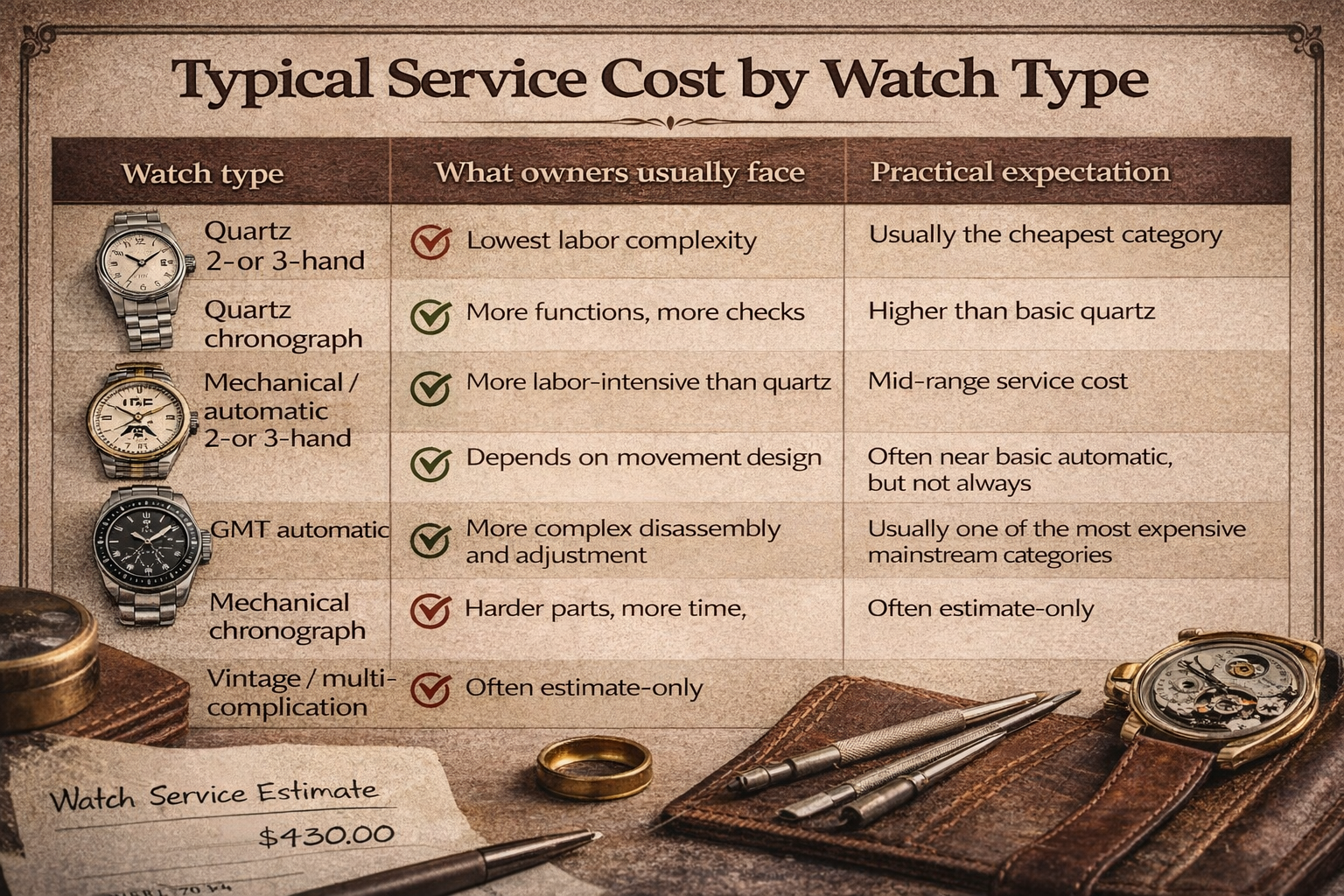
Typical service cost by watch type
The table below is the practical version. These are not universal prices. They are realistic category expectations based on current published authorized-service examples and how the market usually prices labor by movement type.
| Watch type | What owners usually face | Practical expectation |
|---|---|---|
| Quartz 2- or 3-hand | Lowest labor complexity | Usually the cheapest category |
| Quartz chronograph | More functions, more checks | Higher than basic quartz |
| Mechanical / automatic 2- or 3-hand | More labor-intensive than quartz | Mid-range service cost |
| GMT automatic | Depends on movement design | Often near basic automatic, but not always |
| Mechanical chronograph | More complex disassembly and adjustment | Usually one of the most expensive mainstream categories |
| Vintage / multi-complication | Harder parts, more time, more unknowns | Often estimate-only |
Published examples show the pattern clearly: Hamilton UK lists GBP 150 for quartz 2–3 hands, GBP 210 for automatic/manual 2–3 hands, GBP 220 for quartz chronographs, and GBP 310 for automatic chronographs; Longines’ public pricing examples show quartz 2–3 hands at 230 and quartz chronograph at 330 in local listed pricing; Rado’s 2025 Switzerland list shows CHF 230 for quartz 2–3 hands, CHF 280 for basic mechanical, CHF 330 for quartz chronograph/complication, and CHF 450 for mechanical chronograph/complication.
The point is not that your watch will match one of those numbers exactly. The point is that the movement type changes the quote more than many owners expect.
Why quartz is usually cheaper
Quartz owners sometimes panic when they hear the word “service,” but quartz is often a different conversation.
In many cases, a quartz watch does not need a full overhaul right away. It may need:
- a battery,
- a reseal,
- a pressure test,
- a crown or gasket replacement,
- or in some cases a full movement swap rather than a traditional rebuild.
That is one reason quartz often stays at the lower end of service pricing.
Real example
A daily-wear quartz watch stops after two years. The owner assumes the watch is “dead” and imagines a major repair bill. But a professional inspection shows the movement is fine; it only needs a battery, gasket replacement, and a water-resistance check because the owner washes hands with it on every day.
That is not a full mechanical-style service story. It is a maintenance story.
If water protection is part of the concern, Watch Water Resistance Test: What a Pressure Test Checks (and How Often to Do It) is the more useful reference point than a generic “service cost” page.
Why mechanical and automatic service costs jump
Once you move from quartz into mechanical watches, labor becomes the story.
A basic automatic watch may look simple from the outside, but it still has a movement that runs continuously, relies on lubrication, and may need worn parts replaced during service. That is why mechanical service quotes rise much faster than owners of entry-level automatics often expect.
This is also where bad timing can hurt.
A lot of people wait until the watch is clearly sick — poor reserve, erratic timekeeping, or moisture concerns — and then face a bigger quote than they would have if the issue had been addressed earlier. That is part of the reason brands give very different service-interval guidance. Hamilton says a precise interval cannot be fixed because use and environment matter, while Tissot points owners toward checks every 3–4 years and Longines publishes a full-service recommendation of roughly 6–8 years on one page, while also saying automatic service suggestions can be around 3–5 years in other customer-facing materials.
Your existing article on timing already covers that angle well, so in practice this cost article should help readers answer the next question:
Is the quote still worth it now?
Why chronograph service is usually the painful one
Chronographs are where owners get sticker shock.
That is not because brands are trying to be dramatic. It is because chronographs add complexity, more components, more adjustment points, and more places where things can go wrong.
A chronograph that “kind of works” can still hide expensive internal wear.
Real example
An owner notices the chronograph seconds hand does not reset exactly to zero anymore. The pushers feel slightly heavier than before, but the watch still runs. So they keep using it and put off inspection for another year.
Eventually, the watch goes in for service, and the quote is significantly higher than the owner expected.
That story is common because chronograph problems often begin as “small annoyances.” But on a service bench, those annoyances become labor time.
For readers who are not even sure how their chronograph should behave, Chronograph Explained: How to Use It (Plus 10 Common Mistakes to Avoid) is the right companion article.
GMT service cost: why it is harder to predict
GMT watches confuse people because some feel almost as simple as a standard automatic, while others sit much closer to complication territory.
That is why GMT quotes can be inconsistent.
A straightforward GMT may be priced similarly to a normal automatic by one service center. Another GMT, especially one with more complex functionality or a brand-specific setup, may move into estimate-only territory. Hamilton’s own service page groups “watches with multiple movements, complications” into estimate-required territory, which reflects the real-world problem: not all GMTs are equal on the bench.
Real example
A traveler rotates between two watches: a simple diver on weekdays and a GMT during trips. The GMT seems expensive to service compared with the three-hand watch, so the owner assumes GMTs are always costly.
Not necessarily.
Sometimes the quote difference is modest. Sometimes it is not. The deciding factor is not the fourth hand alone — it is the movement design, parts situation, and how the brand classifies the watch in service terms.
That is why a GMT owner should read GMT Watch Explained: How to Set & Use a GMT Hand (2nd & 3rd Time Zone Guide) first, especially when the real problem may be handling or setting confusion rather than true service need.
When service is worth it — and when it isn’t
This is where the conversation becomes practical.
A service is usually worth it when:
- the watch has real sentimental value,
- the replacement cost is meaningfully higher than the service cost,
- the watch is still structurally solid,
- the brand or movement is worth maintaining long-term,
- or the symptoms show the watch genuinely needs proper work.
A service is often harder to justify when:
- the watch is inexpensive and easily replaced,
- parts access is poor,
- the quote approaches or exceeds market value,
- the movement is disposable rather than meaningfully serviceable,
- or the watch has multiple issues that stack into an unattractive final bill.
That does not mean cheap watches should never be serviced. It means the owner should make a decision, not a reflex purchase.
The smartest way to read a watch service quote
This is the part many buyers skip, and it is where money is either saved or wasted.
Before approving any quote, ask these six questions:
1. Is this a full service, a partial service, or a repair?
Those are not the same thing.
A water-resistance issue may need seals and testing, not a full overhaul. A dead quartz watch may need a battery and reseal, not a total intervention.
2. Are parts included?
Some quotes include normal wear parts. Others do not. Crystals, crowns, pushers, and special components may be extra.
3. Is refinishing included?
Case refinishing can be valuable — or completely unnecessary. On some watches, especially sharp-edged sports models or vintage pieces, over-polishing can hurt the watch more than help it.
4. Does the quote include water-resistance testing?
That matters a lot if the owner wears the watch around sinks, rain, pool decks, or beaches. Related reading here would be Can You Swim With a Watch? Pool vs Ocean Water Risks Explained, Screw-Down Crown Mistakes: The Fastest Way People Ruin Water Resistance, and Is It OK to Wear a Watch in the Rain? What’s Safe & What to Check First.
5. How long is the service warranty?
A proper service should come with clear post-service protection.
6. What happens if the brand finds additional problems after opening the watch?
This is where “estimate pending inspection” becomes real.
Authorized service center vs independent watchmaker
This is another decision owners get wrong by turning it into ideology.
Authorized service is not automatically the right answer. Independent service is not automatically the budget answer.
Here is the practical version.
Choose authorized service when:
- the watch is under warranty,
- the brand has proprietary parts,
- resale value and paperwork matter,
- the model is complication-heavy,
- or you want brand-backed standards and documentation.
Choose a strong independent when:
- the watch is out of warranty,
- the movement is common and well-supported,
- the brand quote feels disproportionate,
- or you care more about sensible value than brand stamps.
A good independent can save real money. But that only matters if the watchmaker is actually good.
A 10-minute decision framework
Here is the simplest process I would put in front of any owner:
Step 1: Identify the symptom
Is it stopping, fogging, running fast, losing reserve, draining batteries, or failing chronograph reset?
Step 2: Rule out the obvious
For mechanical watches, check winding habits, reserve, and magnetism first. Start with Magnetized Watch Symptoms: Why Your Watch Runs Fast & How to Fix It (Safely), How to Demagnetize a Watch at Home (Tool, Steps & When to Stop), and Power Reserve Explained: Why Your Watch Stops Early (and How to Fix It).
Step 3: Separate “water issue” from “movement issue”
A pressure test, reseal, or gasket job is not the same as a full movement service.
Step 4: Ask for a written quote
Never approve vague language like “probably needs a service.”
Step 5: Compare the quote to the watch’s real value
Not just resale value — also how much you actually enjoy wearing it.
Step 6: Decide whether this is maintenance, repair, or replacement
Those are three different financial decisions.
The mistake that costs people the most money
It is not always neglect.
Quite often, the most expensive mistake is servicing the wrong problem.
A watch runs fast, so the owner assumes overhaul.
A watch fogs once, so the owner assumes movement failure.
A watch stops early, so the owner assumes the movement is dying.
But sometimes the real answer is magnetism.
Sometimes it is a seal issue.
Sometimes it is low activity and poor winding.
Sometimes it is misuse around water, steam, or heat.
That is why routine care still matters. Weekly Watch Care Routine: A Simple 10-Minute System to Extend Your Watch’s Life (2026) and How to Store Watches Properly When Not Wearing Them (2026) may not sound exciting, but they often prevent the kind of neglect that turns a small issue into an expensive quote.
Bottom line
Watch servicing cost is not really about the watch case, the brand name on the dial, or the price you paid at retail.
It is about movement complexity, labor time, parts risk, and what the watch actually needs.
Quartz is usually the cheapest path.
A basic mechanical or automatic service is the middle ground.
Chronographs are where costs rise quickly.
GMT watches can be surprisingly reasonable — or unexpectedly expensive — depending on how complicated they really are.
The smartest owners do not ask only, “How much is a service?”
They ask, “What work is actually necessary, and is this watch worth doing it properly?”
That is the better question.
And it usually saves more money than chasing the lowest quote.
FAQ
How much does a basic watch service usually cost?
For a simple watch, quartz is usually the lowest-cost category, while a basic automatic costs more because the movement requires more labor. Current authorized published examples commonly place basic quartz below basic automatic, and chronographs above both.
Why does chronograph service cost more?
Because a chronograph movement is more complex to diagnose, disassemble, lubricate, adjust, and test than a basic three-hand movement.
Is GMT service always expensive?
No. Some GMTs are serviced closer to a standard automatic, while others are treated as complication-heavy watches and quoted accordingly.
Is it worth servicing a cheap watch?
Sometimes yes, sometimes no. Compare the quote against replacement cost, sentimental value, and how much you actually wear the watch.
How often should I service a watch?
There is no single universal rule. Brand guidance varies by use case and manufacturer, which is why service timing should be based on both published guidance and actual symptoms. Current brand recommendations commonly range from around every 3–4 years for checks at one end to full-service suggestions around 6–8 years at the other, depending on brand and watch type.
Does a water-resistance problem always mean full service?
No. Sometimes the right fix is a pressure test, gasket replacement, crown work, or a partial maintenance service rather than a full overhaul. Hamilton and Tissot both distinguish partial maintenance from complete service, and Hamilton specifically says water resistance should be checked annually.