Watch Bracelet Sizing Guide: How Tight Should It Be? (Comfort, Fit Tests & Fixes)
 Quick Answer
A well-sized bracelet should feel secure but not restrictive. It shouldn’t slide down to your hand, and it shouldn’t leave deep marks. For most people, the best fit is: you can slip one finger under the bracelet, and the watch stays centered on your wrist during normal movement.
Related (watch size affects bracelet comfort more than most people think):
→Watch Size Guide: Case Diameter, Lug-to-Lug & Thickness (How to Choose the Perfect Fit)
1) The best bracelet fit (simple rules)
Rule 1: The watch head should stay centered
If the watch rotates to the side all the time, it’s usually too loose or the head is too top-heavy for the fit.
Rule 2: It should not slide onto your hand
If the case crosses the wrist bone and lands near the hand when you lower your arm, tighten it.
Rule 3: It should not pinch or “pulse”
If you feel pressure after 30–60 minutes (especially at a desk), loosen it slightly or use micro-adjust.
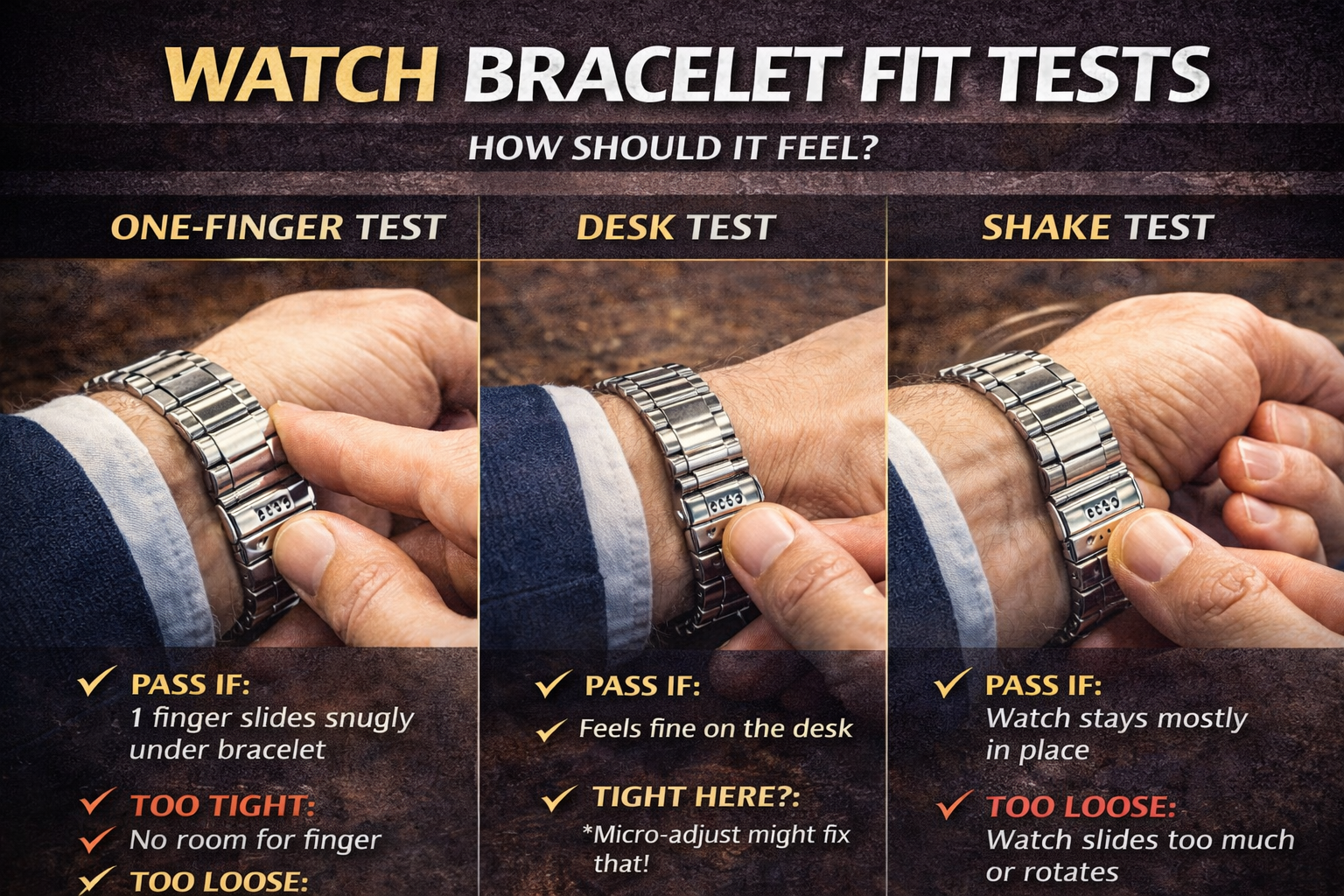
2) 3 quick fit tests (do these in 1 minute)
Test A — One-finger test
Slip one finger between bracelet and wrist at the underside.
-
✅ passes: finger fits with mild resistance
-
❌ too tight: finger can’t fit
-
❌ too loose: two fingers fit easily
Test B — Desk test (most realistic)
Rest your forearm on a desk (typing position).
-
If it feels tight only at the desk, you may need micro-adjust rather than removing/adding a full link.
Test C — Shake test (gentle)
With your arm relaxed, gently shake once.
-
✅ good: watch stays mostly in place
-
❌ too loose: watch slides several centimeters or flips position
3) Where to wear it on the wrist (comfort matters)
Most people wear a watch just above the wrist bone (closer to the elbow).
If it’s below the wrist bone, it will bump the hand and feel loose more easily.
4) How to size a bracelet properly (step-by-step)
What you need
-
spring bar tool or small screwdriver (depends on bracelet)
-
soft cloth (protects case/bracelet)
-
good lighting
Step 1: Start slightly snug, then fine-tune
Put the watch where you intend to wear it (above wrist bone), then size links until it sits centered.
Step 2: Keep the clasp centered
If possible, remove/adjust links on both sides so the clasp sits centered under the wrist.
This improves comfort and prevents the watch from rotating.
Step 3: Use micro-adjust before changing full links
Many clasps have micro-adjust holes or sliding systems. Use them first for small changes.
5) Micro-adjust is your best friend (especially in warm weather)
Wrists expand and shrink through the day:
-
heat, exercise, travel → wrist expands
-
cold rooms → wrist shrinks
Best practice: keep a “normal day” setting and use micro-adjust when needed instead of constantly removing links.
6) Common bracelet problems (and quick fixes)
Problem: Bracelet pulls hair
-
Often caused by bracelet design or loose fit.
-
Slightly tightening can reduce snagging, or consider switching strap type.
Strap alternatives guide:
→ Watch Strap Materials Guide: Bracelet vs Leather vs Rubber vs Nylon (What to Choose)
Problem: Clasp bites into the underside of wrist
-
Usually the clasp is off-center or bracelet is slightly too tight at the desk.
-
Re-center the clasp by balancing links left/right, or use micro-adjust.
Problem: Watch feels heavy and “flops”
-
Often a fit + size issue (lug-to-lug and thickness matter).
-
Consider the sizing guide:
→ Watch Size Guide: Case Diameter, Lug-to-Lug & Thickness (How to Choose the Perfect Fit)
7) Mistakes to avoid
-
Sizing too tight so it becomes uncomfortable at a desk
-
Wearing too loose so the case bangs into surfaces
-
Removing all links from one side (clasp off-center = rotation)
-
Using the wrong tool and scratching the bracelet/case
General care mistakes:
→ 10 Watch Care Mistakes That Ruin Your Watch Faster Than You Think (2026)
8) Maintenance tips (keep it comfortable long-term)
-
Clean bracelet periodically to remove grime between links
-
Store properly to avoid dust build-up
→ How to Store Watches Properly When Not Wearing Them (2026)
Everyday care routine:
→ Everyday Watch Care Guide: How to Keep Your Watch Looking New
Weekly routine:
→ Weekly Watch Care Routine: A Simple 10‑Minute System to Extend Your Watch’s Life
FAQ
1) How tight should a watch bracelet be?
Secure but comfortable. A common target is the one-finger fit underneath, with the watch staying centered.
2) Why does my bracelet feel fine in the morning but tight later?
Wrist size changes with heat, activity, and hydration. Use micro-adjust if your clasp has it.
3) Is it better to wear a bracelet loose or tight?
Neither. Too loose causes sliding and impacts; too tight causes discomfort and clasp bite.
4) How do I stop the watch from rotating?
Center the clasp and adjust fit so the watch head stays on top of the wrist.
Sizing help: → Watch Size Guide: Case Diameter, Lug-to-Lug & Thickness (How to Choose the Perfect Fit)
5) What if I don’t have micro-adjust?
Then you may need half-links (if available) or a different link balance. If the bracelet can’t fit well, consider straps:
→ Watch Strap Materials Guide: Bracelet vs Leather vs Rubber vs Nylon (What to Choose)
6) Can a badly sized bracelet damage the watch?
It can increase scratches and impacts, and it makes daily wear less enjoyable.
Common mistakes: → 10 Watch Care Mistakes That Ruin Your Watch Faster Than You Think