Travel GMT vs Office GMT: What’s the Difference and Which One Is Better for Real Life?
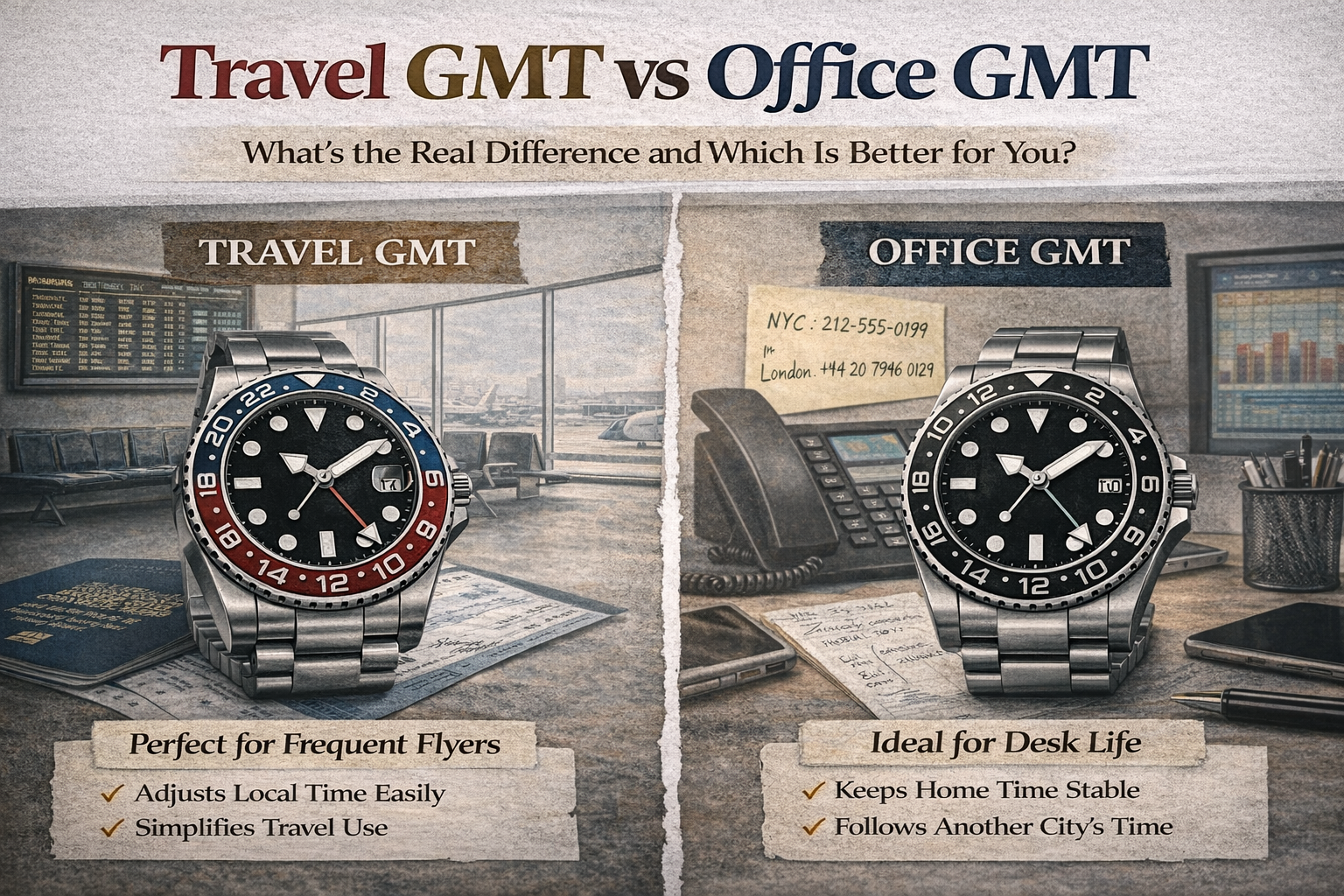
A lot of people say they want a GMT watch.
Far fewer know what kind of GMT they actually want.
That is the problem.
They like the extra hand. They like the travel look. They like the idea of tracking another time zone. But when it comes time to buy, they often discover there are really two different ownership experiences hiding under the same “GMT” label:
- the travel GMT, and
- the office GMT.
On paper, both show a second time zone.
In real life, they do not behave the same way at all.
And that difference matters much more than most buyers expect.
Here is the honest short answer:
If you regularly cross time zones, a travel GMT is usually better.
If you mainly track another city from home or the office, an office GMT is often perfectly fine.
That is the real dividing line.
This is not really about which one sounds more premium.
It is about which one fits how you actually live.
Who this guide is for
This article is for you if:
- you are shopping for your first GMT watch,
- you keep seeing “traveler GMT” and “caller GMT” and want a practical explanation,
- you want to know which type is better in real life,
- or you like the look of GMT watches but are not sure which version makes sense for you.
If you need the basic foundation first, start with GMT Watch Explained: How to Set & Use a GMT Hand (2nd & 3rd Time Zone Guide). This article is the next step: deciding which GMT type actually fits your life.
The short answer
Choose a travel GMT if:
- you fly across time zones regularly,
- you want the easiest local-time adjustment on arrival,
- you care about practical travel use more than just GMT aesthetics,
- and you want the GMT complication to feel genuinely convenient in transit.
Choose an office GMT if:
- you mostly stay in one time zone,
- you want to track another city, office, team, or family member,
- you like the look and utility of a GMT but do not need constant time-zone jumping,
- or you simply want a GMT for everyday desk life rather than airport life.
In plain English:
The best GMT is not the one with the better marketing story. It is the one whose setting logic matches your routine.
What is a travel GMT?
A travel GMT is the kind of GMT that is most convenient when you are the person moving between time zones.
Its big advantage is that the local hour hand can usually be adjusted independently in one-hour jumps. That means when you land somewhere new, you can change the local time quickly without disrupting the rest of the display in the same annoying way other GMTs sometimes do.
That sounds like a small detail.
It is not.
If you have ever landed tired, adjusted a watch in bad airport lighting, or changed time zones several times in a trip, you quickly realize this is the whole reason travel GMTs are so highly praised.
What makes it useful
A travel GMT is built around the reality that:
- your local time changes,
- home time still matters,
- and you want the watch to keep up without feeling like a project.
That is why frequent travelers often become very loyal to this type.
What is an office GMT?
An office GMT is usually better suited to people who stay in one time zone most of the time but want to track another one.
For example:
- your company works across New York and London,
- your partner travels often,
- you call family overseas,
- or you simply like keeping an eye on another city.
In that kind of life, the GMT hand matters more as a reference tool than as a travel adjustment system.
That is why office GMTs make more sense than many buyers realize.
They are not “fake GMTs.”
They are just optimized for a different use case.
What makes it useful
An office GMT fits daily life when:
- your main time zone stays stable,
- but another time zone matters often enough to deserve wrist space.
For a lot of people, that is actually more realistic than constant airport use.
Why this difference confuses so many buyers
Because in photos, both watches just look like GMT watches.
You see:
- a fourth hand,
- maybe a 24-hour bezel,
- a sporty travel-friendly look,
- and all the visual cues that say “adventure, movement, second time zone.”
None of that tells you what the watch will feel like to set and live with.
That is where buyers get caught.
They buy the GMT they think sounds more “serious,” then later realize they bought the wrong user experience for their actual routine.
A person who flies constantly may buy an office GMT and slowly get annoyed every time they land.
A person who never changes time zones may pay extra for a travel GMT and never really use the feature that made it special.
That is why this is not a spec-sheet decision.
It is a lifestyle decision.
A real-world example
Let’s compare two owners.
Owner A
They live in Singapore, travel to Europe and the U.S. several times a year, and want to keep home time visible while changing local time quickly on arrival.
This person is exactly who a travel GMT makes sense for.
Owner B
They live in Toronto, rarely leave their time zone, but work with clients in London and Dubai every week. They want to glance down and know whether it is a reasonable time to call.
This person may be perfectly happy with an office GMT.
Same complication family.
Different best answer.
That is why buyers need to stop asking:
“Which GMT is better?”
And start asking:
“Which GMT is better for the way I actually use time?”
The biggest real-life difference: what happens when you land
This is where travel GMT wins clearly.
If you fly often, the most valuable GMT moment is not usually “checking home time.” It is adjusting the watch when you arrive.
That is the moment where the two designs feel very different.
With a travel GMT, that transition usually feels more natural and more aligned with real travel behavior.
With an office GMT, the watch may still do the job, but the process often feels less intuitive for someone who moves across time zones regularly.
That does not make office GMT bad.
It just makes it less elegant for actual travel.
Practical truth
If you only travel once or twice a year, this advantage may not matter enough to drive the purchase.
If you travel constantly, it matters a lot.
Which is better for real life if you barely travel?
This is where many people overbuy.
A lot of buyers are attracted to travel GMTs because the phrase itself sounds more desirable. It sounds higher-spec, more “proper,” more enthusiast-approved.
But if you barely travel, that advantage may sit unused most of the year.
In that case, an office GMT may be more than enough.
In fact, it may be the more honest buy.
If your real-world use is:
- checking another time zone from your desk,
- coordinating work calls,
- tracking family abroad,
- or simply enjoying the aesthetic of a GMT,
then the office GMT can already do the job beautifully.
That is why buyers should be careful not to confuse aspirational travel identity with actual ownership needs.
Which is better for actual travelers?
If you cross time zones regularly, a travel GMT is usually better.
That is the clearest answer in the whole article.
Why?
Because it reduces the friction that matters most:
- changing local time quickly,
- keeping the rest of the display useful,
- and making the watch feel like a travel tool rather than a travel-themed accessory.
This is especially true if:
- you take long-haul flights,
- change time zones several times on one trip,
- or use the watch as part of a real business-travel routine.
For that kind of owner, the difference is not theoretical. It is felt.
Which is better for office workers and international teams?
This is where office GMT can be the smarter answer.
If your life looks like:
- Slack messages to another country,
- clients in a different market,
- family in another region,
- or just keeping track of a second city from one desk,
then the GMT hand is mostly a reference hand, not a travel transition tool.
That is the office GMT sweet spot.
It gives you the extra time-zone awareness without requiring you to pay for travel-oriented functionality you may rarely use.
That is why office GMT should not be treated like the lesser option.
For many people, it is simply the more relevant option.
What about everyday convenience?
This part depends less on the watch and more on your habits.
A GMT complication is only convenient if:
- you actually use the second time zone,
- you enjoy setting it,
- and you understand what the watch is doing.
If not, the extra hand becomes visual noise.
That is one reason some buyers eventually realize they did not really want a GMT at all. They wanted the look of travel more than the function of travel.
And that is okay. It is just better to know that before spending money.
If you are deciding between a complication watch and pure daily practicality, Quartz vs Automatic for Daily Wear: Total Cost, Accuracy, Convenience & Maintenance is also a useful reality check.
Travel GMT vs office GMT for first-time GMT buyers
For first-time GMT buyers, the best answer is often simpler than they expect.
Choose travel GMT first if:
- you really do travel across time zones,
- you want the most satisfying version of the complication,
- and you know the extra functionality will be used.
Choose office GMT first if:
- you mostly stay put,
- want a second time zone as reference,
- and care more about everyday practicality than complication prestige.
A useful self-check
Ask yourself:
When I imagine using this watch, am I standing at an airport or sitting at a desk?
That answer usually reveals the right GMT type very quickly.
What about price and value?
Without turning this into a broad market-pricing article, there is one practical truth worth mentioning:
In many cases, office GMTs are easier to justify for buyers who want the GMT look and utility without making their purchase decision entirely around travel-focused functionality.
That does not mean travel GMTs are always overpriced or office GMTs are always cheap. Watch pricing is too model-specific for a lazy rule like that.
But it does mean this:
If you are paying more for a travel GMT, make sure you are paying for a feature you will actually use.
That is the important part.
If you are buying used, Used GMT Watch Buying Guide: 10 Things to Check Before You Pay is the right follow-up before you commit to either style.
Which one is better for watch enthusiasts?
This depends on what kind of enthusiast you are.
If you love functional elegance
You may gravitate toward travel GMT because the way it fits actual travel life feels more refined.
If you love practical daily utility
You may prefer office GMT because it solves a real daily problem without pretending your life is always in transit.
If you mainly love the look
Either can work. Just be honest that style, not function, may be driving the purchase.
There is nothing wrong with that.
The only mistake is pretending otherwise and then buying the wrong watch for your routine.
The 5 biggest mistakes buyers make
1. Buying a travel GMT because it sounds better
It may be better for someone else, not necessarily for you.
2. Buying an office GMT without realizing how it differs
Then feeling disappointed later when travel use is less elegant than expected.
3. Ignoring how often you actually travel
One annual vacation is not the same as regular multi-zone movement.
4. Buying the GMT look instead of the GMT function
This is very common.
5. Not learning how the watch works before buying
That is why GMT Watch Explained: How to Set & Use a GMT Hand (2nd & 3rd Time Zone Guide) should come before purchase, not after.
A simple decision framework
Use this if you are still unsure.
Choose a travel GMT if:
- you cross time zones regularly,
- you want the easiest local-time change on arrival,
- and you want the most travel-friendly version of the complication.
Choose an office GMT if:
- you mainly stay in one time zone,
- want to track another city or country,
- and prefer a GMT that fits office life more than airport life.
Choose neither yet if:
- you do not really use a second time zone,
- you mostly want the look,
- or you are still unclear on how GMT ownership would fit your routine.
That last answer is underrated. Sometimes the smartest watch purchase is the one you delay until your actual use case becomes clearer.
A practical “ordinary Tuesday” test
Before you buy, picture an ordinary Tuesday.
Not vacation. Not Instagram. Not airport lounge fantasy.
Just your real life.
Ask:
- Who am I tracking with this watch?
- How often do I change time zones?
- How often will I actually set the GMT?
- Will this watch solve a real daily problem?
If your ordinary Tuesday is full of flights, a travel GMT makes sense.
If your ordinary Tuesday is full of calls with another country, an office GMT makes sense.
If your ordinary Tuesday does not involve any second time zone at all, you may want the style more than the function.
That is the kind of honesty that leads to better watch ownership.
Bottom line
Travel GMT and office GMT both belong in real life.
They just belong in different real lives.
If you regularly move across time zones, the travel GMT is usually better because it matches the way actual travel works.
If you mainly stay put but care about another city, the office GMT is often the more sensible and more honest choice.
So the real answer is simple:
- For travelers, choose travel GMT.
- For desk-based second time-zone tracking, choose office GMT.
- For everyone else, buy the GMT whose setting logic matches your actual routine—not the one with the better myth.
That is how you end up with a GMT you use, not just admire.
FAQ
What is the difference between a travel GMT and an office GMT?
A travel GMT is optimized for people who move between time zones. An office GMT is better for people who stay in one place and track another time zone.
Which GMT is better for frequent flyers?
Usually a travel GMT.
Which GMT is better if I work with overseas clients?
Usually an office GMT is enough, and often the smarter choice.
Is a travel GMT always better than an office GMT?
No. It is only better if your real life actually benefits from its travel-oriented setting design.
Can an office GMT still be good for travel?
Yes, but for frequent travel it may feel less convenient than a travel GMT.
Should first-time buyers choose travel GMT or office GMT?
Choose the one that matches your actual routine. The best first GMT is the one you will really use.