Screw-Down Crown Mistakes: The Fastest Way People Ruin Water Resistance
 A screw-down crown protects your watch from water only when it’s fully screwed down and the seals are healthy. The most common water-damage scenario is simple: the crown is left slightly loose, cross-threaded, or adjusted while wet—then steam, rain, or swimming pushes moisture inside. Use the checklist below to avoid the mistakes that ruin water resistance.
What is a screw-down crown (and what it does)
A screw-down crown is a crown that threads into the case tube, creating a tighter seal and helping protect the crown gasket. It does not make a watch “waterproof forever”—gaskets still age and need maintenance.
If you want the clearest explanation of water ratings and what they really mean:
→ Water Resistance Explained: What Watch Depth Ratings Really Mean
The 9 biggest screw-down crown mistakes (and how to avoid them)
Mistake #1: Wearing the watch with the crown not fully screwed down
This is the #1 cause of “mystery” fogging and water intrusion.
Fix: make “crown check” a habit before any water exposure.
Related: rain is usually fine only if the crown is sealed
→ Is It OK to Wear a Watch in the Rain? What’s Safe & What to Check First
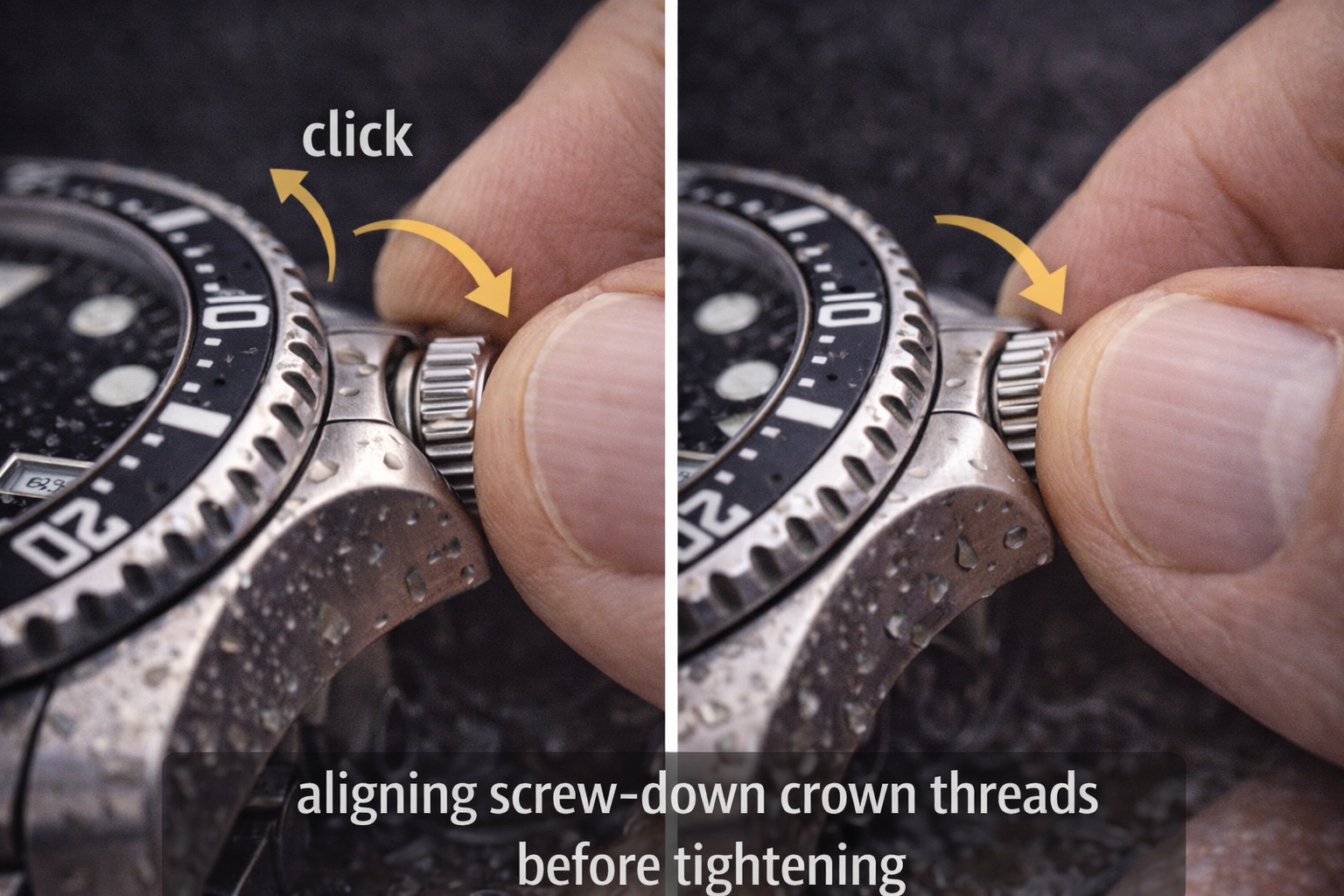
Mistake #2: Cross-threading the crown
If you start tightening at an angle, you can damage threads. A damaged thread can prevent full sealing.
How to avoid cross-threading
-
Push the crown gently in
-
Turn it counter-clockwise until you feel a small “click” (threads align)
-
Then tighten clockwise smoothly
If tightening feels gritty or “skips,” stop.
Mistake #3: Over-tightening the crown
Over-tightening can:
-
compress gaskets unnecessarily
-
accelerate wear on threads
-
make the crown harder to use (people start forcing it)
Fix: tighten until snug—firm contact, then stop.
Mistake #4: Adjusting time/date while the watch is wet
Water on the crown area + crown pulled out = easy path inside.
Fix: dry the watch and your hands first, then adjust.
If you often deal with steam/soap, remember showers are riskier than most people think:
→ Is It Safe to Wear a Watch in the Shower? The Truth About Water, Steam & Soap
Mistake #5: Unscrewing the crown under water “just for a quick change”
Even a second underwater can pull moisture in through the tube.
Fix: never unscrew/pull out the crown when the watch is wet or submerged.
Mistake #6: Pressing chronograph pushers in water (when not designed for it)
Pushers can be entry points. This isn’t strictly “crown,” but it’s the same water-intrusion failure mode.
If you swim with your watch, read this first:
→ Can You Swim With a Watch? Pool vs Ocean Water Risks Explained
Mistake #7: Assuming a screw-down crown means “no maintenance needed”
Seals age. Salt and chlorine speed up degradation.
Pool:
→ Does Chlorine Damage Watches? What Pool Water Really Does
Ocean:
→ Does Salt Water Damage Watches? Ocean Exposure Explained
Maintenance timeline:
→ How Often Should You Service a Mechanical Watch? A Practical Maintenance Timeline
Mistake #8: Not rinsing after swimming (salt/chlorine residue builds up)
Residue around the crown can harden, attract grime, and accelerate gasket aging.
After Swimming With a Watch: The 7-Step Rinse & Dry Routine (Pool vs Ocean)
Mistake #9: Using high-pressure water near the crown
Pressure washers and strong jets can stress seals and push water where it shouldn’t go.
Related:
→ Can a Pressure Washer or Car Wash Damage Your Watch? High-Pressure Water Risks Explained
15-second “Crown Check” routine (do this before water exposure)
-
Crown pushed in
-
If screw-down: crown screwed down snug
-
Don’t press pushers
-
If unsure about seals, avoid water
If you’re deciding whether 50m is enough, check:
→ Is 50m Water Resistance Enough? What You Can (and Can’t) Do
And the 100m vs 200m reality:
→ 100m vs 200m Water Resistance: Do You Really Need a Dive Watch?
What if your watch fogs after water exposure?
Fogging means moisture may have entered the case.
Start here:
→ mediately Why Is My Watch Fogging Under the Crystal? Causes & Fixes (What to Do Now)
If you suspect actual water got inside, follow the immediate steps:
→ Water Got Inside Your Watch? What to Do Immediately (First 30 Minutes)
When to see a watchmaker (don’t wait)
Get professional help if:
-
the crown won’t screw down smoothly
-
threads feel rough or skip
-
fogging returns after “drying”
-
you see droplets under the crystal
-
you swim often and seals haven’t been tested in years
Service reference:
→ How Often Should You Service a Mechanical Watch? A Practical Maintenance Timeline
FAQ
1) How tight should a screw-down crown be?
Snug and secure—tight enough that it stops naturally, but not forced. Over-tightening can wear threads and gaskets.
2) Can water get in even if the crown is screwed down?
Yes—if gaskets are old, damaged, or the crown wasn’t fully sealed, moisture can still enter.
→ Water Resistance Explained: What Watch Depth Ratings Really Mean
3) Should I screw the crown down after adjusting the time?
Yes, immediately. Don’t walk around with it “half-tight.”
4) Can I adjust the crown in the shower?
No. Steam + water on the crown area increases risk.
→Is It Safe to Wear a Watch in the Shower? The Truth About Water, Steam & Soap
5) Why did my watch fog after swimming?
Often the crown wasn’t fully sealed or seals are aging.
→ mediately Why Is My Watch Fogging Under the Crystal? Causes & Fixes (What to Do Now)
6) Is a screw-down crown required for swimming?
It’s strongly recommended, but not the only factor—overall design and seal condition matter.
→ Can You Swim With a Watch? Pool vs Ocean Water Risks Explained
7) Can pressure washers force water past a screw-down crown?
High-pressure water near the crown can stress seals. Avoid direct spray.
→ Can a Pressure Washer or Car Wash Damage Your Watch? High-Pressure Water Risks Explained
Related Guides
-
Water Resistance Explained: What Watch Depth Ratings Really Mean
-
Is It Safe to Wear a Watch in the Shower? The Truth About Water, Steam & Soap
-
Is It OK to Wear a Watch in the Rain? What’s Safe & What to Check First
-
Can You Swim With a Watch? Pool vs Ocean Water Risks Explained
-
mediately Why Is My Watch Fogging Under the Crystal? Causes & Fixes (What to Do Now)
-
Water Got Inside Your Watch? What to Do Immediately (First 30 Minutes)
-
Can a Pressure Washer or Car Wash Damage Your Watch? High-Pressure Water Risks Explained