Sapphire vs Mineral vs Acrylic Watch Crystal: Pros, Cons & Scratch Reality
-
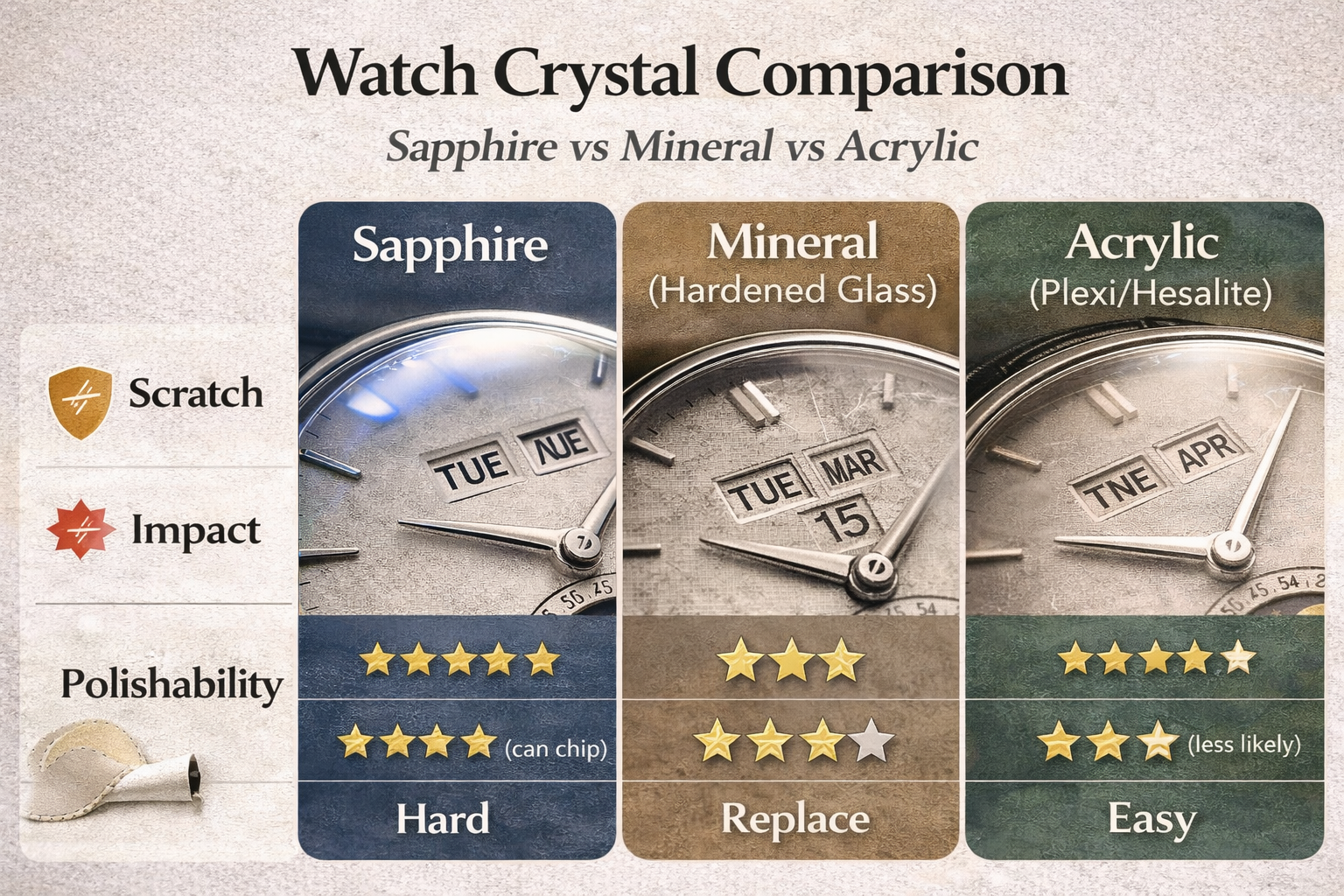
Sapphire: best scratch resistance and clarity for most modern watches, but can chip/shatter under sharp impact.
-
Mineral glass: decent all-around and often more impact-tolerant than sapphire, but scratches easier.
-
Acrylic (Hesalite/Plexi): scratches easiest but is the most forgiving (rarely shatters) and can often be polished back to clear.
Quick Comparison Table
| Feature | Sapphire | Mineral (Hardened Glass) | Acrylic (Plexi/Hesalite) |
|---|---|---|---|
| Scratch resistance | ⭐⭐⭐⭐⭐ | ⭐⭐⭐ | ⭐ |
| Impact/shatter resistance | ⭐⭐⭐ (can chip) | ⭐⭐⭐⭐ | ⭐⭐⭐⭐⭐ (usually won’t shatter) |
| Clarity | ⭐⭐⭐⭐⭐ | ⭐⭐⭐⭐ | ⭐⭐⭐ (warm/vintage look) |
| Weight/feel | premium | standard | light, vintage |
| Repairability | hard to polish; often replace | hard to polish; often replace | easy to polish |
| Typical price tier | higher | mid | varies (often vintage/tool) |
1) Sapphire Crystal (What it’s great at)
Pros
-
Highly scratch resistant in daily life (keys, desk contact, normal wear)
-
Excellent clarity and a “premium” look
-
Common on modern watches
Cons (the part people don’t mention)
-
Under sharp impacts, sapphire can chip at the edge
-
In rare cases, it can crack/shatter more suddenly than acrylic
Best for: office wear, daily wear, people who hate scratches, most modern buyers.
2) Mineral Glass (The practical middle)
Pros
-
Often more impact-tolerant than sapphire at similar thickness
-
Good clarity
-
Typically cheaper to replace
Cons
-
Scratches easier than sapphire (sand/dust/abrasives can mark it)
Best for: value-focused daily wear, rugged “beater” watches where replacement cost matters.
3) Acrylic (Why some collectors still love it)
Pros
-
Very impact forgiving (usually won’t shatter)
-
Can be polished at home to remove light scratches
-
Warm, vintage distortion that some people prefer
Cons
-
Scratches easily (even from clothing abrasives over time)
-
Can haze if neglected (but polish often restores it)
Best for: vintage lovers, tool/vintage aesthetics, people okay with occasional polishing.
“Scratch reality”: what actually scratches your crystal
Most “mystery scratches” come from abrasives:
-
dust/sand on sleeves or cuffs
-
grit on a desk surface
-
micro-particles on a cleaning cloth
This is why “care routine” content helps your whole watch, not just the crystal:
→Everyday Watch Care Guide: How to Keep Your Watch Looking New
→ Weekly Watch Care Routine: A Simple 10‑Minute System to Extend Your Watch’s Life
How to tell what crystal you have (safe methods)
Method 1: Check the specs / listing / caseback paperwork
Safest and most accurate.
Method 2: Visual cues (not perfect, but helpful)
-
Acrylic often has a warmer look and can show gentle distortion at angles
-
Sapphire often looks very crisp; anti-reflective coating may show a blue/purple tint at some angles
-
Mineral sits in between
Avoid gimmick “tests” that involve heat/ice/metal scraping—those can damage coatings or the crystal.
Can you polish scratches out?
Acrylic: usually yes
-
Many light scratches can be polished away (common reason collectors like it).
Mineral: sometimes, but often not worth it
-
Light marks may be improved, but deep scratches usually remain.
Sapphire: generally no (practically)
-
Sapphire is extremely hard; polishing is specialized and often costs more than replacement.
Important note: Sometimes the “scratch” is actually on the anti-reflective coating, not the crystal itself. Coating marks can look like scratches but behave differently.
Which should you choose? (Simple decision guide)
Choose Sapphire if:
-
you hate scratches
-
you want modern premium look
-
you wear the watch daily
Choose Mineral if:
-
you want a good balance at lower cost
-
you’re okay with scratches over time
-
you prefer easier/cheaper replacement
Choose Acrylic if:
-
you love vintage warmth
-
you don’t mind occasional polishing
-
you want maximum impact forgiveness
Care tips to keep any crystal looking new
-
Wipe with a clean microfiber (avoid gritty cloths)
-
Don’t place the watch face-down on unknown surfaces
-
Store it away from dusty/abrasive environments
Storage guide:
→ How to Store Watches Properly When Not Wearing Them -
Avoid common “damage accelerators”
→ Weekly Watch Care Routine: A Simple 10‑Minute System to Extend Your Watch’s Life
FAQ (Long-tail coverage)
1) Is sapphire always better than mineral?
For scratch resistance, usually yes. But “better” depends on your priorities—impact risk and cost matter too.
2) Why does my sapphire crystal still look scratched?
It may be the AR coating scratching, not the sapphire itself.
3) Can acrylic be restored if it’s badly scratched?
Often yes—polishing can significantly improve it, though very deep gouges may remain.
4) Which crystal is best for a “beater” watch?
Mineral is often a good value choice; acrylic can also be very forgiving. Sapphire is great if you mainly worry about scratches.
5) How do I prevent micro-scratches?
Keep a simple weekly wipe-down and avoid gritty cloths/surfaces.
→ https://www.globalwatchindustry.com/blogs/Weekly-Watch-Care-Routine:-A-Simple-10-Minute-System-to-Extend-Your-Watch’s-Life-(2026)
6) Does crystal type affect servicing?
Not directly, but damaged crystals/coatings can be replaced during service.
Service reference:
→ How Often Should You Service a Mechanical Watch? A Practical Maintenance Timeline
Recommended reading
-
Everyday Watch Care Guide: How to Keep Your Watch Looking New
-
Weekly Watch Care Routine: A Simple 10‑Minute System to Extend Your Watch’s Life
-
Weekly Watch Care Routine: A Simple 10‑Minute System to Extend Your Watch’s Life
-
How Often Should You Service a Mechanical Watch? A Practical Maintenance Timeline