Omega Seamaster vs Rolex Submariner: Which Dive Watch Is Actually Better for You?
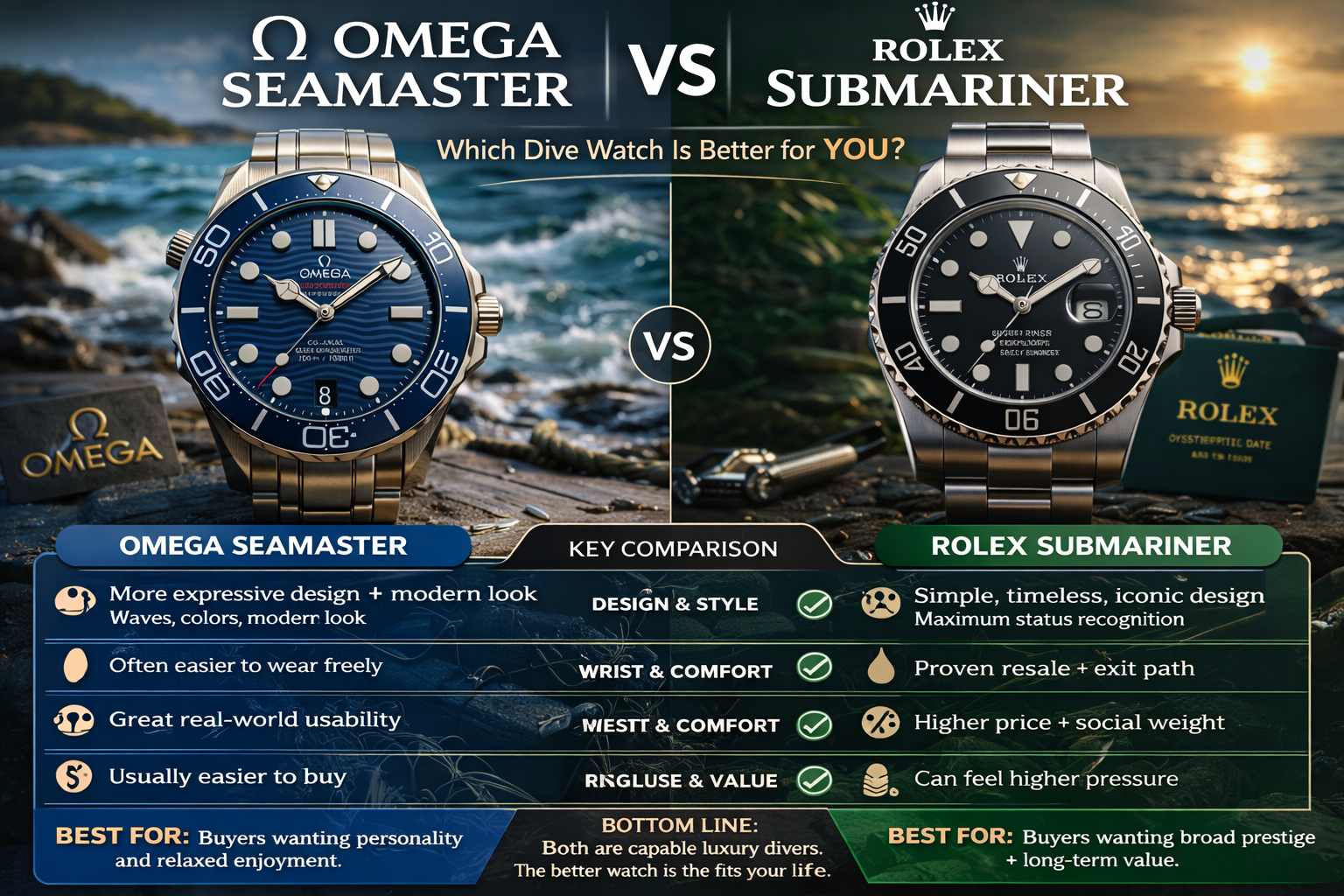
Omega Seamaster vs Rolex Submariner: Which Dive Watch Is Actually Better for You?
This comparison sounds simple until real money gets involved.
On paper, both watches live in the same world: iconic Swiss dive watches, famous brands, serious everyday capability, and enough history to keep enthusiasts arguing for years.
In real life, the choice is not just about specs.
It is about what kind of watch owner you are going to become.
That is the part buyers often miss.
Because the Omega Seamaster and the Rolex Submariner do not just sit differently on the wrist. They sit differently in your life.
One often feels more expressive, more technical, and more comfortable as a watch you actually use.
The other often feels cleaner, more universal, and more emotionally loaded as a milestone purchase.
So which one is actually better?
For most real buyers, the answer comes down to five things:
- how much brand prestige matters to you
- how simple or expressive you like your design
- whether this is a daily wear watch or a milestone watch
- how much you care about long-term resale flexibility
- whether you want a luxury diver to enjoy freely or manage carefully
That is the real debate.
The cleanest answer
The Rolex Submariner usually makes more sense for buyers who care most about timeless design, broad recognition, resale strength, and one-watch simplicity.
The Omega Seamaster usually makes more sense for buyers who want more visible personality, strong real-world usability, easier emotional wear, and a luxury dive watch that feels a little less socially loaded.
Neither answer is more correct in the abstract.
It depends on the kind of buyer standing behind the credit card.
Why this comparison never goes away
Because these two watches compete for the same mental budget even when they do not sit at the same price level in every market.
A buyer may walk into the process thinking:
“I want one serious dive watch.”
Then the brain immediately splits in two directions.
One side says:
- get the Submariner
- it is the benchmark
- it works with everything
- it is the safe answer
The other side says:
- the Seamaster has more character
- it feels a bit less predictable
- I could wear it more casually
- maybe it fits my real life better
That is why this comparison matters so much.
It is not only brand vs brand.
It is aspiration vs practicality, clean icon vs personality piece, milestone object vs use-it watch.
Case study 1: the buyer who thought he wanted a Submariner
A buyer in his late 30s wants one luxury sports watch. He works in an office, dresses casually most of the time, travels a few times a year, and wears watches on weekends without overthinking them.
Naturally, he starts with the Submariner. Almost everyone does.
It has the reputation.
It has the clean look.
It has the “done” feeling.
Then he starts trying watches on.
What happens?
He likes the Rolex immediately.
But he also notices that he becomes more self-conscious around it. He starts thinking about:
- scratches
- theft
- resale
- whether it feels a bit too expected
- whether he will baby it more than wear it
Then he tries the Seamaster.
It feels less formal psychologically.
A bit more relaxed.
A bit more like a watch than a symbol.
He ends up buying the Omega, not because it is “better,” but because it solved the actual problem: he wanted a serious luxury diver he would wear often, not a trophy he would keep mentally wrapped in bubble film.
That is a real Seamaster win.
Case study 2: the buyer who kept circling the Submariner and finally bought it
Now the opposite.
Another buyer starts with Omega because it feels rational. He appreciates the history, likes the design, and knows it is a great watch.
But for months, he keeps returning to the same thought:
“It’s excellent. But it’s not the Submariner.”
That thought matters.
Because sometimes a buyer does not want “the sensible luxury diver.”
They want the one that closes the loop emotionally.
Eventually he buys the Submariner anyway.
And that is the lesson: some people are not shopping for a dive watch in the practical sense. They are shopping for the specific satisfaction of finally owning a Submariner.
For those buyers, delaying the obvious answer can become expensive.
Design: expressive vs clean
This is where the choice becomes obvious for many people.
The Submariner is one of the cleanest sports-watch designs ever made.
That is its superpower.
It does not need to explain itself.
It looks right in almost any setting.
It is simple enough to disappear into daily life and strong enough to still feel significant.
The Seamaster, by contrast, usually speaks louder. Not in a flashy way necessarily, but in a more designed way.
It often feels:
- more technical
- more modern in personality
- more obviously “watchy”
- more distinctive from across the room
That is why buyers who love understatement often end up with the Submariner, while buyers who want a little more texture and identity often drift toward the Seamaster.
This is not a specs issue.
It is a taste issue.
And taste is often the most expensive part of watch buying.
Wrist feel: which one disappears more easily?
For many buyers, the Submariner is the easier watch to live with visually.
It tends to feel like the simpler all-rounder. You can wear it with:
- a T-shirt
- a polo
- office clothes
- a sweater
- a blazer
- travel clothes
The Seamaster can also do all of that, but it usually brings more personality with it. Some people love that. Some eventually decide they want something cleaner and quieter.
This is worth saying clearly:
The better watch on paper is not always the watch you will reach for more often.
Sometimes the cleaner watch wins because it asks less of the rest of your outfit and your mood.
Sometimes the more distinctive watch wins because it feels less generic and more personally chosen.
Try both with normal clothes, not only boutique lighting and watch-geek excitement.
That tells the truth faster.
Daily wear: which one feels easier in real life?
For a lot of normal owners, the Seamaster can feel easier emotionally.
That does not necessarily mean tougher.
It means easier to wear without turning every small mark into a financial event.
Many buyers find that the Omega experience comes with less mental pressure:
- less status signaling
- less anxiety around public attention
- less obsession with protecting resale
- less emotional tension about wearing it hard
The Submariner often brings more weight than its case alone.
You are not only wearing a dive watch.
You are wearing one of the most culturally loaded watches in the world.
Some buyers love that.
Some get tired of it.
That is why the “best daily wearer” question is partly about steel and partly about psychology.
Water use: what actually matters more than the logo
Here is where people get distracted by brand mythology.
If you are genuinely buying one of these as a watch you may swim with, travel with, or wear around water, the practical question is not “Which logo is more dive famous?”
The practical question is:
What condition is the watch in today?
That matters far more than most buyers think.
If you have not read them already, it is worth understanding what watch water resistance ratings really mean, whether you really need 100m or 200m water resistance, and what a pressure test actually checks.
That becomes even more important in the pre-owned market. A used Submariner with unknown service history is not magically safer in water than a well-maintained Seamaster. And a luxury dive watch that has been opened, serviced, or resealed should not be trusted on faith alone. That is why how often you should pressure test a watch and whether a watchmaker can really guarantee water resistance after repair are questions worth taking seriously.
A famous dive watch is still just a watch if its seals are tired.
Prestige and recognition: one brand wins easily
This part is straightforward.
The Submariner carries more instant social recognition.
Even people who know very little about watches tend to understand Rolex. They may not know references, years, or movements, but they know the brand signal.
Omega is highly respected, but it does not hit the average person in quite the same immediate way.
That matters for some buyers more than they admit.
And it should be admitted openly.
Because once you are spending luxury-watch money, it is silly to pretend emotion does not matter.
The real issue is not whether prestige should matter.
The issue is whether it matters to you.
For some buyers, the stronger crown-logo effect is exactly why the Submariner feels worth it.
For others, that same effect is why the Seamaster feels more comfortable and more genuinely wearable.
Resale and exit flexibility
This is another area where the Submariner often feels like the safer answer in buyers’ minds.
Many buyers approach Rolex with the belief that it gives them a stronger exit path later. That perception alone changes behavior:
- they feel more comfortable spending more
- they justify the purchase as safer
- they believe the watch is easier to move later
- they mentally treat the watch as partly financial, not only personal
The Seamaster usually does not trigger the same mindset.
That can actually be a hidden advantage.
Because when a watch feels less like a tradeable asset, you may be more likely to wear it like a watch instead of a graph.
Still, buyers who know they may flip, rotate, or trade later often feel calmer with the Submariner route.
That is not the most romantic truth, but it is a real buying truth.
Buying pre-owned: where mistakes happen faster
This is where the comparison becomes practical, not theoretical.
A used Seamaster can be a great buy.
A used Submariner can also be a great buy.
But the Rolex side of the market usually comes with more fake pressure, more parts questions, and more emotional overpaying.
That is why any buyer considering pre-owned should already be comfortable with the logic in How to Check a Used Watch in Person, Used Watch Full Set vs Watch Only, and How to Tell If a Watch Is Overpolished Before You Buy.
A real Submariner can still be a bad buy if it is:
- overpolished
- overpriced
- not as original as implied
- sold mainly on box and papers
- attached to a seller who avoids direct answers
The same is true for Omega, just usually with a little less counterfeit drama and a little less social heat around the transaction.
That is one reason many buyers describe pre-owned Omega shopping as calmer.
The hidden question: do you want a dive watch or a benchmark?
This is the question that decides the article.
Because the Submariner is not merely a dive watch anymore.
It is a benchmark object.
People buy it for:
- design
- history
- reputation
- symbol value
- one-watch-collection confidence
The Seamaster is famous too, but it more often remains what it started as in the buyer’s mind: a watch.
A very good one.
A luxurious one.
A serious one.
But still, more often, a watch first.
That difference changes everything.
One buyer sees that as proof the Submariner is the ultimate answer.
Another sees it as proof the Seamaster is easier to love honestly.
Both reactions are valid.
A simple 7-step decision test
Here is the practical test I would use.
Step 1: Decide what this purchase is really for
Is this a milestone, a one-watch collection, a vacation watch, or a daily luxury sports watch?
Step 2: Ask whether the brand matters emotionally
Not socially. Emotionally.
If the Rolex dream is specific and persistent, that matters.
Step 3: Think about how you treat expensive objects
Do you wear them freely, or do you start protecting them from life?
That answer points hard toward one watch or the other.
Step 4: Try both on with normal clothes
Not only boutique clothes or internet fantasy clothes. Wear what you actually wear.
Step 5: Picture both watches three years from now
Which one looks more like your real routine?
Not your aspirational routine. Your actual one.
Step 6: Consider how you buy
If you are shopping pre-owned, read Should You Buy a Used Luxury Watch Online? 12 Checks Before You Pay before sending money anywhere.
Step 7: Be honest about regret risk
Would you regret not buying the Rolex?
Or would you regret paying Rolex money for a watch you start wearing cautiously?
That question usually decides it.
Which one makes more sense for different buyers?
For the buyer who wants the cleanest, safest, most universally respected icon:
Submariner.
For the buyer who wants a luxury diver with more visible personality and less psychological pressure:
Seamaster.
For the buyer who keeps talking about “the benchmark”:
Usually the Submariner.
For the buyer who says “I actually want to wear this thing everywhere”:
Often the Seamaster.
For the buyer who treats watches partly as movable value:
Usually the Submariner.
For the buyer who wants a little more individuality and a little less expected luxury signaling:
Often the Seamaster.
My honest take
The Rolex Submariner is the better benchmark.
The Omega Seamaster is often the better life watch.
That is the cleanest way I can put it.
The Submariner is often the stronger answer for a buyer who wants one watch that says, “This is the one.”
The Seamaster is often the stronger answer for a buyer who wants one watch that says, “I’m actually going to enjoy wearing this.”
That sounds subtle, but it is not.
It is usually the whole decision.
FAQ
Is the Omega Seamaster better than the Rolex Submariner?
For some buyers, yes. Especially where comfort, individuality, and relaxed ownership matter more than benchmark status. For others, the Submariner remains the stronger overall answer.
Which is better for daily wear?
Many owners find the Seamaster easier emotionally for daily wear. The Submariner is often simpler visually, but heavier psychologically because of the brand weight and value perception.
Which is better for water use?
Condition and maintenance matter more than the logo. A properly maintained example is more important than brand mythology. Start with Water Resistance Explained and Can You Swim With a Watch? before assuming anything.
Which holds value better?
Many buyers see the Submariner as the stronger exit-flexibility option. That belief itself influences how the watch is bought and sold.
Is the Seamaster the smarter buy?
It can be the smarter life buy for buyers who want to wear the watch hard, travel with it, and enjoy it without constantly thinking about market value.
Which one should I buy pre-owned?
Whichever one you understand well enough to inspect properly. Use strong seller screening, compare multiple examples, and do not let papers or hype replace condition analysis.
Final thoughts
The Omega Seamaster vs Rolex Submariner debate gets flattened too often into brand prestige, specs, or internet loyalty.
But the real answer is simpler and more personal.
The Submariner usually wins when the buyer wants timelessness, recognition, and the psychological closure of owning a benchmark watch.
The Seamaster usually wins when the buyer wants personality, lower emotional friction, and a luxury dive watch that feels easier to live with.
The best choice is not the one the internet shouts loudest.
It is the one that matches how you will actually wear it, think about it, and enjoy it once the purchase excitement wears off.
That is the watch worth buying.