- Home
- Omega Aqua Terra 38 vs 41: Which One Fits Better, Looks Better, and Resells Better?
Omega Aqua Terra 38 vs 41: Which One Fits Better, Looks Better, and Resells Better?
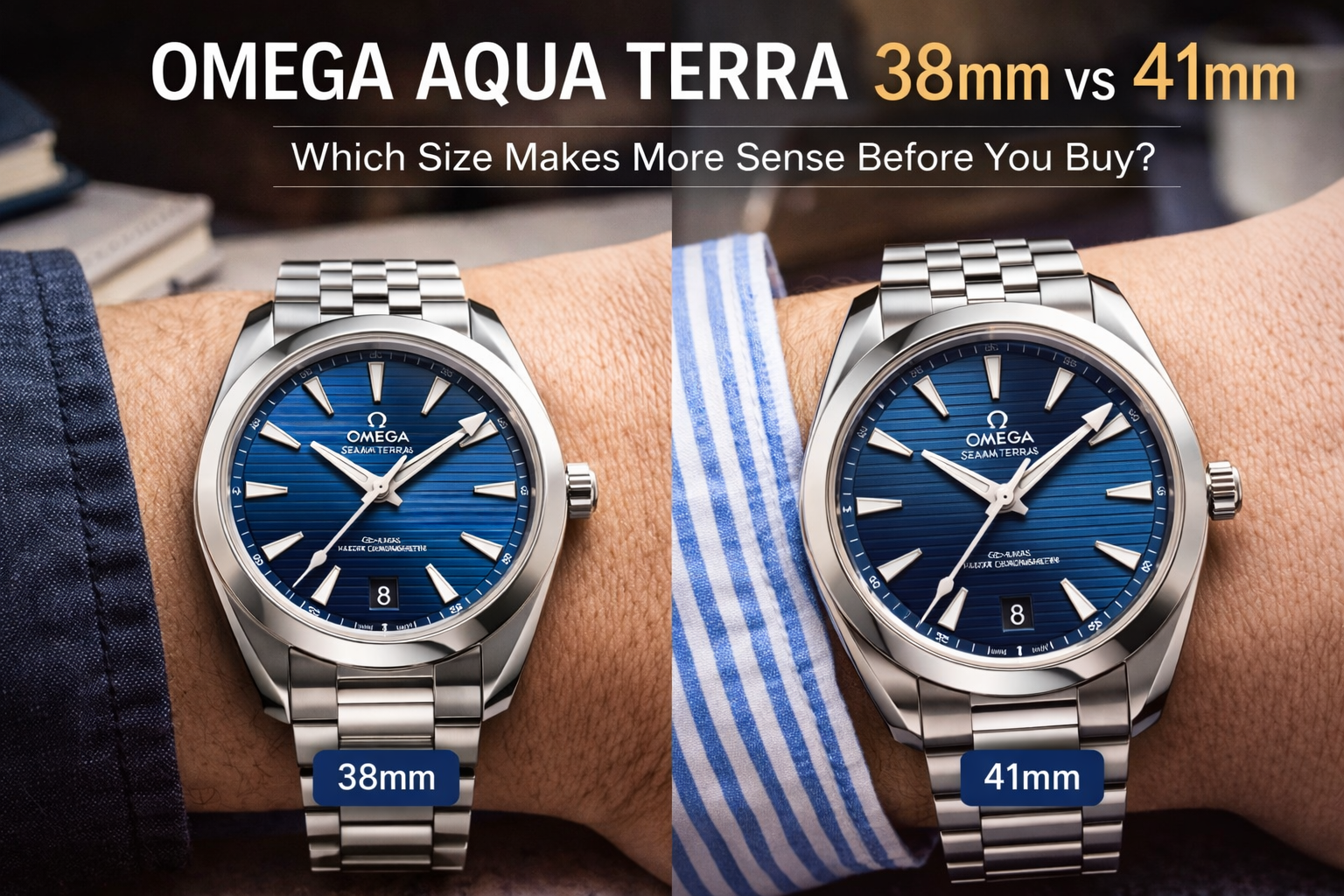
If you are shopping for an Omega Aqua Terra, there is a good chance you are not deciding whether the watch itself is good.
You already know it is.
The real problem is size.
And once you are stuck between the Aqua Terra 38 and the Aqua Terra 41, the decision gets weirdly difficult. On paper, it sounds like a simple measurement issue. In real life, it is not. It is a style issue, a comfort issue, a confidence issue, and, if you are thinking ahead, a resale issue too.
That is exactly why so many buyers hesitate here longer than they expected.
The 38 often looks cleaner, more balanced, and more refined on the wrist. The 41 often looks bolder, sportier, and more obviously “luxury watch” from a distance.
Both can work. Both can look great. But they do not create the same kind of ownership experience.
So which one actually fits better, looks better, and resells better?
The short answer is this: the Aqua Terra 38 is usually the better all-around daily-wear choice, while the Aqua Terra 41 is usually the better choice for buyers who want more presence and a more modern sports-watch feel.
That is the simple version. But the real answer depends on what kind of watch wearer you actually are.
The short answer
Buy the Omega Aqua Terra 38 if you want a watch that feels more balanced, more versatile, and easier to wear across office, travel, and everyday life.
Buy the Omega Aqua Terra 41 if you want more wrist presence, a sportier visual identity, and a watch that makes a stronger first impression.
If you are truly undecided, the 38 is usually the safer long-term choice.
If you already know you dislike smaller-feeling watches, the 41 may be the better fit from day one.
That is the part most people understand.
What they do not always understand is why the “better” choice in the mirror is not always the better choice after six months of ownership.
Why this size decision is harder than it should be
The Aqua Terra is one of those watches that looks simple until you actually have to buy one.
It is clean. It is versatile. It is polished without being flashy. It is sporty without becoming a full dive watch. That is exactly why it attracts so many buyers looking for one serious luxury watch that can handle almost everything.
But that same versatility makes the size decision more important.
When a watch is supposed to do everything, size affects everything.
It changes how formal the watch feels. It changes how sporty it feels. It changes how it sits under a cuff, how it wears during a full workday, how noticeable it is in casual settings, and how quickly the honeymoon feeling turns into either comfort or doubt.
That is why this is not just a numbers question.
It is a life question.
If you have not already thought carefully about general watch proportions, Watch Size Guide: Case Diameter, Lug-to-Lug & Thickness (How to Choose the Perfect Fit) is the best place to start, because a watch that sounds right on paper can still feel wrong once it is on your wrist.
The Aqua Terra 38: why it often ends up being the smarter choice
The Aqua Terra 38 has something many buyers only fully appreciate after the excitement wears off: restraint.
It feels more composed.
More balanced.
More intentional.
It wears in a way that does not ask for too much attention. And that matters, because the Aqua Terra is at its best when it feels like part of your life rather than the center of it.
On the wrist, the 38 usually comes across as more versatile. It transitions more naturally between office wear and casual wear. It feels cleaner with tailoring, more elegant with knitwear, and less likely to dominate your wrist in normal daily situations.
It is also the version more likely to make someone say, “That just looks right.”
Not because it is dramatic.
Because it is proportionate.
That is a big deal with a watch like the Aqua Terra. This is not a watch people usually buy to make the loudest statement in the room. They buy it because they want something refined, capable, and easy to live with.
The 38 often delivers that balance better.
The Aqua Terra 41: why it wins so many first impressions
Now let’s be fair to the 41.
A lot of buyers try it on and immediately prefer it.
And that reaction makes sense.
The Aqua Terra 41 feels more substantial. More modern. More obviously premium at a glance. If you are used to larger watches, sports watches, or smartwatches, the 41 may feel more natural from the first minute.
It also leans more clearly into the sporty side of the Aqua Terra identity.
If the 38 feels like a polished all-rounder, the 41 feels more like a confident luxury daily sports watch. It has more dial presence, more visual weight, and more of that “serious watch” look that some buyers want when they are spending this kind of money.
That is why the 41 tends to do especially well with buyers who want the Aqua Terra to feel closer to a modern luxury sports model than a dress-sport crossover.
The important thing is understanding what that extra presence costs you.
Not in money.
In flexibility.
The 41 can still be versatile, but it asks more from the wearer. More wrist. More confidence. More acceptance that the watch will be a little more visible in daily life.
For some people, that is exactly the point.
For others, it becomes the reason they wear it less than they expected.
A real buyer example: what changes after the second try-on
A buyer I know was convinced he wanted the Aqua Terra 41.
He was coming from larger everyday watches, liked the way the 41 looked in photos, and felt the 38 might be too conservative for the money. On first try-on, his reaction was immediate: the 41 felt more exciting.
Then he did the one thing more buyers should do.
He went back and tried both on again on a different day.
That second try-on changed everything.
The 41 still looked good, but now he noticed that it felt more like a watch he had to “carry.” The 38 felt easier. Not more impressive, but more natural. Less showroom energy, more real-life fit.
That is where the real decision often happens.
The first try-on is about attraction.
The second try-on is about compatibility.
He ended up buying the 38, and a few months later he said something I hear all the time with this kind of size decision: “The 41 impressed me more. The 38 fit my life better.”
That does not mean the 41 is wrong. It means the watch that gives you the bigger initial hit is not always the one you enjoy wearing most.
Which one fits better for real daily wear?
For most people, the 38.
That is the honest answer.
Not because the 41 is too big. Not because the 38 is objectively superior. But because real daily wear rewards comfort, flexibility, and ease much more than people expect.
A watch you wear every day should feel good when you are typing, walking, commuting, eating, traveling, and living normally. It should work with your actual wardrobe, your actual cuffs, your actual habits.
The Aqua Terra 38 usually does that more gracefully.
It disappears just enough. It still feels premium, but it does not constantly remind you that you are wearing a luxury object. That makes it easier to wear often, which is exactly what most people claim they want from a one-watch purchase.
The 41 can absolutely work as a daily watch too, especially if you prefer more wrist presence. But it feels less neutral. It is more of a conscious choice every time you put it on.
Bracelet fit matters here more than many people realize. A slightly wrong fit can make either size feel clumsy or uncomfortable, which is why Watch Bracelet Sizing Guide: How Tight Should It Be? (Comfort, Fit Tests & Fixes) is worth reading before you blame the case size alone.
Which one looks better?
This depends on what you mean by “better.”
If you mean more elegant, more balanced, and more likely to age well stylistically, the 38 usually looks better.
If you mean bolder, more modern, and more likely to stand out quickly, the 41 usually looks better.
That difference matters because buyers often confuse “more impressive” with “better looking.”
The 41 usually wins from across the room.
The 38 usually wins when you live with it.
That is why the 38 often appeals more to buyers who care about proportion, subtlety, and long-term satisfaction, while the 41 appeals more to buyers who want a stronger visual reward every time they look down at the wrist.
Neither is shallow. They are just different priorities.
Which one resells better?
This is where the answer gets more nuanced.
If you are talking about pure first-glance market appeal, the 41 often feels easier to explain to casual buyers because modern buyers have spent years getting used to larger watches. Bigger often reads as more premium to less experienced shoppers, and that can help the 41 feel easier to move in certain buyer pools.
But that is not the whole story.
The 38 has a different advantage: it is easier to wear well.
And watches that wear well tend to create fewer regrets after purchase.
So if your question is, “Which size might get faster attention from buyers who shop with their eyes?” the 41 may have an edge.
If your question is, “Which size is less likely to disappoint once actually worn?” the 38 often has the stronger argument.
That is why resale is never just about size. It is about buyer type, listing quality, condition, completeness, and whether the watch looks right on the wrist once someone tries it.
If you are buying pre-owned with resale in mind, you should not stop at size comparisons. Read Should You Buy a Used Luxury Watch Online? 12 Checks Before You Pay, then follow it with How to Check a Used Watch in Person: 15 Things to Inspect Before You Buy and Used Watch Full Set vs Watch Only: How Much Do Box and Papers Really Matter?. Those three decisions often affect resale more than buyers expect.
And if you do end up negotiating, How to Negotiate the Price of a Used Watch Without Losing the Deal is the kind of guide that saves money quietly.
The hidden truth: this is not really about wrist size alone
A lot of buyers ask for a simple rule.
“Under this wrist size, buy 38.”
“Over this wrist size, buy 41.”
That sounds useful, but it misses the real point.
Wrist size matters. Wrist shape matters too. So does your height, your build, your style, your sleeve habits, and what kind of watches you are used to wearing.
Two people with the same wrist size can make opposite decisions and both be right.
One may want the 38 because they want the Aqua Terra to feel elegant and versatile.
The other may want the 41 because they want it to feel more like a modern luxury sports watch.
That is why size charts only get you so far.
A better question is this:
Do you want your Aqua Terra to wear like a polished daily companion, or like a more assertive modern statement watch?
That question usually gets people closer to the truth than wrist measurement alone.
Which one is better if you want one watch for everything?
If your goal is one watch for office, weekends, dinners, travel, and normal daily life, I would usually point you toward the 38.
It simply asks for fewer compromises.
It is easier under a cuff. Easier with mixed wardrobes. Easier to wear frequently. Easier to forget about in the best way.
That last point matters.
The best daily luxury watches are not always the ones that impress you the most in the boutique. They are the ones that keep making sense once the novelty fades.
That is where the 38 is very strong.
The 41 becomes more compelling if you already know you want the Aqua Terra to lean sportier, larger, and more visibly premium. If that is your preference, pretending the 38 is “more correct” will not help. You will only end up second-guessing the purchase later.
A simple 5-minute try-on test
If you are stuck between them, do not rely on one wrist selfie.
Do this instead.
Try on the 38 and keep it on for five minutes. Move naturally. Sit down. Stand up. Use your phone. Check the time casually.
Then do the same with the 41.
Now ask yourself:
- Which one looks better from normal wrist-checking distance?
- Which one feels more natural with your real clothes?
- Which one seems less likely to annoy you after a full day?
- Which one would you wear more often, not just admire more in the mirror?
- Which one still feels right after the excitement drops a little?
That last question matters the most.
Because with the Aqua Terra, long-term compatibility matters more than first-minute impact.
Final verdict
Choose the Omega Aqua Terra 38 if you want the more balanced, more versatile, and more wearable version for real daily life.
Choose the Omega Aqua Terra 41 if you want more presence, more sportiness, and a stronger first impression on the wrist.
If you are genuinely unsure, the 38 is usually the safer choice.
Not because it is smaller.
Because it is easier to live with.
The 41 often wins the first glance.
The 38 often wins the long-term relationship.
And when you are buying a watch like the Aqua Terra, the long-term relationship is the part that matters.
FAQ
Is the Omega Aqua Terra 38 too small?
No. For many buyers, it is the more balanced and more versatile size, especially for daily wear.
Is the Omega Aqua Terra 41 too big?
Not necessarily. But it is easier to buy for the wrong reasons if you are chasing presence more than real-life comfort.
Which Aqua Terra size is more timeless?
Usually the 38. It tends to look more proportionate and less trend-sensitive over time.
Which Aqua Terra size is better for resale?
The 41 may get faster attention from some buyers who prefer more modern, larger watches, but the 38 often makes more sense long term because it fits a wider range of real daily wear.
Which size should I buy if I only want one nice watch?
For most people, the 38. It is the more flexible and lower-risk one-watch choice.