New vs Used Rolex: Which Is Smarter in 2026?
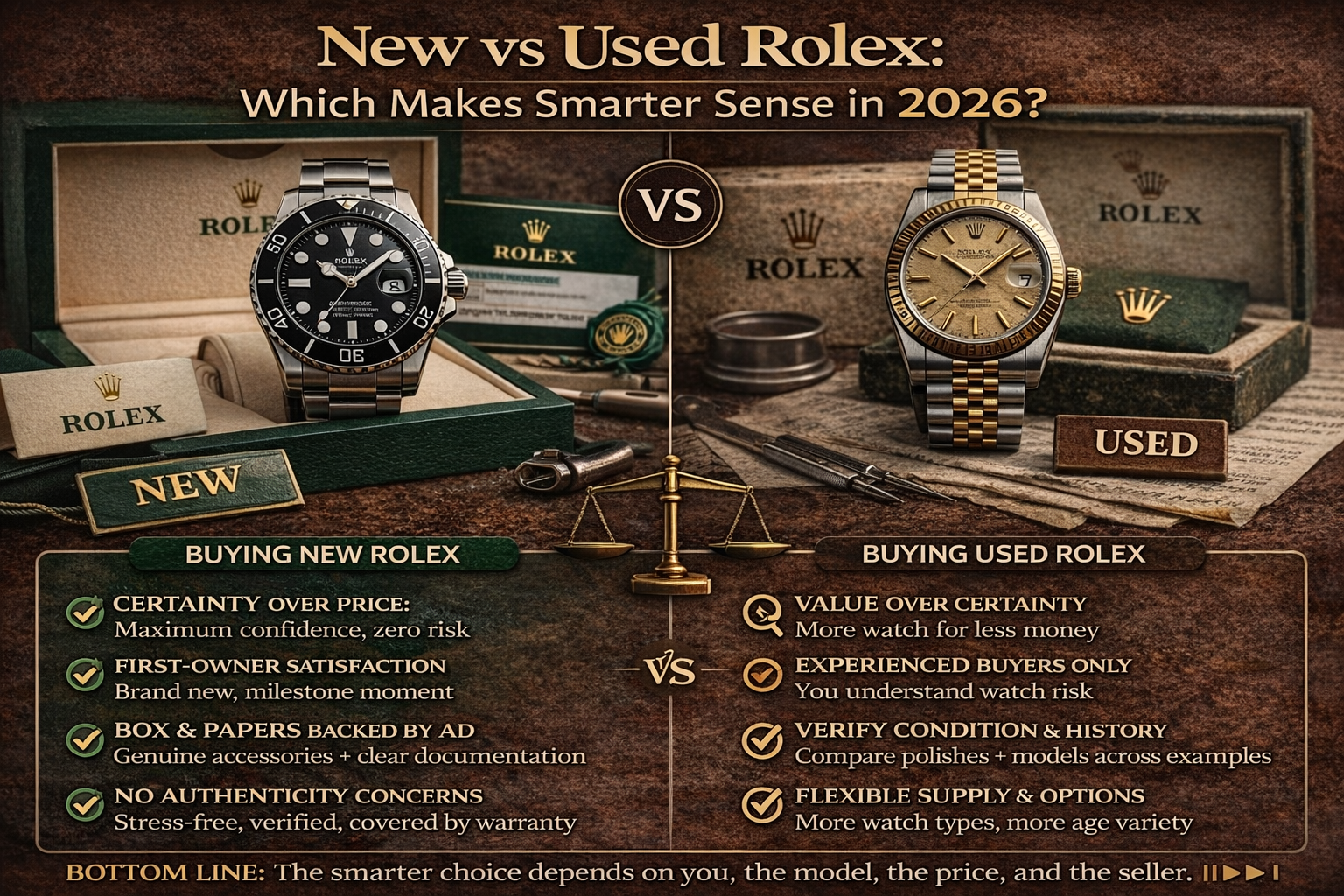
New vs Used Rolex: Which Is Smarter in 2026?
Buying a Rolex sounds simple until you actually try to do it.
At first, the question seems clean:
Should you buy new and get the full boutique experience, factory-fresh condition, and peace of mind?
Or should you buy used and let someone else absorb the first hit of the price?
That sounds like a normal luxury-goods decision.
With Rolex, it rarely stays that simple.
Because when people compare new vs used Rolex, they are not only comparing two watches. They are comparing:
- certainty vs flexibility
- emotional payoff vs buying discipline
- clean history vs better value
- easier trust vs more variables
- the pride of “brand new” vs the practicality of “smart money”
And the truth is this:
The smarter choice is not always the cheaper one, and it is not always the newer one.
It depends on the kind of buyer you are, the model you want, how much risk you can actually manage, and whether you are buying a Rolex to celebrate, to wear, or to optimize.
This guide is for real buyers, not fantasy buyers.
The short answer
A new Rolex usually makes more sense if you want maximum confidence, clean condition, easy provenance, and the emotional satisfaction of being the first owner.
A used Rolex usually makes more sense if you know what you are looking at, care about value more than ceremony, and are willing to do the work to avoid overpaying for condition, accessories, or seller stories.
That is the short answer.
The useful answer is more detailed, because a good used Rolex can be smarter than a new one, and a bad used Rolex can be far more expensive than people expect.
Why this question matters more with Rolex than with many other brands
A lot of products become simpler when bought used.
Rolex often becomes more complicated.
Why?
Because with a used Rolex, you are not just buying:
- steel
- movement
- bracelet
- dial
- box
- papers
You are also buying:
- condition
- originality
- seller honesty
- polish history
- service history
- replacement parts risk
- counterfeit risk
- market timing
- your own ability to stay rational
That is why used Rolex is not automatically “the smart option.” It is only smart if the watch is right, the seller is right, and the price is right.
Otherwise, “saving money” turns into paying luxury prices for uncertainty.
Case study 1: the buyer who should have bought new
A first-time luxury buyer wants a Datejust.
He has always wanted a Rolex, has never spent this much on a watch before, and is nervous about making a mistake. He is not especially interested in watch forums, reference minutiae, clasp codes, or service-part debates.
But he sees online advice saying used is smarter, so he starts looking pre-owned.
Very quickly, he gets flooded with complexity:
- full set vs watch only
- polished vs unpolished
- service dial vs original dial
- aftermarket bezel risk
- overpaying for condition
- “great seller, no returns”
- “all original to the best of my knowledge”
He starts out trying to save money.
He ends up stressed, confused, and one rushed payment away from an expensive lesson.
This is exactly the buyer who often should buy new.
Not because used is bad.
Because he is buying peace of mind, and peace of mind is part of the value.
Case study 2: the buyer who was smarter buying used
Now the other side.
A buyer wants a Submariner. He knows the modern reference range, has handled a few Rolexes before, understands what overpolishing looks like, and is comfortable walking away from a deal that feels even slightly off.
He also does not care about being the first owner. He cares about getting a clean example at a rational price.
He buys pre-owned from a seller who provides:
- sharp macro photos
- clear service disclosure
- direct answers about condition
- no fuzzy language about originality
- a reasonable inspection window
He ends up with a watch he actually wears, at a price he feels good about, without paying for the fantasy of untouched boutique freshness.
That is exactly the kind of buyer who can make used Rolex the smarter move.
What buying new Rolex really gives you
A lot of internet talk around Rolex gets cynical too fast.
Yes, new can cost more.
Yes, availability can be annoying depending on model and market.
Yes, some people romanticize the “factory fresh” idea too much.
But new still gives you some real advantages.
1) Clean provenance
This is the biggest one.
A new Rolex removes most of the questions that make used buying tiring:
- has it been polished?
- has anything been swapped?
- are the parts period-correct?
- is the bracelet original to the watch?
- has the watch been opened before?
- is the seller hiding anything?
You are not buying a story.
You are starting the story.
That matters more than many buyers admit.
2) Full emotional payoff
For some people, buying Rolex is not just a transaction. It is a milestone.
They want:
- the first-owner feeling
- the fresh condition
- the ritual of unboxing
- the psychological closure of “I did it right”
That is not irrational.
It is part of the product.
A new Rolex can feel final in a way that used sometimes does not.
3) Simpler ownership mindset
When you buy new, you start from certainty.
That often makes future decisions easier:
- service timeline
- wear expectations
- documentation
- water use confidence
- resale story later
You do not spend your first week wondering whether the case was polished by someone overconfident in 2019.
What buying used Rolex really gives you
Used Rolex has real strengths too, but only if you know what you are actually buying.
1) Better value entry
The obvious advantage is price discipline.
Not every buyer wants or needs the clean, first-owner premium. Some just want a real Rolex they can wear and enjoy without paying extra for untouched-new emotions.
That can be perfectly sensible.
2) More flexibility across references, ages, and styles
Used is not just “cheaper Rolex.”
Used also opens the door to:
- older case shapes
- discontinued configurations
- different bracelet feel
- specific dial variations
- watches that have already settled into their real market identity
For many enthusiasts, that is the real attraction.
3) Less fear of the first scratch
This is underrated.
Some buyers buy new and then spend six months protecting the watch from life.
Used can soften that pressure.
If a watch already has light wear, you may wear it more freely, which for many people leads to a better ownership experience.
The biggest mistake: thinking used Rolex is automatically smarter
It is not automatic.
Used Rolex becomes smarter only when three things are true:
- the watch is clean enough
- the price reflects reality
- the buyer knows how to inspect risk
If even one of those is weak, used becomes much less smart.
This is where many people get trapped. They treat “pre-owned” as if it automatically means “savvy.” But sometimes the used Rolex buyer is simply paying a large amount of money for:
- uncertain originality
- vague condition claims
- seller confidence instead of evidence
- accessories that distract from the watch itself
That is not smart buying.
That is expensive ambiguity.
The real risks of buying used Rolex
These are the reasons some buyers are better off new.
1) Fake risk
This is the obvious one.
Rolex attracts more counterfeit attention than most brands. If you are shopping pre-owned and not comfortable with detailed inspection, your margin for error is smaller than you think.
That is why our article on How to Spot a Fake Rolex Before You Buy should be required reading before sending money anywhere.
2) Overpolishing
A real Rolex can still be a bad buy if the case has lost shape.
That is where How to Tell If a Watch Is Overpolished Before You Buy matters. Overpolishing does not make a watch fake, but it can absolutely make it overpriced.
3) Aftermarket and mixed-part issues
Some watches are not fully fake, but they are not clean either.
That is where buyers need to understand the difference between fake, aftermarket, and franken watches. A used Rolex can be technically genuine and still be the wrong watch at the wrong price.
4) Seller psychology
A weak seller can make even a decent watch feel riskier.
If the seller avoids direct answers, hides behind “I’m not an expert,” or leans too heavily on accessories instead of the watch itself, slow down.
5) Box and papers overconfidence
Buyers relax too fast when they hear “full set.”
That is why Used Watch Full Set vs Watch Only matters so much in Rolex buying. Box and papers help, but they should support the watch—not rescue a questionable watch.
The hidden downside of buying new Rolex
To be fair, new is not perfect either.
1) You may pay for certainty you do not need
Some buyers do not care about first ownership, untouched condition, or boutique emotions nearly as much as they think they do.
If that is you, paying new premiums may not improve your real enjoyment.
2) The first scratch can hit harder
This sounds small, but it is real.
A new Rolex can make some owners weirdly tense. They baby it, monitor it, and slowly turn the watch into an object to manage instead of enjoy.
3) You may still be buying mostly for the idea
This happens when someone wants the Rolex feeling more than the Rolex itself.
They buy new because it feels like the “proper” version of the fantasy. But after the purchase, they realize they mostly wanted to complete a milestone narrative, not actually wear the watch like a normal owner.
That is not a disaster.
It is just worth admitting before you buy.
New vs used Rolex by buyer type
This is where the answer gets practical.
Buy new Rolex if…
- this is your first serious luxury watch
- you are anxious about fake or parts risk
- you want the cleanest, simplest buying experience
- you care deeply about being the first owner
- the emotional milestone matters to you
- you do not enjoy detective work
For this buyer, new is not just a watch purchase.
It is stress reduction.
Buy used Rolex if…
- you care more about value than ceremony
- you are comfortable inspecting condition carefully
- you understand seller risk
- you know how to compare examples
- you can walk away from a “good deal”
- you are not paying mainly for the feeling of brand-new ownership
For this buyer, used can be the more intelligent move.
Case study 3: when used looks cheaper but costs more
A buyer finds a pre-owned GMT-Master at an attractive price.
It is not suspiciously cheap.
That is what makes it dangerous.
The seller says:
- full set
- recently serviced
- all original to the best of my knowledge
- light wear only
The buyer gets excited because the price looks “smart.”
Then reality unfolds:
- the case is more polished than expected
- the insert is not original
- the bracelet stretch is worse in person
- the seller gets vague about service paperwork
- pressure-testing status is unclear
- resale confidence is not as strong as the buyer assumed
Now the “smart” used purchase has become a watch with weaker originality, weaker confidence, and weaker exit flexibility.
That is the kind of used Rolex deal that teaches people why new can sometimes be smarter.
Case study 4: when new looks expensive but ends up cleaner
A buyer wants one Rolex for the long term and does not plan to flip.
He buys new, pays more up front, and gets:
- clean provenance
- predictable condition
- zero ambiguity about originality
- a watch he can build a real ownership history around
Five years later, he is still wearing it. He never spent mental energy worrying about whether the dial, bracelet, or seller story was “good enough.” He simply enjoyed the watch.
That is not only emotional value.
That is practical value too.
A 9-step decision framework you can actually use
If you are stuck between new and used Rolex, use this.
Step 1: Ask why you want the watch
Is this a milestone purchase, an everyday Rolex, a collector move, or a value-driven buy?
Step 2: Decide whether certainty matters more than savings
If ambiguity ruins your enjoyment, used may not be worth the discount.
Step 3: Be honest about your expertise
Can you really assess condition, originality, and seller trust?
Or do you just think you can after reading three threads?
Step 4: Decide whether first-owner feeling matters
Some buyers genuinely care. Others only think they should care.
Step 5: Compare total satisfaction, not only price
A lower price is not automatically a higher-value experience.
Step 6: If buying used, inspect the watch before the accessories
That is the logic behind How to Check a Used Watch in Person. Start with the watch, not the box.
Step 7: Ask direct condition and originality questions
Use questions like:
- Has the watch been polished?
- Are all visible parts original?
- Any aftermarket or replaced parts?
- What service has been done?
- Has it been pressure tested recently?
For water-capable models, this last point matters more than many buyers think. It is worth understanding both what a pressure test checks and whether a watch needs a pressure test after battery change or service.
Step 8: Think about resale honestly
Are you really a long-term owner? Or do you usually rotate?
Step 9: Buy the version you can relax into
The smarter Rolex is the one you can enjoy without constantly second-guessing the decision.
A practical checklist for buying used Rolex
If you do go used, do not improvise.
Here is the routine.
Before contacting the seller
- compare at least 5 to 10 similar listings
- understand the normal condition range
- note what “too clean” and “too vague” both look like
When messaging the seller
Ask:
- Is the watch fully original to the best of your knowledge?
- Has it been polished?
- Any replaced dial, hands, bezel, crystal, bracelet, or clasp parts?
- Any service records?
- Can you provide clear macro photos of dial, rehaut, clasp, bracelet, and case sides?
- Is the sale subject to inspection/authentication?
When evaluating the watch
Check:
- dial printing
- case definition
- bracelet wear
- clasp quality
- consistency of aging
- whether the story matches the object
Before paying
- confirm return or inspection terms
- avoid rush pressure
- never let “other buyers are waiting” replace your process
That is also where How to Negotiate the Price of a Used Watch Without Losing the Deal becomes useful. A calm buyer often gets a better outcome than an eager one.
My honest take
For most first-time Rolex buyers, new is often smarter than the internet admits.
For many experienced buyers, used is often smarter than boutiques make it look.
That is the most honest answer.
New is smarter when peace of mind, milestone feeling, and certainty matter most.
Used is smarter when you know how to inspect risk, do not need the boutique story, and care more about value than ceremony.
The problem starts when buyers choose used for ego reasons.
They want to feel clever.
They want to say they “beat the market.”
They want to save money without doing the work that safe used buying requires.
That is where expensive mistakes happen.
What I would recommend for different buyers
For the first-time Rolex buyer who wants one meaningful watch:
Buy new if the budget allows and the emotional milestone matters.
For the buyer who wants a daily-wear Rolex and is comfortable inspecting condition:
Buy used, but only from a seller who makes clarity easy.
For the buyer who constantly worries about authenticity:
Buy new or buy used only with strong inspection and authentication structure.
For the buyer who rotates watches often:
Used usually makes more sense, because you are less likely to overpay for first-owner emotions you will not keep long.
For the buyer who keeps saying “I just want the safest path”:
That is usually new.
FAQ
Is it smarter to buy a new or used Rolex?
It depends on the buyer. New is usually smarter for peace of mind and emotional clarity. Used is usually smarter for experienced buyers who care more about value and know how to inspect risk.
Is a used Rolex worth it?
Yes, if the watch is clean, honestly described, correctly priced, and bought from a trustworthy seller. No, if the deal relies on ambiguity.
Is it safer to buy a new Rolex?
Generally yes, because you remove many questions around originality, polish history, parts replacement, and seller honesty.
Can a used Rolex still be overpriced?
Absolutely. A real Rolex can still be a poor buy if it is overpolished, partially aftermarket, inconsistently worn, or supported by weak seller disclosure.
Do box and papers make a used Rolex safer?
They help, but they are not proof by themselves. The watch still has to stand on its own quality and consistency.
Should I buy used if I am not confident checking authenticity?
Usually no, not without strong third-party verification. Rolex is not the place to learn expensive lessons casually.
Final thoughts
The new vs used Rolex debate sounds like a money question.
Usually, it is really a self-knowledge question.
Do you want:
- certainty or flexibility
- first-owner satisfaction or better value
- clean provenance or more options
- less risk or less upfront cost
There is no universal smartest answer.
But there is a smart answer for you.
If you want maximum confidence, cleaner emotions, and a Rolex experience that starts without suspicion, buy new.
If you want stronger value, more market options, and you know how to inspect risk without talking yourself into weak deals, buy used.
Just do not confuse “used” with “smart” automatically.
With Rolex, the smartest buy is the one that still feels smart six months later.