- Home
- Miyota vs ETA vs Sellita vs NH35: Watch Movements Explained for Real Buyers
Miyota vs ETA vs Sellita vs NH35: Watch Movements Explained for Real Buyers
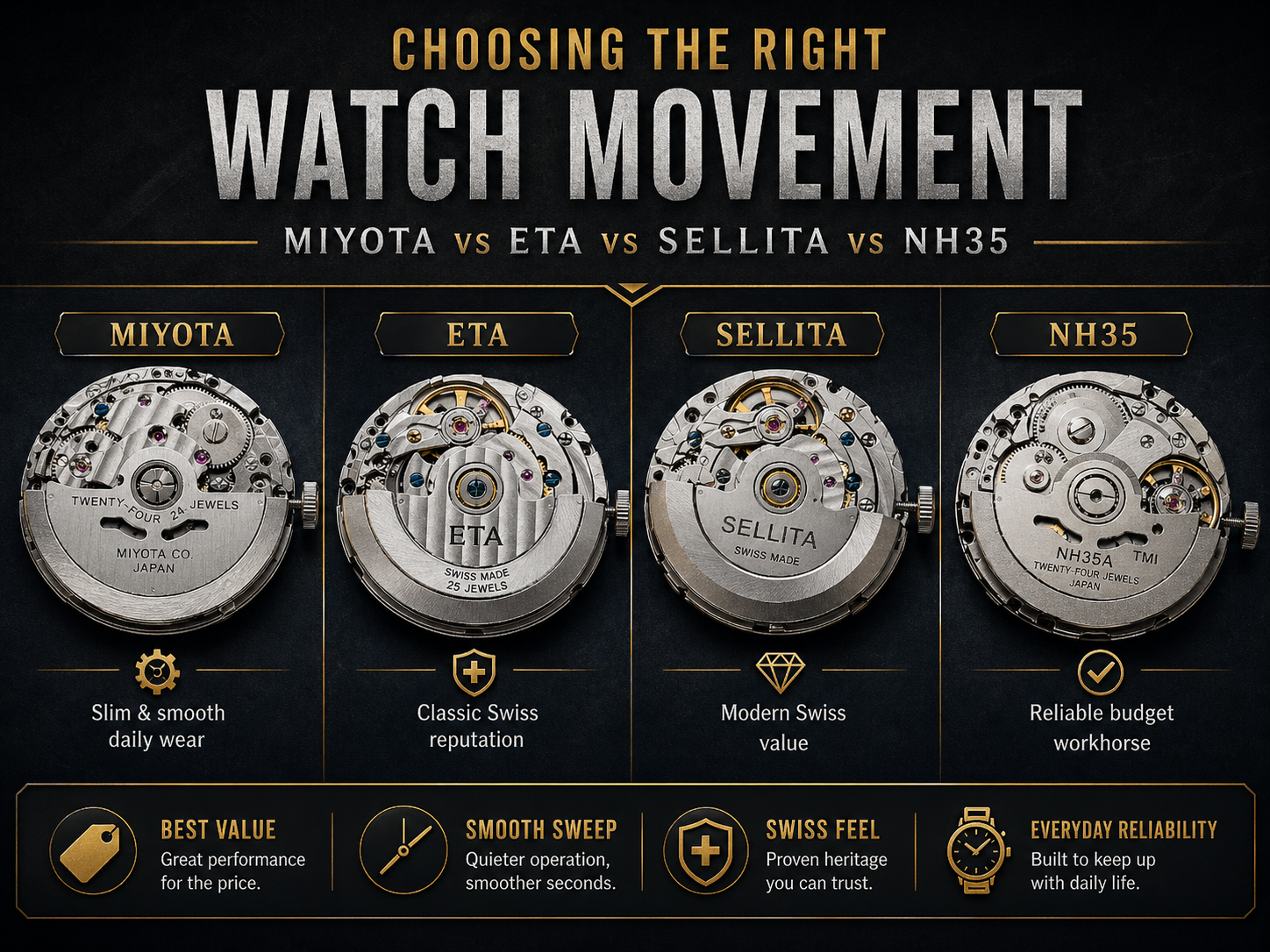
When buyers compare watches, they usually focus on the dial, bezel, bracelet, case size, and brand name first.
That makes sense. Those are the things you see immediately.
But once you start comparing automatic watches more seriously, one question always appears:
What movement is inside?
You may see listings mention Miyota, ETA, Sellita, NH35, 8215, 9015, SW200, 2824, or “automatic movement.” If you are shopping for a genuine watch, homage watch, microbrand watch, or high-quality replica watch, these movement names can affect price, accuracy, thickness, serviceability, and daily wearing experience.
The problem is that movement discussions often become too technical too quickly.
This guide keeps it practical.
We will compare Miyota vs ETA vs Sellita vs NH35 from a real buyer’s point of view: what they are, how they feel, which one suits different watches, and what to check before buying.
If you are new to mechanical watches, you may also want to read this guide first: How to Wind a Mechanical Watch Properly.
Quick Answer: Which Watch Movement Is Best?
There is no single “best” movement for every buyer.
Choose NH35 if you want a reliable, affordable, easy-to-live-with automatic movement for daily wear.
Choose Miyota 8215 if you want a simple, budget-friendly automatic movement with good availability.
Choose Miyota 9015 if you want a slimmer, smoother-sweeping, more premium Japanese automatic movement.
Choose ETA 2824-2 if you want a well-known Swiss automatic movement with strong reputation and broad watch-industry history.
Choose Sellita SW200-1 if you want a modern Swiss automatic movement often used as an ETA 2824-style alternative.
For replica watch buyers, the best choice depends on the model. A Submariner-style or Seamaster-style replica may feel more premium with a smoother high-beat movement, while a value-focused daily watch can still be enjoyable with NH35 or Miyota.
The smart question is not “Which movement sounds most expensive?”
The smart question is:
Which movement fits the watch, the price, and the way I will actually wear it?
Miyota vs ETA vs Sellita vs NH35: Simple Comparison
| Movement Type | Best For | Main Strength | Buyer Personality |
|---|---|---|---|
| NH35 | Affordable daily automatic watches | Reliable, common, practical | Value-focused daily wearer |
| Miyota 8215 | Budget automatic watches | Simple and widely used | Buyer who wants automatic at low cost |
| Miyota 9015 | Slimmer, better-feeling watches | 28,800 vph sweep, thinner build | Buyer who wants better wrist feel |
| ETA 2824-2 | Swiss automatic watches | Famous, respected, well-known | Buyer who values Swiss reputation |
| Sellita SW200-1 | Modern Swiss automatic watches | ETA-style Swiss alternative | Buyer who wants Swiss movement value |
The most important thing to understand is this:
A movement does not automatically make a watch good or bad.
A strong movement inside a poorly made case will not save the watch. A basic movement inside a comfortable, well-built watch can still be a great daily choice.
What Is a Watch Movement?
The movement is the engine of the watch.
In an automatic mechanical watch, the movement uses springs, gears, jewels, a balance wheel, and a rotor to keep time. When you wear the watch, wrist motion spins the rotor and winds the mainspring. You can also manually wind many automatic movements through the crown.
The movement affects:
- How smoothly the seconds hand moves
- How long the watch runs after being fully wound
- How accurate it may be
- How thick the watch case needs to be
- How easy it is to service
- How premium the watch feels when winding and setting
- How much the watch costs
For most buyers, you do not need to know every technical detail. But you should understand the basic personality of the movement inside your watch.
This is especially useful when buying replica watches because two watches can look similar from the outside but feel different depending on the movement inside.
What Is NH35?
The NH35 is one of the most common automatic movements in affordable watches, homage watches, microbrand watches, and some entry-level replica-style watches.
It is popular because it is practical.
TMI lists the NH35 as a 3-hand/date automatic movement with 21,600 vibrations per hour, stop-second function, 24 jewels, and 5.32mm height.
In plain English, that means:
- It is automatic
- It can stop the seconds hand when setting time
- It has a date function
- It is not ultra-thin
- It beats at a slower 3Hz rate
- It is widely used and familiar to many watch builders
The NH35 is not glamorous, but it is dependable. Think of it as the practical engine that gets the job done.
Who Should Choose NH35?
NH35 makes sense if you want:
- A reliable daily automatic watch
- Good value for money
- Easy ownership
- A movement used in many affordable watches
- A practical choice rather than a luxury talking point
It is especially good for buyers who care more about the overall watch than movement prestige.
For example, if you are buying a Submariner-style homage or a value-focused automatic watch, NH35 can be a perfectly sensible movement. It may not feel as refined as a high-beat Swiss movement, but it can be very easy to live with.
For a daily wearer, that matters.
What Is Miyota 8215?
The Miyota 8215 is another common automatic movement, often seen in affordable watches.
Miyota describes the 8215 as a standard automatic movement with automatic and hand winding, quick date setting, stop-second device, approximately 42 hours of running time, 21,600 vibrations per hour, and 21 jewels.
The 8215 is simple, durable, and cost-effective. It is often used when a brand wants to offer an automatic watch without pushing the price too high.
In daily life, a Miyota 8215 watch can be very wearable. The main thing some buyers notice is that it is not as smooth or refined as a higher-beat movement like Miyota 9015, ETA 2824-2, or Sellita SW200-1.
But for the right price, that is not necessarily a problem.
Who Should Choose Miyota 8215?
Miyota 8215 makes sense if you want:
- A budget automatic movement
- Simple mechanical ownership
- Good parts availability
- A watch that does not need to feel ultra-premium
- A lower-cost entry into automatic watches
It is suitable for casual daily watches, affordable dress watches, and lower-priced homage or replica-style watches.
If you are buying for appearance and budget, the 8215 can be enough. If you want a smoother seconds hand, thinner case, and more premium feel, you may prefer Miyota 9015 or a Swiss movement.
What Is Miyota 9015?
The Miyota 9015 is a more premium Japanese automatic movement than the 8215.
Miyota lists the 9015 as 3.90mm thick with stop-second device, automatic and hand winding, quick date setting, approximately 42 hours running time, 28,800 vibrations per hour, and 24 jewels.
This makes the 9015 attractive for watches that need to feel slimmer, smoother, and more refined.
The higher beat rate gives the seconds hand a smoother visual sweep than 21,600 vph movements. The thinner height also helps watchmakers build slimmer cases.
For many buyers, the Miyota 9015 is the sweet spot: better than basic, still practical, and often more affordable than Swiss alternatives.
Who Should Choose Miyota 9015?
Miyota 9015 makes sense if you want:
- A slimmer watch
- A smoother seconds hand
- A more premium Japanese movement
- Good daily performance
- Better feel without Swiss-movement pricing
For replica watch buyers, Miyota 9015 can be a strong option in watches where slimness and sweep matter. For example, a Datejust-style or Aqua Terra-style watch may benefit from a thinner movement because the case profile matters a lot.
If the watch is supposed to look elegant, thick case sides can reduce the effect. That is where the 9015 can be useful.
For more on Datejust-style choices, read: The Ultimate Rolex Datejust Buying Guide.
What Is ETA 2824-2?
The ETA 2824-2 is one of the most famous Swiss automatic movements.
It is widely known in the watch industry and has been used in many Swiss watches over the years. Commonly listed specifications include 25 jewels, 28,800 bph, 4Hz beat rate, and around 38 hours of power reserve.
The reason buyers like ETA is simple: reputation.
ETA movements have a long history, and many watch enthusiasts recognize the 2824-2 name immediately. For a lot of buyers, seeing ETA inside a watch creates confidence.
In a genuine Swiss watch, ETA can be a strong selling point. In a replica watch listing, however, buyers should be careful with wording. “ETA-style,” “ETA clone,” and “genuine ETA” are not the same thing.
That does not mean one is automatically bad. It simply means you should know what is actually inside the watch before comparing prices.
Who Should Choose ETA?
ETA makes sense if you want:
- Swiss movement reputation
- A familiar movement name
- A higher-beat sweep
- Good service familiarity
- A traditional mechanical-watch feel
- Strong buyer confidence
If you are buying a genuine Swiss watch, ETA can be a major plus. If you are buying a replica watch, ask whether the movement is genuine ETA, ETA clone, or another movement described in ETA-like terms.
That detail matters because the price should match the actual movement.
What Is Sellita SW200-1?
The Sellita SW200-1 is a Swiss automatic movement often discussed alongside the ETA 2824-2.
Commonly listed specifications include 26 jewels, 25.6mm diameter, 4.6mm height, 28,800 bph, hand winding, hacking seconds, and around 38–41 hours of power reserve.
Sellita became especially important as many brands looked for Swiss automatic movement supply outside ETA. Today, the SW200-1 is widely used in many Swiss and microbrand watches.
For buyers, the SW200-1 often represents a practical Swiss movement choice.
It has the high-beat sweep many people like, Swiss identity, and broad familiarity among watch brands and watchmakers.
Who Should Choose Sellita SW200-1?
Sellita SW200-1 makes sense if you want:
- A Swiss automatic movement
- Similar practical role to ETA 2824-style movements
- Smooth 28,800 bph seconds sweep
- Good brand acceptance
- A movement commonly used in modern watches
- A strong balance of quality and availability
For many buyers, Sellita is not a compromise. It is simply the modern Swiss automatic movement they are most likely to encounter.
If you are comparing a genuine watch with Sellita against one with ETA, do not assume ETA is automatically better. Look at the whole watch: case, finishing, regulation, bracelet, price, warranty, and service options.
Real-Life Case 1: The Buyer Choosing a Submariner-Style Replica
Imagine a buyer named Chris.
Chris wants a Submariner-style replica for daily wear. He likes the black bezel, black dial, Oyster-style bracelet, and strong wrist presence. He is not buying it as an investment. He wants the look, feel, and everyday style.
He sees two versions:
Version A has an NH35-style movement.
Version B has a higher-beat automatic movement.
Version A is cheaper and reliable enough for daily use. Version B costs more but has a smoother sweep and may feel closer to the luxury-watch experience.
Which should he choose?
If Chris wants the best value, Version A may be enough.
If Chris wants the more premium wearing feel, Version B may be worth the extra cost.
This is the right way to think about movements. Not “cheap equals bad,” but “what experience am I paying for?”
For related reading, see: Rolex Submariner No Date vs Date.
Real-Life Case 2: The Buyer Choosing a Dressier Datejust-Style Watch
A buyer named Eric wants a Datejust-style watch. He cares about wrist comfort, bracelet feel, and case thickness. He wants the watch to slide under a shirt cuff and look elegant.
For Eric, movement thickness matters.
An NH35 or Miyota 8215 can work, but the case may be thicker depending on the watch design. A Miyota 9015 can help create a slimmer profile because the movement itself is thinner than many basic automatic movements. Miyota lists the 9015 height as 3.90mm, while the 8215 is listed at 5.67mm.
For Eric, the 9015-style option may be worth paying extra for.
Not because the name sounds better, but because it fits the design goal.
A dressier watch should not feel bulky.
Real-Life Case 3: The Buyer Who Wants Swiss Movement Confidence
A buyer named Michael is comparing two microbrand dive watches.
One uses Miyota 9015.
The other uses Sellita SW200-1.
Both watches look good. Both are automatic. Both have solid specs. But Michael likes the idea of a Swiss movement, and he knows his local watchmaker is familiar with Sellita.
For Michael, Sellita may be the better emotional and practical choice.
The watch may cost more, but the movement confidence matters to him.
Another buyer may choose the Miyota 9015 and be completely happy because it offers strong performance at a better price.
Both choices can be correct.
Beat Rate: 21,600 vs 28,800 vph
Beat rate affects how the seconds hand moves.
A 21,600 vph movement ticks 6 times per second.
A 28,800 vph movement ticks 8 times per second.
That means 28,800 vph usually looks smoother on the wrist.
NH35 and Miyota 8215 are commonly listed at 21,600 vph, while Miyota 9015, ETA 2824-2, and Sellita SW200-1 are commonly listed at 28,800 vph.
Does this matter?
For some buyers, yes. The smoother sweep feels more premium.
For other buyers, not much. If the watch looks good, keeps acceptable time, and feels comfortable, the exact beat rate may not matter.
Choose 28,800 vph if you care about smooth visual sweep.
Choose 21,600 vph if you care more about value and reliability.
Power Reserve: How Long Will the Watch Run?
Power reserve means how long the watch runs after being fully wound and left unworn.
Typical numbers:
- NH35: more than 41 hours depending on reference and documentation
- Miyota 8215: approximately 42 hours
- Miyota 9015: approximately 42 hours
- ETA 2824-2: around 38 hours
- Sellita SW200-1: around 38–41 hours
These are normal power reserve ranges for many common automatic movements.
For daily wear, all of these are usable.
If you wear the same watch every day, power reserve is usually not a big issue. If you rotate watches, a longer power reserve can be more convenient, but none of these should be treated like a long-reserve movement.
If your watch stops early, read: Power Reserve Explained: Why Your Watch Stops Early.
Accuracy: What Should Real Buyers Expect?
Accuracy depends on the movement, regulation, condition, position, magnetism, service history, and how you wear the watch.
A movement name alone does not guarantee perfect timekeeping.
A well-regulated NH35 can perform better in daily life than a poorly regulated Swiss movement. A Miyota 9015 can run very well if properly adjusted. ETA and Sellita movements can also vary by grade and regulation.
For replica watch buyers, this is especially important.
Do not judge only by the movement name in the listing. Ask whether the watch has been tested, regulated, or checked before shipping.
Practical buyer questions:
- How many seconds per day does it usually run?
- Has the movement been regulated?
- Does the seller test before shipping?
- Does the watch hack?
- Does it hand wind smoothly?
- Does the date change correctly?
- Is there any rotor noise?
- What movement is actually inside?
If you want to understand accuracy more deeply, read: Watch Accuracy Standards Explained: COSC vs METAS.
Hacking Seconds: Why It Matters
Hacking means the seconds hand stops when you pull the crown to set the time.
This makes precise time setting easier.
NH35, Miyota 9015, Sellita SW200-1, and ETA 2824-2 are commonly associated with hacking seconds. Miyota’s current 8215 page also lists a stop-second device.
For most buyers, hacking is useful but not essential.
It matters more if:
- You like setting the time precisely
- You compare your watch to phone time
- You rotate watches often
- You care about accuracy
- You enjoy mechanical-watch details
For more on this feature, read: Hacking Seconds Explained: How to Set Time Precisely.
Movement Thickness and Case Feel
Movement thickness affects how thick the final watch may become.
This is why Miyota 9015 is popular in slimmer watches. Miyota lists the 9015 at 3.90mm thick, while the 8215 is listed at 5.67mm. NH35 is listed by TMI at 5.32mm height.
A thicker movement does not automatically mean a bad watch. Dive watches, tool watches, and sporty watches can handle more thickness.
But for dressier designs, thickness matters.
A Datejust-style, Aqua Terra-style, Cartier-style, or slim everyday watch usually feels better when the case is thinner.
So ask yourself:
Is this watch supposed to feel sporty?
Or is it supposed to feel elegant?
For sporty watches, NH35 or 8215 can be fine.
For elegant watches, a thinner movement may be worth paying for.
Serviceability: Which Movement Is Easier to Live With?
For most real buyers, serviceability means three things:
Can a watchmaker work on it?
Are parts available?
Is it worth repairing?
NH35 and Miyota movements are common in affordable watches, so many watch builders and repairers are familiar with them. ETA and Sellita are also well-known in the Swiss watch world.
However, service cost should match the watch value.
For a lower-cost watch, it may be more practical to replace the movement than fully service it. For a higher-value genuine Swiss watch, servicing the original movement makes more sense.
For replica watches, ask the seller what movement is inside and whether replacement or repair is realistic.
This is not negative. It is practical ownership planning.
If you want a watch you can enjoy daily, you should know what happens if it needs adjustment later.
Miyota vs NH35: Which Is Better?
Miyota and NH35 both make sense in affordable automatic watches.
Choose NH35 if you want a widely used, reliable, value-focused movement.
Choose Miyota 8215 if the watch is budget-focused and you are comfortable with a simple automatic movement.
Choose Miyota 9015 if you want a thinner, smoother, more premium Japanese automatic movement.
In many cases, Miyota 9015 is the step-up choice over NH35. But NH35 remains one of the easiest movements to recommend for affordable daily watches because it is common, practical, and widely understood.
For a first automatic watch, NH35 is often enough.
For a better-feeling automatic watch, Miyota 9015 is more attractive.
ETA vs Sellita: Which Is Better?
ETA and Sellita are often compared because both are Swiss automatic movement names that buyers recognize.
ETA has a longer reputation and strong historical recognition. Sellita is widely used today and often fills a similar role in modern Swiss watches.
The ETA 2824-2 and Sellita SW200-1 share similar basic dimensions and high-beat 28,800 bph performance; the ETA 2824-2 is commonly listed with 25 jewels and around 38 hours reserve, while SW200-1 is commonly listed with 26 jewels and around 38–41 hours reserve.
For real buyers, the difference is usually less important than the watch itself.
A well-regulated Sellita in a well-built case can be better to own than an ETA in a poorly finished watch.
Look at:
- Regulation
- Grade
- Case finishing
- Bracelet quality
- Warranty
- Price
- Service options
- Seller reputation
Do not buy only because a listing says “ETA” or “Sellita.”
Buy the complete watch.
Best Movement for Replica Watches
For replica watches, the best movement depends on the watch style.
Best for Submariner-Style Replicas
A higher-beat movement can make the watch feel more premium because the smoother seconds sweep matches the luxury-sport look. However, a well-built NH35-based version can still be a good daily choice if value is the priority.
Related guide: Rolex Submariner No Date vs Date.
Best for Seamaster-Style Replicas
Seamaster-style watches are sporty and detailed. Movement smoothness helps, but strap comfort, bezel feel, and dial quality may matter even more.
Related guide: Replica Omega Seamaster vs Real.
Best for Datejust-Style Replicas
A thinner movement can matter more here because the watch should feel elegant. Miyota 9015-style options can be attractive if the case is built around slimness.
Related guide: Replica Rolex Datejust vs Real.
Best for Daily Budget Replicas
NH35 and Miyota 8215 can be practical if the price is right and the watch is mainly for casual wear.
The key is matching the movement to the watch’s purpose.
Practical Checklist Before Choosing a Movement
Before buying a watch, ask these questions:
1. What movement is actually inside?
Do not accept vague wording if movement matters to you. Ask for the exact movement name.
2. Is it genuine, clone, or compatible style?
This is especially important with ETA-style listings. Genuine ETA, ETA clone, and ETA-compatible movement are different.
3. Does the watch hack?
Hacking makes precise setting easier.
4. Does it hand wind?
Hand winding is useful if the watch stops after being left unworn.
5. What is the power reserve?
Most common movements in this guide sit around 38–42 hours, which is fine for daily use.
6. How thick is the watch?
Movement thickness can affect case thickness. This matters more for dress watches than dive watches.
7. Is the movement easy to repair or replace?
For affordable watches, replacement may be more practical than full service.
8. Does the price match the movement?
A basic movement is fine at the right price. A premium price should come with better finishing, regulation, case quality, and bracelet quality.
Common Mistakes Buyers Make
Mistake 1: Thinking Swiss Always Means Better
Swiss movements can be excellent, but a movement alone does not define the whole watch. Case quality, regulation, bracelet feel, and seller quality matter too.
Mistake 2: Ignoring Japanese Movements
Miyota and NH35 movements can offer excellent practical value. Many buyers enjoy them because they are simple and easy to live with.
Mistake 3: Paying Extra for a Name Without Checking Details
A listing may use impressive movement language, but you should still confirm what is actually inside.
Mistake 4: Choosing the Movement Before Choosing the Watch
The movement should fit the watch. A slim dress watch, rugged diver, and casual daily watch do not need the same movement.
Mistake 5: Expecting Perfect Accuracy From Any Mechanical Movement
Mechanical watches are not quartz watches. Some variation is normal. Regulation, position, wear pattern, and magnetism can all affect performance.
If your watch suddenly runs very fast, read: How to Demagnetize a Watch at Home.
Which Movement Should You Choose?
Here is the simple buyer-focused answer.
Choose NH35 if:
You want value, reliability, and a practical daily automatic watch.
Choose Miyota 8215 if:
You want a budget automatic movement and do not need a premium sweep or thin case.
Choose Miyota 9015 if:
You want a better Japanese movement with slimmer construction and smoother sweep.
Choose ETA 2824-2 if:
You want a famous Swiss automatic movement with strong reputation.
Choose Sellita SW200-1 if:
You want a modern Swiss automatic movement with high-beat performance and broad use in current watches.
For many buyers, Miyota 9015 and Sellita SW200-1 are the most attractive middle-to-premium choices. NH35 remains one of the best value choices. ETA is the most famous name, but fame alone should not be the only reason to pay more.
Final Verdict: Movement Matters, But It Is Not Everything
Miyota, ETA, Sellita, and NH35 movements all have a place.
NH35 is practical and affordable.
Miyota 8215 is simple and budget-friendly.
Miyota 9015 is slimmer and smoother.
ETA 2824-2 is famous and respected.
Sellita SW200-1 is a strong modern Swiss option.
The best movement depends on the watch and the buyer.
If you are buying a genuine Swiss watch, ETA or Sellita may add confidence.
If you are buying a value automatic watch, NH35 may be perfect.
If you want a slimmer daily watch, Miyota 9015 may be a smart choice.
If you are buying a replica watch, match the movement to the design, price, and wearing purpose.
A watch is not only its movement. It is the whole experience: case, dial, bracelet, fit, accuracy, comfort, style, and how often you actually wear it.
The smartest buyer does not chase the most impressive movement name.
The smartest buyer chooses the movement that makes sense for the watch they want to enjoy.
FAQ
Is Miyota better than NH35?
Miyota 9015 is generally the more premium choice compared with NH35 because it is thinner and runs at 28,800 vph. But NH35 is still a very practical and reliable movement for affordable daily watches.
Is ETA better than Sellita?
ETA has stronger historical recognition, but Sellita SW200-1 is widely used in modern Swiss watches. The better choice depends on the exact watch, regulation, price, and service options.
Is NH35 a good movement?
Yes. NH35 is a good value-focused automatic movement. It is widely used because it is practical, reliable, and suitable for many affordable watches.
Is Miyota 9015 good for replica watches?
Yes, Miyota 9015 can be a good choice for replica watches, especially when a slimmer case and smoother seconds sweep matter.
What is the difference between Miyota 8215 and 9015?
Miyota 8215 is a standard automatic movement with 21,600 vph and 21 jewels. Miyota 9015 is thinner, has 24 jewels, and runs at 28,800 vph, giving a smoother seconds sweep.
What is the best movement for a Submariner-style replica?
For best value, NH35 or Miyota can work well. For a more premium feel, a higher-beat movement such as Miyota 9015, ETA-style, or Sellita-style may feel closer to the luxury-watch experience.
Does a smoother seconds hand mean a better watch?
Not always. A smoother sweep can feel more premium, but reliability, regulation, bracelet comfort, case quality, and price matter too.
Should I pay more for a Swiss movement?
Pay more if Swiss movement identity, smoother sweep, service familiarity, and emotional confidence matter to you. If you mainly want a good-looking daily watch, a Japanese movement may offer better value.