How to Tell If a Watch Is Overpolished Before You Buy
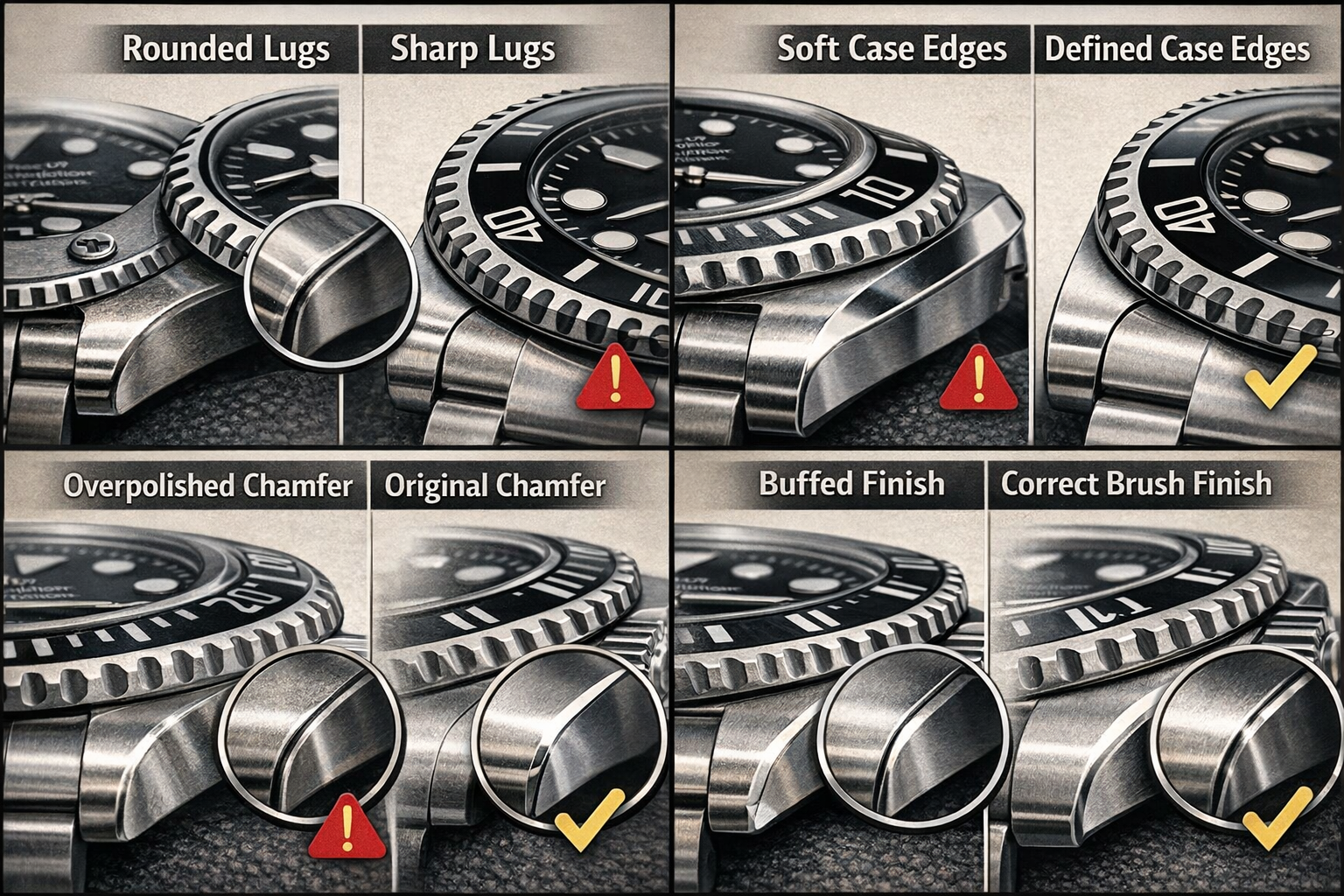
A used watch with scratches is not necessarily a bad buy.
In fact, in many cases, a lightly worn watch with sharp original lines is a better buy than a “clean” watch that has been polished too aggressively.
That is the part many buyers miss.
They see one watch with visible hairlines and another that looks bright, smooth, and almost new. The second one feels safer. It feels more premium. It photographs better. And very often, it is the worse watch to buy.
Because once a case has been overpolished, you usually cannot put the metal back.
That is why overpolishing matters.
It is not just about appearance. It affects the watch’s original shape, its visual character, and often its resale appeal. On some models, especially sport watches with sharp bevels, brushed planes, or defined case geometry, bad polishing can completely change the way the watch looks on the wrist.
So here is the short version:
A few honest scratches are normal. Soft, rounded, distorted case lines are the real problem.
Who this guide is for
This article is for you if:
- you are buying a used watch online,
- you are comparing “clean” vs “honest wear” examples,
- you are unsure whether a case has been polished too much,
- or you want to avoid paying strong money for weak geometry.
If you are already shopping the pre-owned market in general, this article works especially well alongside Should You Buy a Used Luxury Watch Online? 12 Checks Before You Pay.
The short answer
A watch is more likely to be overpolished if you notice:
- rounded lug tips,
- soft or uneven case edges,
- missing or faded chamfers,
- brushed and polished surfaces bleeding into each other,
- bezel teeth that look worn down,
- crown guards that look thinner or less defined,
- or a bracelet and case that no longer match in sharpness or finish.
A watch is less likely to be badly polished if:
- the case lines still look crisp,
- the surface transitions are clear,
- the lug shape is still symmetrical,
- and the watch shows honest wear instead of trying too hard to look “like new.”
Why overpolishing is such an expensive mistake
Scratches are easy to understand. They are visible, familiar, and emotionally simple. Most buyers can see them and decide whether they care.
Overpolishing is trickier because it often hides inside a watch that looks superficially attractive.
A heavily polished watch can look bright in photos. It can reflect light beautifully. It can even seem “better cared for” than a scratched example.
But what polishing really removes is not just marks. It removes metal.
And when too much metal is removed, these things start to disappear:
- edge definition,
- original factory proportions,
- lug sharpness,
- chamfers,
- bezel character,
- and sometimes the feeling that the watch still looks like the model people actually want.
That matters even more on watches with strong case architecture. A soft dress watch may hide bad refinishing better. A sharp sports watch usually does not.
If you want a clearer understanding of how different case materials behave in finishing, Watch Case Materials Explained: Steel vs Titanium vs Ceramic vs Bronze (Pros & Cons) gives useful context before you start judging used examples.
A real-world example
Imagine two used luxury sports watches listed at similar prices.
Watch A has visible desk-diving marks on the clasp, light hairlines on the side of the case, and one or two shallow bezel marks. But the lug edges are still sharp, the case transitions are clear, and the original brushing looks intact.
Watch B looks cleaner in the main listing photo. The bezel shines. The case is bright. The seller describes it as “professionally polished.” But in the close-ups, the lugs look slightly swollen and rounded, the chamfers have faded, and the edge between the brushed top and polished side is no longer crisp.
A first-time buyer often picks Watch B.
An experienced buyer usually picks Watch A.
Why?
Because honest wear can be lived with.
Lost shape usually cannot.
1. Start with the lugs: they tell the truth fast
If you only have 20 seconds to inspect a used watch case, look at the lugs.
Lugs give away bad polishing quickly because they hold a lot of the watch’s geometry. When polishing becomes too aggressive, the first thing that often goes is crispness.
Look for:
- rounded lug tips,
- uneven lug thickness,
- softened outer edges,
- and lugs that look “melted” instead of defined.
What you want to see
You want the lugs to look deliberate. Even if the watch is worn, the shape should still feel precise.
What should worry you
If the lugs look puffy, too smooth, or noticeably softer than the model should be, that is a red flag.
Practical move:
Ask for a straight-on shot of the whole watch plus close-ups of all four lugs in daylight. Studio light hides softness. Daylight reveals it.
2. Check whether the case edges still look crisp
A good watch case usually has visual structure.
That structure may come from:
- a sharp edge,
- a defined shoulder,
- a straight line,
- or a clean border between two finishing styles.
Overpolishing blurs those borders.
Instead of a clear edge, you get a vague one. Instead of a sharp transition, you get a soft roll. Instead of a confident shape, you get something that looks tired.
This is one of the easiest ways to separate “fresh-looking” from “correct-looking.”
Practical move:
Look at side-profile photos and ask yourself:
“Do the edges look engineered, or do they look smoothed over?”
If the answer is “smoothed over,” slow down.
3. Look for missing or weakened chamfers
On many watches, especially sports models, the chamfer is one of the most beautiful details on the case.
It is also one of the easiest details to ruin.
A chamfer should usually look:
- intentional,
- even,
- consistent from lug to lug,
- and visually separate from the brushed or polished surfaces next to it.
When a watch has been overpolished, chamfers may:
- disappear completely,
- fade on one side more than the other,
- become too wide,
- become too soft,
- or stop looking symmetrical.
That is not a small cosmetic issue. On many references, it is a big part of what gives the watch its identity.
Practical move:
Compare left and right lug chamfers. If one side looks crisp and the other looks washed out, the case has probably had a harder life than the listing suggests.
4. Watch the line between brushed and polished surfaces
This is one of the best inspection tricks because it is simple and effective.
Many watch cases combine different finishes:
- brushed tops,
- polished case sides,
- polished bevels,
- brushed bracelets,
- polished center links,
- or a mix of all of the above.
A well-finished watch has clean boundaries between those surfaces.
An overpolished watch often shows “bleed,” where one finish spills into another and the transitions become muddy.
What that looks like in practice
- The top of the lug is supposed to be brushed, but now the brushing fades unevenly into a shiny edge.
- The case side is polished, but the border where it meets the upper plane no longer looks straight.
- The bracelet and case no longer seem to belong to the same watch.
If you are still learning how finishing affects daily appearance, Watch Strap Materials Guide: Bracelet vs Leather vs Rubber vs Nylon (What to Choose) and Watch Bracelet Sizing Guide: How Tight Should It Be? (Comfort, Fit Tests & Fixes) can help you think more clearly about how a watch actually presents on the wrist, not just in a product-style photo.
5. Bezel teeth and bezel edges are major warning signs
Bezel teeth are incredibly revealing.
On watches with coin-edge or tool-style bezels, aggressive polishing can wear down the teeth and make the bezel look dull, tired, or strangely soft.
You may see:
- flattened teeth,
- uneven edge depth,
- lost crispness,
- or a bezel that looks less grippy and less precise than it should.
This is especially important on sport and dive-style watches where the bezel is part of the watch’s visual personality.
A watch with worn bezel teeth may still function.
But it may no longer look like the sharp, purposeful design buyers expect.
Practical move:
Ask for an angled bezel close-up. Not just straight-on. Teeth and edge wear often show up best when light hits from the side.
6. Crown guards should look intentional, not thinned out
Crown guards are another easy place to spot trouble.
On watches that have them, they should usually look:
- balanced,
- shaped correctly,
- symmetrical,
- and proportionate to the crown.
After repeated or careless polishing, crown guards can become:
- thinner,
- shorter,
- softer,
- or visually uneven.
That can make the entire case look subtly wrong, even if the buyer cannot explain why at first glance.
And once you see it, you usually cannot unsee it.
Practical move:
Compare the crown-guard side with reference photos of the same model. Ask yourself whether the guards still look protective and sculpted, or whether they now look smoothed down.
7. The caseback can expose the story too
Most buyers spend all their time staring at the dial and bezel. Smart buyers also inspect the back.
A caseback can reveal:
- heavy opening marks,
- excessive refinishing,
- softened edges,
- poor brushing restoration,
- and general care quality.
A heavily refinished top side with a rough or careless caseback often tells you the watch has been cosmetically “prepared for sale,” not properly preserved.
That difference matters.
Because the kind of seller who hides damage with surface shine often hides other problems too.
8. Learn the difference between clean and original
This is one of the most important mindset shifts in used-watch buying.
A watch can be:
- clean but overworked,
- worn but original,
- shiny but wrong,
- or scratched but excellent.
Many buyers instinctively prefer clean.
Better buyers learn to prefer original.
That does not mean every untouched watch is automatically superior. Some watches genuinely benefit from careful refinishing, especially if it is light, correct, and respectful of the original lines.
But once refinishing starts changing proportions instead of refreshing surfaces, the trade-off becomes bad.
A practical rule
If the watch looks “better than it should” for its age, ask more questions.
Not because that proves anything.
Because it often means something has been done.
9. Pay attention to symmetry, not just condition
Overpolishing rarely ruins a watch in one dramatic place.
More often, it creates a collection of small asymmetries:
- one lug looks thinner,
- one case side looks softer,
- one chamfer is wider,
- one bracelet shoulder looks more rounded,
- or one crown guard seems weaker.
Each issue alone may seem minor. Together, they tell a very clear story.
This is why symmetry matters so much in used watch inspection.
Even if you do not know the model extremely well, you can still ask a useful question:
Does the watch look balanced from side to side?
If the answer is no, stop trusting the description and start trusting your eyes.
10. Bracelet sharpness should match case sharpness
A case and bracelet should usually make sense together.
If the case is extremely glossy and soft-looking but the bracelet still seems relatively crisp, or vice versa, that mismatch deserves attention.
Possible reasons include:
- the case was refinished separately,
- the bracelet was replaced,
- the bracelet was worn much more heavily,
- or the watch was “improved” for sale without consistent finishing work.
This is not automatic proof of a problem. But it is often a clue that the condition story is more complicated than the listing suggests.
Practical move:
Ask for one photo showing the watch head and the first bracelet links together from above and from the side. Transitions often reveal more than isolated macro shots.
11. Crystal clarity can distract you from case problems
This is a subtle one, but it matters.
A clean crystal and a glossy dial can make buyers feel the entire watch is in better condition than it really is. That effect gets stronger when listing photos are edited or heavily lit.
So do not let the face of the watch distract you from the shape of the watch.
And if the crystal itself looks marked, make sure you know whether you are seeing actual crystal damage or coating wear. AR Coating Explained: Why Your Watch Crystal Looks Scratched (But Isn’t) and Sapphire vs Mineral vs Acrylic Watch Crystal: Pros, Cons & Scratch Reality are useful here, because buyers often misread crystal condition and miss the more important issue happening around it.
12. Ask the seller one direct polishing question
A lot of buyers ask vague condition questions and get vague answers.
Ask a direct one instead:
Has the watch ever been polished or refinished? If yes, by whom, and was it a light refinish or a full polish?
This question matters because honest sellers often answer it clearly. Weaker sellers often answer around it.
Good responses sound like:
- “Yes, lightly refinished during service in 2023.”
- “No, to my knowledge it has never been polished.”
- “I bought it used and cannot confirm, but here are detailed close-ups.”
Bad responses sound like:
- “Looks great for age.”
- “Normal used condition.”
- “You can judge from photos.”
- “Professionally cleaned up.”
“Cleaned up” is not a technical standard. It is sales language.
A 5-minute photo inspection routine before you pay
Here is a simple routine you can use on any used listing.
Step 1: Look at the full front shot
Does the watch feel crisp or soft overall?
Step 2: Zoom into the lugs
Are the lug tips defined and even?
Step 3: Check the edge transitions
Can you clearly see where brushed and polished surfaces meet?
Step 4: Inspect the bezel and crown guards
Do they still look sharp and proportionate?
Step 5: Compare left and right sides
Does the watch still feel symmetrical?
Step 6: Look at the bracelet-to-case relationship
Do the finishes and sharpness match?
Step 7: Ask for daylight photos if anything feels hidden
If your confidence depends on edited listing photos, you do not have enough information yet.
This routine alone will save many buyers from paying strong money for weak cases.
What honest wear looks like
This is important because many buyers are afraid of the wrong thing.
Honest wear often looks like:
- light desk scratches,
- clasp marks,
- small side hairlines,
- minor bezel nicks,
- surface swirls,
- and normal signs of actual use.
Those things are not ideal, but they are understandable.
In many cases, they are preferable to a watch that has had its character sanded away.
A watch with honest wear tells you it was used.
An overpolished watch often tells you it was cosmetically managed.
Those are not the same story.
When light polishing is acceptable
Not all polishing is bad.
A careful, minimal, well-executed refinish can be perfectly acceptable on some watches, especially if:
- the case lines remain intact,
- the finishing style is restored correctly,
- the watch is not rare or geometry-sensitive,
- and the asking price reflects the condition honestly.
The problem is not “any polishing.”
The problem is polishing that changes the watch instead of refreshing it.
That is the distinction smart buyers learn to make.
When to walk away immediately
Walk away if:
- the seller refuses close-ups,
- the lugs look uneven,
- the case edges are obviously soft,
- the chamfers are gone on a model known for them,
- the bezel teeth look worn down,
- or the price is still strong despite obvious case loss.
There will always be another watch.
The hardest lesson in pre-owned buying is that patience usually saves more money than speed.
A message template you can send the seller
Use this if you want a cleaner way to ask for the right things:
Hi, I’m interested in the watch. Before payment, could you please send fresh daylight photos of the four lugs, side profiles, bezel edge, crown side, clasp, and the first bracelet links next to the case?
Also, has the watch ever been polished or refinished to your knowledge? If yes, was it light refinishing during service or a full polish? Thanks.
A strong seller will not be offended by this.
A strong seller will expect it.
Bottom line
The biggest mistake in used watch buying is not buying a scratched watch.
It is buying a watch that has lost its original shape because the photos made it look clean.
Sharp lines matter.
Defined edges matter.
Correct geometry matters more than surface shine.
So when you are deciding between a bright, polished-looking watch and a lightly worn but crisp one, remember this:
Metal can be removed. It usually cannot be put back.
A few honest scratches are easy to live with.
A softened case is much harder to forget.
FAQ
Is every polished watch a bad buy?
No. Light, correct refinishing is not automatically a problem. Overpolishing is the problem.
What is the easiest sign of overpolishing?
Rounded lugs and soft case edges are usually the fastest signs.
Are scratches better than polishing?
Not always, but many buyers would rather have honest wear than lost factory geometry.
Does overpolishing affect value?
Usually yes, especially on watches where case shape, chamfers, and sharp finishing are part of the model’s appeal.
Can overpolishing be fixed?
Usually not fully. Light refinishing can improve surfaces, but missing metal and lost geometry generally cannot be restored completely.
Should I avoid all “professionally polished” watches?
No, but you should inspect them carefully and judge the result, not just the phrase.