How to Spot a Fake Rolex Before You Buy: 13 Red Flags That Actually Matter
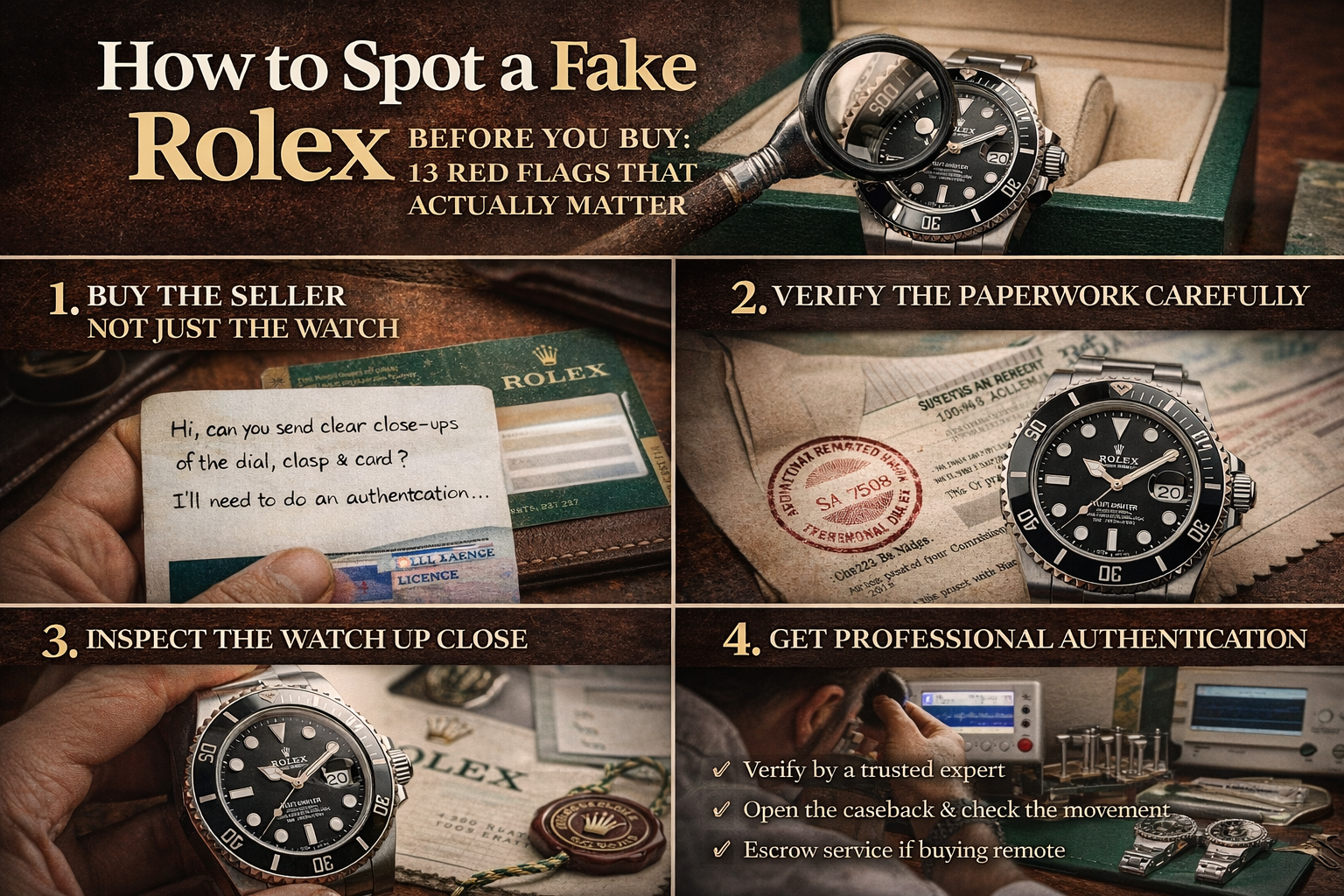
How to Spot a Fake Rolex Before You Buy: 13 Red Flags That Actually Matter
Buying a Rolex should feel exciting.
Too often, it feels like a trap.
That is because fake Rolex watches have become much harder to spot from a few blurry listing photos. Some are still laughably bad. Others are good enough to fool first-time buyers, casual collectors, and even people who think they “know watches.”
Here is the good news: most fake Rolex deals still fall apart under a calm, methodical inspection.
If you remember only one thing from this guide, remember this:
The safest way to avoid a fake Rolex is not to hunt for one perfect “tell.” It is to check the seller, the watch, the paperwork, and the story together.
And if you are buying remotely, start with our broader guide on buying a used luxury watch online, because many fake-watch mistakes happen before the watch is even in your hand.
The short answer: how can you tell if a Rolex is fake?
A fake Rolex usually reveals itself through a combination of problems:
- a seller who avoids basic questions
- mismatched parts for the supposed reference or year
- weak or sloppy dial details
- incorrect date magnification or alignment
- poor bracelet and clasp finishing
- suspicious paperwork
- a price that is just low enough to tempt you, but not low enough to look ridiculous
No single sign proves authenticity by itself. Even a real box and papers do not automatically make the watch real, which is why our article on full set vs watch only matters so much in the Rolex world.
A real-world buying scenario: the “great deal” Submariner
A buyer sees a Rolex Submariner listed privately at a price about 20% below typical market level.
The seller says:
“Bought it a few years ago, full set, worn occasionally, selling because I want something dressier.”
That sounds reasonable.
The photos look decent at first glance. The watch comes with a box, card, hang tag, and a few wrist shots. But when the buyer asks for close-up photos of the dial, clasp, rehaut, and bracelet reference, the seller gets vague. The follow-up photos are dim, soft, and taken from awkward angles.
A few things start to feel off:
- the date looks slightly too low in the window
- the lume color on the hands and markers does not quite match
- the bezel pearl looks a touch wrong
- the clasp finishing looks softer than it should
- the seller refuses an in-person inspection at a watchmaker
That is the moment smart buyers stop thinking, “Maybe I’m overthinking this.”
They start thinking, “Why is this person making it hard to verify?”
That shift saves money.
Why fake Rolex watches still fool people
Most people expect fake watches to fail in obvious ways. They imagine crooked logos, quartz ticking, or a completely wrong case shape.
Modern fakes are more dangerous because they often get the headline look right:
- the right color
- the right general proportions
- a smooth-looking seconds hand
- decent overall weight
- branded packaging
That is why surface-level myths are so dangerous.
A “smooth sweep” does not prove a Rolex is real.
A heavy watch does not prove it is real.
A green box does not prove it is real.
A warranty card does not prove it is real.
You need a process.
13 red flags that actually matter when checking a Rolex
1) Buy the seller before you buy the watch
This is the first rule because it is the rule most buyers ignore.
A trustworthy seller should be willing to provide:
- clear macro photos
- the reference and serial details they are comfortable sharing
- service history, if any
- a straight answer about replaced parts
- a reasonable inspection method before final payment
A seller does not need to sound like a Rolex historian. But they should sound consistent, calm, and transparent.
Warning signs include:
- rushing you
- refusing close-up photos
- changing the story
- avoiding questions about service or ownership
- insisting on unusual payment methods
- saying things like “I’m not an expert, so sold as seen” while also asking strong money
If you are meeting in person, pair this article with our checklist on how to check a used watch in person. A fake Rolex often becomes much easier to spot once the watch leaves flattering listing photos and enters real light.
2) Make sure the reference, era, and parts all belong together
A very common problem is not a totally fake watch, but a mismatched watch.
That might mean:
- the dial is from one era
- the bezel insert is from another
- the bracelet is not original to the watch
- the clasp code and production period do not line up
- aftermarket parts have been used to make the watch look “newer” or more expensive
This matters because buyers often ask, “Is it fake?” when the real question is, “Is it correct?”
A watch can be genuine Rolex and still be a bad buy if the parts do not match the reference and age.
That is especially true in the Submariner, GMT-Master, Datejust, and Daytona world.
3) Look hard at the dial printing
Rolex dials are one of the first places where quality differences start to show.
Check for:
- uneven text thickness
- fuzzy edges
- poor spacing
- markers that look slightly off-center
- a coronet logo that feels crude under magnification
You do not need to obsess over microscopic details in a random phone photo. But on a watch in hand, the dial should look deliberate, clean, and balanced.
A fake or refinished dial may still look “nice.” What it often lacks is precision.
4) Check the date window and cyclops carefully
The date area is one of the easiest places for a buyer to slow down and spot trouble.
Ask yourself:
- Is the date centered in the window?
- Does the magnification look natural or oddly weak?
- Does the cyclops sit cleanly over the numeral?
- Does the date change cleanly and consistently?
A bad date window can be a major clue.
So can a seller who never includes a straight-on date photo.
If you are comparing two watches and one seller keeps avoiding that angle, pay attention.
5) Do not trust the “smooth seconds hand” myth
A lot of people still believe this:
“If the seconds hand glides smoothly, it must be real.”
Not true.
Many fake Rolex watches imitate the sweeping motion well enough to fool someone who is only looking for a one-second tick like a cheap quartz watch.
A better question is this:
Does the whole watch hold up under inspection, or am I clinging to one comforting detail?
That is a much safer mindset.
6) Check whether the hands, lume, and dial all age the same way
Real watches age like real objects.
They rarely age in perfect isolation.
If the dial markers look creamy and old, but the hands look fresh and bright, ask why.
If the lume on the hands glows differently from the lume on the hour markers, ask why.
If one part of the watch looks heavily worn while the rest looks suspiciously new, ask why.
Sometimes there is a valid explanation, such as a service replacement.
But that explanation should exist, and the seller should be able to say it plainly.
7) Inspect the bezel action, alignment, and feel
On a Rolex sports model, the bezel tells you a lot.
Things to look for:
- sloppy alignment
- weak click feel
- inconsistent resistance
- insert details that look too thick, too shiny, or slightly off
Many buyers judge bezels only by appearance.
That is not enough.
How the bezel moves matters.
A watch that looks convincing in a photo can feel wrong in the first ten seconds on the wrist.
8) Watch out for overpolishing and shape loss
This is where some buyers confuse “fake” with “badly refinished.”
A real Rolex can lose value and visual sharpness if it has been polished too aggressively.
The lugs may become too soft, the case lines too rounded, and the overall shape less crisp than it should be.
Before paying Rolex money for any used piece, read our guide on how to tell if a watch is overpolished before you buy.
A heavily polished Rolex is not automatically fake.
But it can absolutely be overpriced.
9) Bracelet and clasp quality matter more than many buyers think
A weak bracelet is one of the fastest ways a fake watch gives itself away.
Check for:
- rattly feel beyond normal wear
- rough edges
- loose tolerances
- weak engraving
- clasp action that feels cheap or vague
- a general mismatch between the quality of the case and the quality of the bracelet
This is also where “full set” psychology hurts buyers.
They see a nice box and relax, instead of focusing on the part they will actually wear every day.
Again, box and papers matter—but not as much as people think.
10) Ask what has been replaced, refinished, or serviced
A seller who says “all original” too quickly is not always helping you.
Ask directly:
- Has the crystal ever been replaced?
- Have the hands or dial ever been changed?
- Has the bracelet been repaired or swapped?
- Has the watch been polished?
- Was the movement serviced, and by whom?
A fake seller hates precise questions.
A sloppy seller hates them too.
A good seller usually welcomes them, even if the answers are not perfect.
11) Be careful with “replica,” “custom,” and “aftermarket” language
This matters because buyers often lump very different things together.
A replica Rolex is a counterfeit watch pretending to be Rolex.
An aftermarket watch may use non-original parts on a genuine Rolex base.
A franken watch is built from mixed parts that do not properly belong together.
Those are not the same thing.
But they all change value, risk, and buyer expectations.
If a seller uses language like:
- “custom build”
- “aftermarket dial”
- “upgraded bezel”
- “1:1”
- “looks just like the real thing”
slow down immediately.
That may not always mean the seller is openly scamming you.
It does mean you are no longer buying a simple, straightforward Rolex transaction.
12) Dive-model Rolex buyers should care about water resistance after service
If you are buying a Submariner, Sea-Dweller, or other water-oriented Rolex, do not assume it is water-safe just because it screws down properly.
A watch may look fine and still fail a pressure test.
If the case has been opened recently, or if the seller mentions service, ask whether the watch has been pressure tested afterward. Our guide on what a watch water resistance test actually checks explains why appearance alone is not enough.
And if a seller makes strong claims about swim-readiness, it is also worth reading can a watchmaker guarantee water resistance after repair?.
13) The smartest move is still third-party authentication before final payment
Here is the truth buyers sometimes resist:
If the watch is expensive enough to hurt you financially, it is expensive enough to justify authentication.
That can mean:
- meeting at a reputable watchmaker
- using an escrow-style process where available
- having the watch opened and checked by a trusted professional
- making the deal contingent on verification
The bigger the money, the less pride should be involved.
You are not being paranoid.
You are being rational.
A simple 7-step inspection routine you can actually use
If you are looking at a Rolex in person, use this order:
Step 1: Look at the watch from arm’s length
Does anything feel off immediately? Proportions, shine, thickness, or printing?
Step 2: Go straight to the dial and date
Do not start with the box. Start with the watch.
Step 3: Check the case lines and bracelet
Feel the edges. Open and close the clasp. Rotate the bezel if applicable.
Step 4: Compare the story to the object
Does a “lightly worn, original” watch look like that?
Step 5: Ask direct service and parts questions
You want plain answers, not vague reassurance.
Step 6: Check paperwork last, not first
Papers support a watch. They do not rescue a bad watch.
Step 7: If anything feels wrong, pause the deal
You do not need a courtroom-level proof to walk away from a suspicious purchase.
A practical message you can send any Rolex seller
Here is a clean message buyers can use before paying:
Hi, I’m seriously interested. Before moving forward, could you send clear close-up photos of the dial, date window, clasp, bracelet, case sides, and any paperwork? Also, please confirm whether the watch has had any replaced parts, polishing, or recent service. If we proceed, I’d like the sale to be subject to inspection/authentication. Thanks.
A trustworthy seller should not be offended by that.
What smart buyers do instead of chasing the cheapest Rolex
A lot of fake Rolex problems start with one emotional mistake:
wanting the deal to be real more than wanting the watch to be real.
That is where people talk themselves into weak evidence.
A smarter path looks like this:
- compare multiple examples first
- learn the normal market price range
- use articles like our guide on negotiating the price of a used watch without losing the deal
- accept that paying a bit more to a better seller is often cheaper than “saving” money on a risky one
Cheap Rolexes are expensive when they go wrong.
So should you buy a Rolex from a private seller?
Yes—but only if the transaction is structured well.
Private sales can offer strong value.
They can also expose you to the highest fake risk if you are buying based on trust, hype, and low-resolution photos.
A private Rolex deal starts to make sense when:
- the seller is transparent
- the watch details are consistent
- the price is realistic, not magical
- authentication is possible
- you are comfortable walking away
If any of those pieces are missing, there will be another Rolex.
FAQ
Is a fake Rolex always easy to spot?
No. Some are obvious, but many are good enough to fool buyers who rely on only one or two signals.
Does box and papers prove a Rolex is real?
No. Box and papers help, but they should support the watch—not replace inspection of the watch.
Can a real Rolex still be a bad buy?
Absolutely. Overpolishing, mismatched parts, heavy wear, poor servicing, or incorrect components can all make a genuine Rolex a poor purchase.
Is an aftermarket Rolex the same as a fake Rolex?
Not always. A counterfeit is pretending to be Rolex. An aftermarket or franken watch may involve genuine and non-genuine parts mixed together. Either way, the value and risk change dramatically.
Should I avoid any seller who refuses authentication?
Yes, in most cases. That refusal is often more revealing than any single photo.
Final thoughts
The best Rolex buyers are not the people who know the most trivia.
They are the people who stay calm, ask better questions, and refuse to be rushed.
If you are trying to figure out how to spot a fake Rolex, do not search for one magic giveaway.
Look for consistency:
- consistency in the seller
- consistency in the parts
- consistency in the condition
- consistency in the story
That is how real buyers stay safe.
And if the watch is still tempting but the facts are not clean, the right move is simple:
Walk away.