How to Spot a Fake Omega Aqua Terra Before You Buy
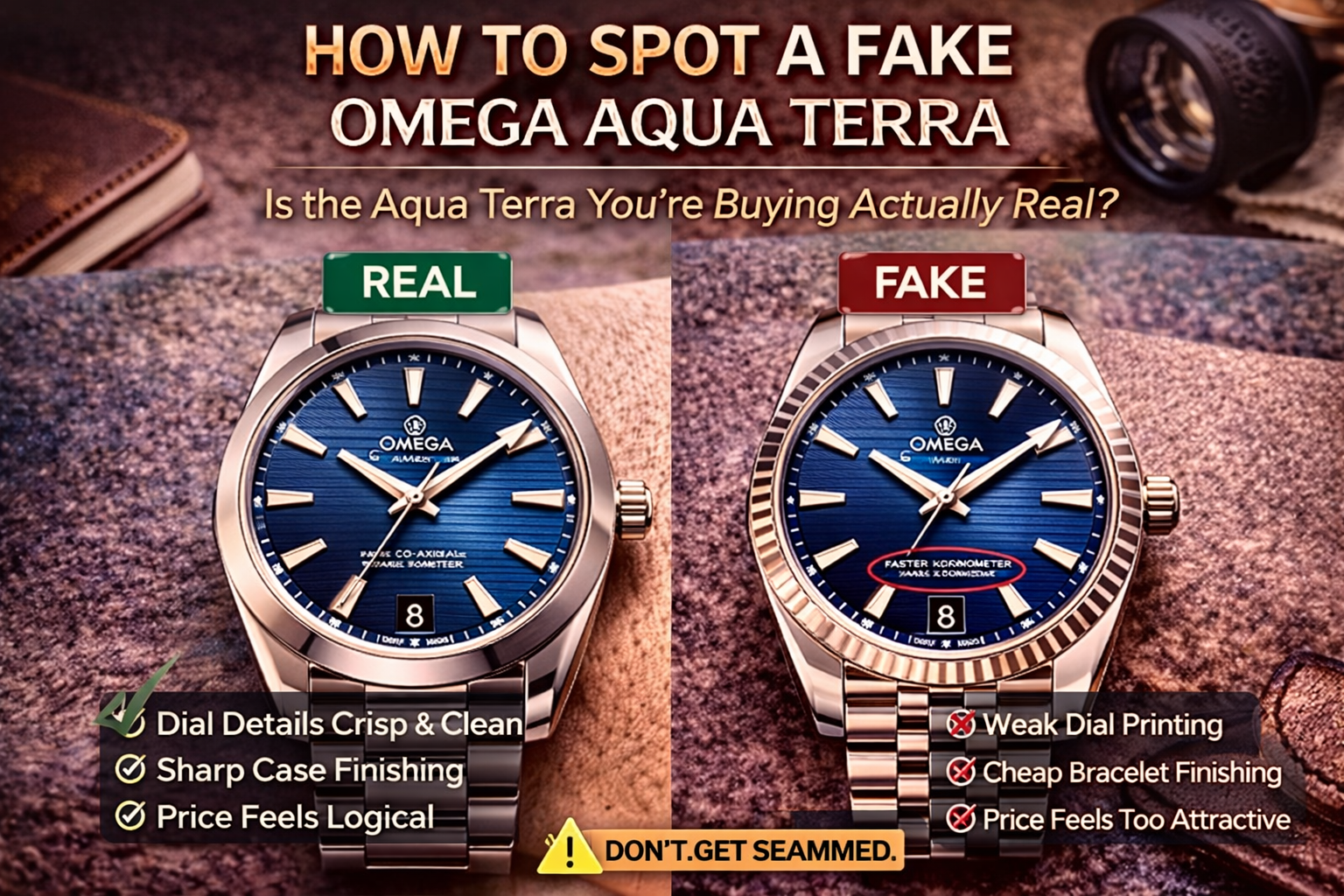
The Omega Aqua Terra is one of the easiest luxury watches to underestimate and one of the easiest to buy too quickly.
That combination creates a problem.
Because the Aqua Terra looks clean, versatile, and relatively understated, many buyers assume it is safer to shop than more obvious status models. They think the real risk is with Rolex, not Omega. They think if the dial looks close enough and the seller sounds normal, the watch is probably fine.
That is exactly how people get burned.
A fake Omega Aqua Terra does not always look ridiculous. Some are obvious, yes. But others are just convincing enough in photos to get buyers comfortable, rushed, and careless. And once money has been sent, “I had a bad feeling” stops being useful.
So how do you spot a fake Omega Aqua Terra before you buy?
The short answer is this: do not rely on one clue, and do not buy based on seller confidence. You need to check the watch as a whole — dial, case, bracelet, date window, finishing, reference consistency, seller behavior, and price logic — because most bad watches give themselves away through pattern mismatch, not one giant mistake.
This guide is practical on purpose. We are not going to pretend every buyer has a loupe, a timegrapher, and an Omega-trained watchmaker on standby. We are going to look at what you can actually do from a laptop or phone before you send money, and what you should check in person if you meet the seller.
The short answer
If you want the fast version, here it is:
A fake Omega Aqua Terra usually exposes itself through some combination of these problems:
- the dial furniture looks off
- the teak pattern looks wrong, too shallow, or poorly spaced
- the date window looks cheap, misaligned, or the wrong size
- the hands and markers look poorly finished
- the case and bracelet finishing lacks Omega-level sharpness
- the caseback details do not match the reference
- the seller avoids clear movement, clasp, or serial photos
- the price is too attractive for the condition and package offered
One red flag does not always prove the watch is fake.
But multiple weak details together should stop the deal immediately.
If you are already comparing this with broader used-watch buying risks, keep Should You Buy a Used Luxury Watch Online? 12 Checks Before You Pay open while you read, because fake risk is only one part of the decision.
Why the Omega Aqua Terra fools buyers so easily
The Aqua Terra is a dangerous watch for inexperienced buyers because it looks simple.
That sounds like it should make fakes easier to spot. In reality, it often does the opposite.
A highly complicated watch gives you more things to check. The Aqua Terra gives you fewer obvious distractions, so every detail has to be right: dial texture, logo position, marker shape, handset finishing, date placement, case brushing, bezel proportion, bracelet execution, and overall balance.
That is why many fake Aqua Terra listings do not fail loudly.
They fail quietly.
The watch looks “pretty good” at first glance. The problem is that luxury watches are not supposed to look pretty good. They are supposed to look precise.
And once you understand that difference, many fake Aqua Terras become much easier to reject.
If you have already read How to Spot a Fake Omega Seamaster Before You Buy, think of this guide as the more specific version for the Aqua Terra buyer. Same risk category, but different visual tells and buying traps.
Start here: never buy the first photo set you like
The first practical mistake buyers make is emotional.
They see a listing with a nice blue dial, decent lighting, and a price they can justify. Then they start looking for reasons to believe it is real instead of looking for reasons to reject it.
That is backwards.
When you shop pre-owned luxury watches, your job is not to confirm your desire. Your job is to disprove the listing.
That is especially true with an Aqua Terra, because fake examples can look acceptable in one or two flattering angles.
Before you do anything else, ask for or check the following:
- straight-on dial photo
- side profile
- clasp photo
- caseback photo
- crown photo
- bracelet end-link fit
- movement photo if available
- warranty card and serial-related paperwork
- a photo of the watch showing the date clearly
If the seller cannot provide clear, direct images of those basics, stop there.
That is not you being difficult.
That is you avoiding a predictable mistake.
Step 1: check whether the watch makes visual sense as an Aqua Terra
Before you obsess over tiny details, ask the bigger question:
Does this watch actually look like a coherent Aqua Terra reference?
A lot of fake watches fail here first.
The dial shade may be close, but the hands feel too thick. The markers may be roughly correct, but the date window placement feels awkward. The teak pattern may exist, but the rest of the dial does not balance the way a real Aqua Terra usually does.
This is where buyers get in trouble because they look for isolated features instead of overall harmony.
A real Aqua Terra typically feels balanced. The dial furniture, date placement, minute track, hands, case shape, and bracelet all look like they belong together. Fakes often look like someone got 80 percent of the idea right and guessed the rest.
If something feels slightly “off” but you cannot name it yet, trust that instinct and keep digging.
Step 2: study the dial, because that is where many fakes lose
The dial is one of the best places to catch a fake Omega Aqua Terra.
The Aqua Terra’s design is simple enough that the dial has very little room for sloppiness. That is exactly why you should zoom in hard here.
Look at the logo and text
On a fake, the Omega logo, model text, and lower dial text often look slightly weak. Not always obviously wrong, just weaker than they should. The printing may look too thick, too thin, too soft around the edges, or uneven in spacing.
Luxury dial printing should feel crisp and deliberate.
If it looks like ordinary decent printing, that is already a problem.
Look at the teak pattern
This is a major one.
Many Aqua Terra references use the horizontal teak-inspired dial pattern, and fake versions often get it almost right without getting it truly right. The grooves may be too heavy, too shallow, too shiny, too widely spaced, or simply not refined enough.
On real watches, the pattern tends to support the dial.
On fakes, it often competes with it.
Look at the date window
The date window is one of the easiest practical checks.
Ask yourself:
- Is it centered properly?
- Does it look the correct size relative to the dial?
- Does the printed date sit neatly inside the window?
- Does the font look clean and proportionate?
Cheap date printing ruins a lot of fake watches, and many buyers still ignore it because they are distracted by the dial color.
Do not make that mistake.
A real buyer mistake that happens all the time
A buyer sees a blue Aqua Terra listed at an attractive price. The seller has box, papers, and a few good-looking photos. The dial looks close enough. The bracelet looks clean. The listing says “100% authentic no issues.”
So the buyer focuses on whether the deal feels good instead of whether the watch feels correct.
Then later, after money changes hands, they start noticing small things: the date feels slightly cramped, the hands seem flatter than expected, the brushing on the bracelet looks dull, the clasp action feels cheap, and the whole watch has a slightly wrong energy in person.
By then, they are no longer evaluating.
They are regretting.
That is why your goal is not to fall in love with the listing. Your goal is to force the watch to prove itself before you pay.
Step 3: check the hands and hour markers closely
This is another area where fake Aqua Terras often fall apart.
The hands and applied markers on a real Aqua Terra should look sharp, clean, and confidently finished. They are not supposed to look soft, rounded off, or strangely thick. The polished surfaces should catch light cleanly, and the shapes should feel intentional.
Fakes often miss this.
The hands may look a little too broad. The marker edges may not look crisp. The lume plots may seem untidy. The polished surfaces may reflect light in a flatter, cheaper way.
You do not need a loupe to notice this in a good photo.
You just need to zoom in and compare structure, not just color.
This is also where low-quality aftermarket restoration can confuse buyers. If parts have been replaced poorly or refinished badly, the watch may not be a straight fake, but it may still be a bad buy. That is why Fake vs Aftermarket vs Franken Watch: The Difference That Can Cost You Thousands matters so much in the pre-owned market.
Step 4: the case finishing should look expensive, not just shiny
A lot of fake-watch buyers make the same visual mistake:
They see polished metal and think “luxury.”
That is not enough.
A real Omega Aqua Terra should show quality through finishing transitions, not just shine. The brushing and polishing should feel intentional. The case should have shape and definition. The lugs should look deliberate, not generic. The edges should feel controlled.
Many fake examples miss that completely.
They may look bright in photos, but the finishing often lacks discipline. The brushed surfaces are too coarse or too flat. The polished surfaces look a little dead. The case shape feels slightly swollen or slightly generic.
This is even easier to spot in side-profile shots, which is why you should always ask for them.
If a seller only gives you front-facing glamour photos, that is not enough.
Step 5: check the bracelet and clasp like you actually care
Because you should.
The bracelet is one of the most revealing parts of a luxury watch, and many fake Aqua Terras lose credibility fast once you start paying attention here.
Look for these things:
- uneven brushing
- end links that do not fit cleanly
- soft-looking clasp engraving
- cheap-feeling clasp construction
- links that look too thick or too crude
- finishing that looks more industrial than refined
A real bracelet does not need to be perfect in every used listing, but it should still look like it belongs on a premium Swiss watch.
If the bracelet is letting the watch down, you need to ask whether the watch is fake, heavily altered, or simply not worth the asking price.
And if the seller starts saying things like “bracelet might have been changed by previous owner,” slow down immediately.
That is exactly how expensive ambiguity gets sold.
Step 6: do not ignore the caseback, but do not overtrust it either
Some buyers think the caseback settles authenticity.
It does not.
A fake caseback can still look convincing in a listing photo, and some buyers place far too much weight on engraved text, symbols, or decorative movement views.
Still, the caseback matters.
Check that the style matches the reference family you are buying. Check that the finishing quality is consistent with the rest of the watch. Check that the seller is not avoiding caseback photos altogether.
The important thing here is consistency.
If the dial suggests one kind of Aqua Terra, but the caseback suggests another, stop.
If the watch looks like an older reference but comes with a caseback style that feels wrong for that generation, stop.
If the seller says the watch is one thing but the visible details suggest something else, stop.
A luxury watch listing should not require optimistic imagination.
Step 7: papers help, but they do not rescue a bad watch
This is where many first-time buyers relax too early.
They see “box and papers” and think the risk is basically handled.
It is not.
Papers can help. They do not guarantee anything by themselves.
You still need to check whether the watch, the paperwork, the seller story, the reference, and the visible details all make sense together.
That is why Used Watch Full Set vs Watch Only: How Much Do Box and Papers Really Matter? is worth reading if you are newer to the market. A bad watch with paperwork is still a bad watch. A convincing fake with accessories is still a fake.
Do not let packaging do the thinking for you.
Step 8: use the seller’s behavior as part of the authenticity check
This is the step too many buyers ignore.
A bad seller often tells on themselves before the watch does.
Watch for behavior like this:
- refuses close-up photos
- answers simple questions vaguely
- gets impatient when asked for specific angles
- keeps repeating “authentic” without actually proving anything
- claims not to know the reference but “bought it from a trusted source”
- avoids discussing service history, origin, or ownership details
- pressures you to pay quickly because “someone else is interested”
A legitimate seller may not know everything, but they usually do not act like basic scrutiny is offensive.
A seller who becomes slippery the moment you ask for evidence is part of the evidence.
Step 9: if the price feels too easy, stop and ask why
Everyone wants a deal.
That is how bad listings keep working.
A fake Omega Aqua Terra is often sold at a price designed to feel believable, not absurd. Too cheap can scare buyers off. Slightly cheap pulls them in. That is where the trap works best.
So do not ask only whether the price is good.
Ask whether the price makes sense for the stated condition, completeness, age, and seller credibility.
If a watch looks exceptionally clean, includes box and papers, and is priced noticeably below where comparable sellers sit, that is not automatically good news.
It may be the entire problem.
If you are going pre-owned, price discipline matters almost as much as authenticity discipline. That is why How to Negotiate the Price of a Used Watch Without Losing the Deal and How to Check a Used Watch in Person: 15 Things to Inspect Before You Buy belong in the same research session.
Step 10: if you see movement photos, use them carefully
Movement photos can help.
They can also create false confidence.
Many buyers think, “I saw the movement, so it must be real.”
That is not good enough.
What matters is whether the movement looks appropriate for the reference and whether the seller is showing it clearly, not hiding behind one fuzzy photo. Some fake watches use decorative tricks to imitate a more premium movement presentation. Some bad listings borrow movement photos from elsewhere.
So do not treat movement photos as a magic solution.
Treat them as one more consistency check.
If the movement photo quality is poor, the seller will not explain why the caseback was opened, or the visible details feel wrong for the watch being sold, that is not reassurance.
That is another reason to stop.
The easiest safe-buying workflow before you send money
If you want a practical system, use this one.
Before contacting the seller
Read the listing once for desire, then once for doubt.
The second read matters more.
Ask for these photos
Straight-on dial, date close-up, clasp, crown, side profile, caseback, bracelet end links, and any included cards or paperwork.
Compare the whole watch, not one detail
Does the watch feel visually coherent as an Aqua Terra? Or does it feel like several “close enough” parts forced together?
Watch the seller’s reaction
Helpful sellers usually stay helpful. Bad sellers often become evasive once you ask for specifics.
Never pay because you are afraid to miss out
Missing one deal hurts less than owning one fake.
That is the truth most buyers learn slightly too late.
What if the watch is not fake, just “not right”?
That still matters.
Some watches are not outright fake but are still bad purchases because of aftermarket parts, refinishing, heavy polishing, swapped components, or confusing history.
That is why How to Tell If a Watch Is Overpolished Before You Buy matters here too. Many buyers think they are only screening for fake vs real, when they should really be screening for safe buy vs risky buy.
Those are not the same thing.
A watch can be authentic and still be the wrong purchase.
Should you still buy online?
Yes, but with discipline.
Buying an Omega Aqua Terra online is not automatically reckless. Plenty of real buyers do it successfully every year. The problem is not the internet. The problem is buying while emotionally ahead of your evidence.
If you keep the process slow, insist on proof, compare details carefully, and walk away from weak listings early, your odds improve a lot.
But if you start making excuses for the watch because you want the watch, you are already in danger.
Final verdict
The best way to spot a fake Omega Aqua Terra before you buy is to stop looking for one dramatic giveaway and start looking for inconsistency.
A fake usually reveals itself through a pattern:
the dial is almost right,
the date is almost right,
the hands are almost right,
the case is almost right,
the seller is almost reassuring,
the price is almost believable.
That word — almost — is where buyers lose money.
A real Aqua Terra should feel coherent, precise, and confidently finished. The listing should make sense. The seller should make sense. The watch should make sense.
If any of those three things do not hold up, you do not have a buying opportunity.
You have a warning.
And when it comes to pre-owned luxury watches, the smartest buyers are not the ones who find the fastest deal.
They are the ones who know when to leave.
FAQ
What is the easiest way to spot a fake Omega Aqua Terra?
Start with the dial, date window, hands, and case finishing. Most fake examples look close from far away but become weaker the moment you zoom in on details and overall consistency.
Are Omega Aqua Terra fakes common?
They are common enough that buyers should take the risk seriously, especially in private-sale and marketplace listings.
Do box and papers prove an Omega Aqua Terra is real?
No. They help, but they do not prove authenticity by themselves. The watch, paperwork, and seller story still have to match.
Is a low price always a red flag?
Not always, but it should always trigger more questions. A price that feels unusually easy is often where buyers stop thinking clearly.
What if I am still unsure after checking photos?
Do not buy yet. Ask for more specific photos, compare more carefully, or walk away. Uncertainty before payment is a warning, not a challenge.