How to Negotiate the Price of a Used Watch Without Losing the Deal
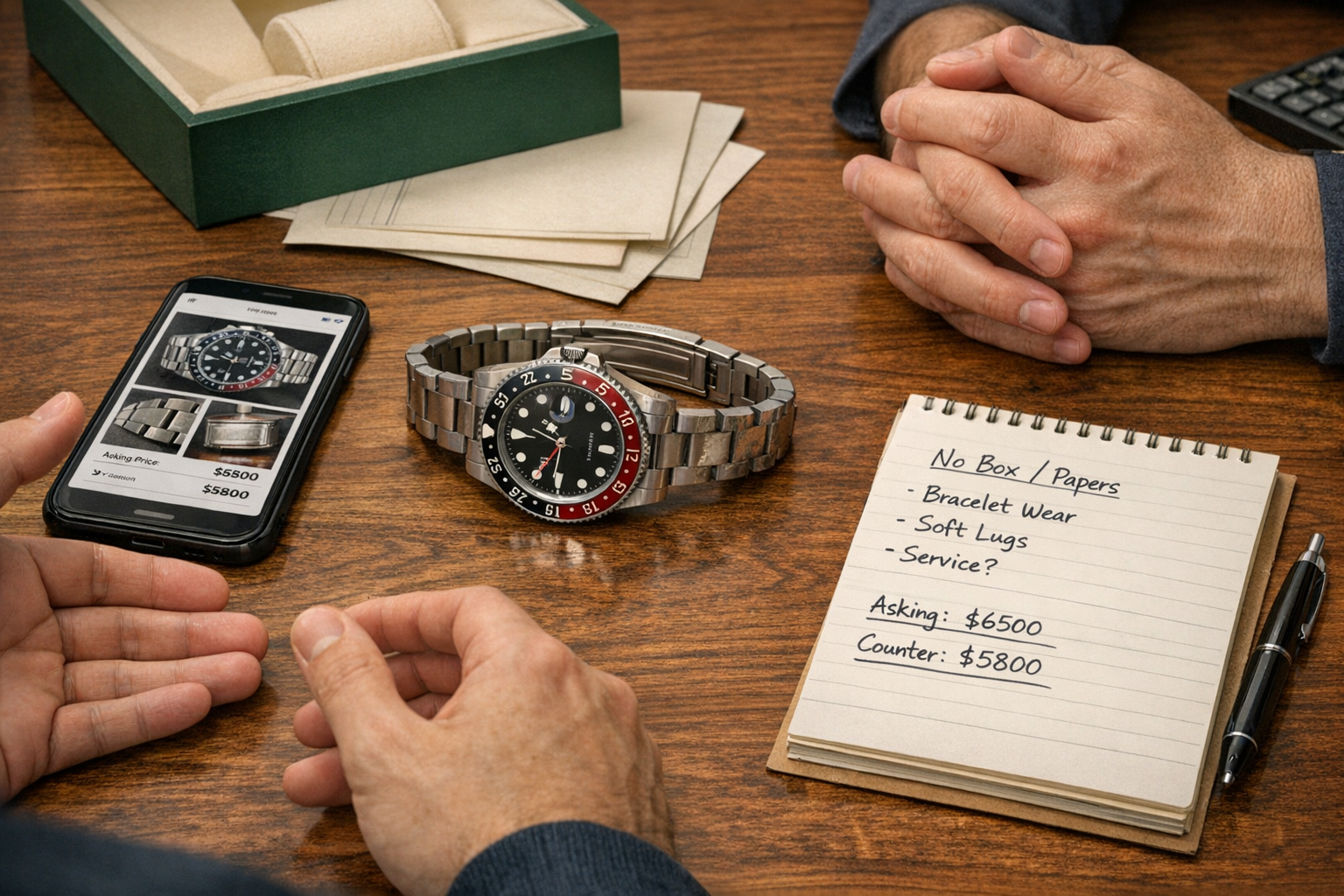
Negotiating the price of a used watch is not really about being aggressive.
It is about being accurate.
A lot of buyers get this wrong in one of two ways. Some are too timid and pay full ask even when the watch clearly has condition or service risk that justifies a lower number. Others go too hard, too early, and turn a workable deal into an awkward dead end.
Both mistakes cost money.
Here is the honest short answer:
The best way to negotiate a used watch is to stay calm, use real condition-based reasons, and make the seller feel you are serious—not annoying.
That is the difference between a discount and a blocked message thread.
The goal is not to “win” the conversation.
The goal is to buy the right watch at a fairer number without damaging trust.
Who this guide is for
This article is for you if:
- you are buying a used watch from a private seller or dealer,
- you found a watch you like but think the asking price is a little high,
- you want to negotiate without sounding cheap,
- or you need a practical framework for making an offer that has a real chance of being accepted.
If you are still earlier in the buying process, start with Should You Buy a Used Luxury Watch Online? 12 Checks Before You Pay and How to Check a Used Watch in Person: 15 Things to Inspect Before You Buy. Negotiation works much better when you already know what you are actually looking at.
The short answer
A used watch negotiation usually goes well when you:
- know the market before messaging,
- identify real reasons for a lower price,
- make one clean offer instead of endless little pushes,
- stay respectful,
- and show that you are ready to buy if the numbers make sense.
A used watch negotiation usually goes badly when you:
- lowball for no reason,
- argue emotionally,
- point out fake “issues” the seller can see through,
- ask for the best price before doing any inspection,
- or keep pushing after the seller has already been reasonable.
In simple terms:
Good negotiation feels like problem-solving. Bad negotiation feels like performance.
The first rule: do not negotiate before you know what you are buying
A surprising number of buyers try to negotiate too early.
They see a listing, decide the price feels high, and immediately send:
What’s your best price?
This is one of the weakest negotiation messages you can send.
Why?
Because it tells the seller three things:
- you may not have done your homework,
- you want them to negotiate against themselves,
- and you have not yet explained why the watch should be cheaper.
A serious seller is much more likely to respond well when you sound informed.
That means you should know:
- the approximate market range,
- whether the watch is full set or watch-only,
- how condition compares to similar listings,
- whether polishing affects value,
- and what likely service risk still exists.
That is why articles like How to Tell If a Watch Is Overpolished Before You Buy and Should You Polish a Watch? Scratch Reality, Resale Value & Better Alternatives matter even in a pricing conversation. Condition is not just cosmetic. It is leverage.
What sellers actually respond to
Most sellers are not offended by negotiation.
They are offended by lazy negotiation.
A reasonable seller usually understands that used-watch pricing has some room, especially when the watch has visible wear, missing accessories, weak service history, or uncertain water-resistance status.
What they usually want is simple:
- a buyer who sounds real,
- a price discussion grounded in actual facts,
- and a path to closing the deal without wasting time.
That means your negotiation should sound like this:
I like the watch, I understand what it is, I see a few things that affect value, and I can move quickly if we can land on a fair number.
That tone works.
This tone does not:
Too high. I can pay 30% less today.
One sounds like a buyer.
The other sounds like a problem.
A real-world example
Let’s say you find a used GMT watch listed at a strong number.
At first glance, it looks attractive. But after a closer look, you notice:
- the lugs are softer than ideal,
- the clasp has more wear than the seller emphasized,
- the seller cannot document the last service,
- and the watch has not been recently pressure-tested.
Now compare two buyers.
Buyer A says:
Best price?
Buyer B says:
I like the watch and I’m seriously interested. From the photos and your description, I do see some case softening and a bit more clasp wear than I expected, and the unknown service history means I’d need to budget for that after purchase. If you’d consider X, I’d be ready to move quickly.
Buyer B has a much better chance.
Not because the offer is magically lower.
Because the seller can see the reasoning.
That is what good negotiation looks like.
Step 1: Build your price argument before you make the offer
Before you negotiate, write down the real factors affecting value.
These usually fall into a few categories.
1. Condition
- overpolishing,
- bracelet stretch,
- crystal damage,
- bezel wear,
- clasp wear,
- soft crown action,
- weak strap condition,
- or obvious cosmetic mismatch between photos and reality.
2. Completeness
- no box,
- no papers,
- missing links,
- replaced strap,
- missing accessories,
- unclear history.
3. Service risk
- unknown last service,
- no timing information,
- no pressure test,
- complication function uncertainty,
- or generally vague mechanical history.
4. Market positioning
- seller is asking at the top of the range,
- but the watch is not top-of-range condition.
These are real reasons.
They are much stronger than “I just want it cheaper.”
If you need to judge whether future costs matter, How Much Does Watch Servicing Cost? Mechanical vs Quartz vs Chronograph vs GMT should be part of your thinking before you make an offer.
Step 2: Know the difference between fair negotiation and lowballing
Not every offer below ask is a lowball.
A lower offer becomes a lowball when it ignores reality.
For example:
- asking 5–10% below ask on a normally priced used watch can be perfectly reasonable,
- asking meaningfully lower on a watch with service or condition issues can also be reasonable,
- but throwing out a number far below market with no justification usually just wastes everybody’s time.
A simple rule
If your number only makes sense in your own head, it is probably too low.
If your number can be explained clearly using condition, missing items, and service risk, it is probably at least worth asking.
Good negotiation is not about shocking the seller.
It is about making acceptance easier.
Step 3: Never start with “What’s your best price?”
This deserves its own section because it is so common.
Most serious sellers dislike that question because it does all the work for the buyer and none of the work for the offer.
It also creates a weak dynamic:
- the buyer stays vague,
- the seller is asked to negotiate alone,
- and there is no real signal that the buyer understands the watch.
A better opener is:
I’m seriously interested. Based on the condition and the unknown service history, would you consider X?
That is much better.
It gives:
- seriousness,
- a reason,
- and a number.
All three matter.
Step 4: Use one clean offer, not a drip-feed of tiny pushes
One of the fastest ways to lose a deal is to negotiate like this:
- first ask for a lower price,
- then ask for free shipping,
- then ask for extra links,
- then ask for a strap,
- then ask for another small reduction,
- then ask for a faster decision.
This makes even a fair buyer feel exhausting.
A cleaner approach is:
If we can do X including shipping and the extra link, I’m ready to pay today.
That works better because it feels final, not slippery.
Sellers do not only respond to numbers.
They respond to how easy or difficult the buyer seems likely to be.
Step 5: Make the seller feel the deal can actually close
A lot of sellers get negotiation fatigue.
They have already dealt with:
- message collectors,
- fake buyers,
- endless “interested” people,
- and people who negotiate hard and then disappear.
So if you want the best result, make it clear that you are a real buyer.
That means phrases like:
- “I’m ready to move today if we can make the number work.”
- “I’m not shopping ten other watches right now—I’m focused on this one.”
- “If we agree on the price, I can pay right away.”
These phrases matter because they reduce seller uncertainty.
Sometimes a seller will accept a slightly lower number from a buyer who feels real, calm, and easy to close—rather than hold out for full ask from someone who feels unreliable.
Step 6: Negotiate with condition, not insult
This is one of the biggest mindset shifts in used-watch buying.
You are not negotiating by proving the seller is wrong.
You are negotiating by showing that the watch is worth a little less to you because of identifiable factors.
So instead of saying:
This case is wrecked.
Say:
I do see some softness on the lugs and more clasp wear than I’d expect at this price point.
Instead of saying:
This watch definitely needs service.
Say:
With no recent service documentation, I’d need to budget for that possibility on my side.
One sounds confrontational.
The other sounds grounded.
Grounded gets further.
If you need sharper eyes before having those conversations, How to Check a Used Watch in Person: 15 Things to Inspect Before You Buy is the practical inspection companion.
The best reasons to negotiate a used watch price
Not every imperfection deserves a lower price. These usually do.
1. Unknown service history
This is one of the strongest negotiation points because it has real financial consequences.
2. Overpolishing or softened case lines
Many sellers know this matters, especially if they are dealing with informed buyers.
3. Missing box, papers, or links
This does not automatically kill a deal, but it should affect value.
4. Bracelet wear or clasp fatigue
These can materially affect ownership cost and buyer confidence.
5. Unverified water resistance
Especially important on dive or sports watches. If a used watch has not been pressure-tested recently, that uncertainty is real. Watch Water Resistance Test: What a Pressure Test Checks (and How Often to Do It) and Can You Swim With a Watch? Pool vs Ocean Water Risks Explained explain why that matters after purchase.
6. Complication risk
If the watch has a chronograph, GMT, moonphase, or calendar setup and the history is vague, your risk is higher than with a simpler three-hand watch.
That is why complication knowledge matters in price discussions too:
- Chronograph Explained: How to Use It (Plus 10 Common Mistakes to Avoid)
- GMT Watch Explained: How to Set & Use a GMT Hand (2nd & 3rd Time Zone Guide)
- Moonphase Setting Guide: How to Set a Moonphase Watch Safely (Avoid Common Damage)
The worst reasons to negotiate
These usually weaken your position.
1. “I only have this much.”
That may be true, but it is not the seller’s pricing problem.
2. “I saw one cheaper once.”
Unless you can explain the condition comparison, this usually sounds vague.
3. “Cash today.”
Cash is not a magic bargaining tool unless it genuinely makes the transaction easier and safer for the seller.
4. “It’s been listed for a while.”
Sometimes that helps. Often sellers already know and do not care.
5. “I just always negotiate.”
That tells the seller nothing useful.
In-person negotiation vs online negotiation
The tone changes depending on where the deal is happening.
Online negotiation
Online, clarity matters most.
Keep it clean:
- state interest,
- identify the value gap,
- make one reasoned offer,
- and avoid endless message loops.
In-person negotiation
In person, you have a major advantage: the watch is in front of both of you.
That means your negotiation can be more precise.
For example:
I do like it, but now that I’ve seen it in person, I think the case has a bit more polish than I expected, and I’d need to assume service risk from here. If you’d take X, I’d be comfortable doing the deal.
That is much stronger in person because it is anchored to shared reality.
It also pairs naturally with the kind of checklist in How to Check a Used Watch in Person: 15 Things to Inspect Before You Buy.
A simple negotiation script that actually works
Here is a practical version you can use and adapt.
Online
Hi, I’m seriously interested in the watch. I like the overall condition, but with the missing links and no recent service history, I’d need to budget for a bit of work after purchase. If you’d consider X, I’d be ready to move forward today.
In person
Thanks for meeting. I do like the watch, but seeing it in person, I think the clasp wear and case softness put it a little above where I’d be comfortable at full ask. If you could do X, I’d be happy to close the deal now.
Both versions work because they are:
- direct,
- respectful,
- and tied to observable facts.
How much should you ask off?
There is no universal answer, but there is a useful way to think about it.
Ask for an amount that reflects:
- condition reality,
- likely near-term ownership cost,
- and the actual room between this watch and stronger examples on the market.
Not:
- your dream number,
- your budget gap,
- or your hope that the seller is desperate.
A better rule
Make an offer that would still sound fair if the seller showed it to another informed watch buyer.
If it would look embarrassing in that context, it is probably too low.
When to stop negotiating
This is one of the most underrated buyer skills.
Sometimes the seller says no, gives a modest counter, and that is the deal.
If the counter is fair and the watch is right, stop trying to squeeze every last bit out of it.
Why?
Because there is a hidden cost to over-negotiating:
- you create tension,
- you increase the chance the seller sells to someone else,
- and you sometimes lose a good watch over a relatively small amount.
There is a difference between negotiating well and negotiating compulsively.
Smart buyers know where that line is.
When to walk away
Walking away is part of good negotiation too.
Walk away if:
- the seller becomes evasive when you raise real condition issues,
- the watch is worse than described and the seller refuses to acknowledge it,
- the price stays strong despite obvious value gaps,
- the story keeps changing,
- or the whole interaction starts feeling defensive, rushed, or slippery.
Sometimes the best deal is the one you do not force.
There will always be another watch.
That mindset alone makes you a better negotiator.
A practical case study
Let’s say a used sports watch is listed at a firm number.
You inspect it and find:
- watch-only, no papers,
- visible clasp wear,
- soft-ish lug edges,
- no confirmed recent pressure test,
- and the seller says it “runs fine” but has no actual timing data.
You do not say:
This is overpriced.
You say:
I do like the watch, but with it being watch-only, the visible clasp wear, and the unknown service and pressure-test history, I’d need to account for that on my side. If you’d take X, I’d be happy to move ahead.
That is a serious offer.
It gives the seller a real choice:
- reject,
- counter,
- or accept.
And that is all good negotiation needs to do.
The 5 biggest negotiation mistakes buyers make
1. Asking for the best price too early
This is lazy and easy to ignore.
2. Lowballing without evidence
You may save time by being bold, but you often lose the deal before it starts.
3. Confusing politeness with weakness
You can be respectful and still negotiate firmly.
4. Talking too much
Long emotional explanations often weaken your leverage. Clean reasoning works better.
5. Forgetting that the watch still has to be worth buying
Do not negotiate so hard that you convince yourself to buy a watch you were uncertain about in the first place.
A 7-step negotiation framework
Here is the simplest usable system.
Step 1
Know the market range first.
Step 2
Identify the real value gaps in this specific watch.
Step 3
Decide your actual buy number before messaging.
Step 4
Make one clean, respectful offer with reasons.
Step 5
Signal that you are ready to close if the seller agrees.
Step 6
If the seller counters reasonably, decide quickly.
Step 7
If the seller refuses and the deal no longer makes sense, walk away calmly.
That is enough to handle most used-watch negotiations well.
Bottom line
Negotiating the price of a used watch is not about pressure.
It is about credibility.
The buyers who get the best deals are usually not the loudest or the most aggressive. They are the ones who understand condition, know the market, communicate clearly, and make sellers feel that a fair agreement can happen smoothly.
So do not ask for discounts just to ask.
Do not lowball for sport.
Do not overpush a seller who has already come down fairly.
Use real reasons.
Make one strong offer.
Stay calm enough to walk away if needed.
That is how you negotiate without losing the deal.
FAQ
Is it rude to negotiate the price of a used watch?
No. In most used-watch transactions, polite negotiation is normal. The problem is not negotiating—it is negotiating badly.
How much below asking price should I offer?
There is no fixed number. Your offer should reflect condition, completeness, service risk, and how the watch compares with similar listings.
Should I ask “What’s your best price?”
Usually no. A reasoned offer works better than asking the seller to negotiate against themselves.
What is the strongest negotiation point on a used watch?
Unknown service history is often one of the strongest, especially when combined with visible wear or missing accessories.
Should I negotiate differently in person than online?
Yes. In person, you can use what you are physically seeing and feeling. Online, you need to rely more on photos, description, and documented condition.
When should I stop negotiating?
When the seller has already countered fairly and the watch still makes sense, or when pushing further risks losing a good deal over a relatively small difference.