How to Check a Used Watch in Person: 15 Things to Inspect Before You Buy
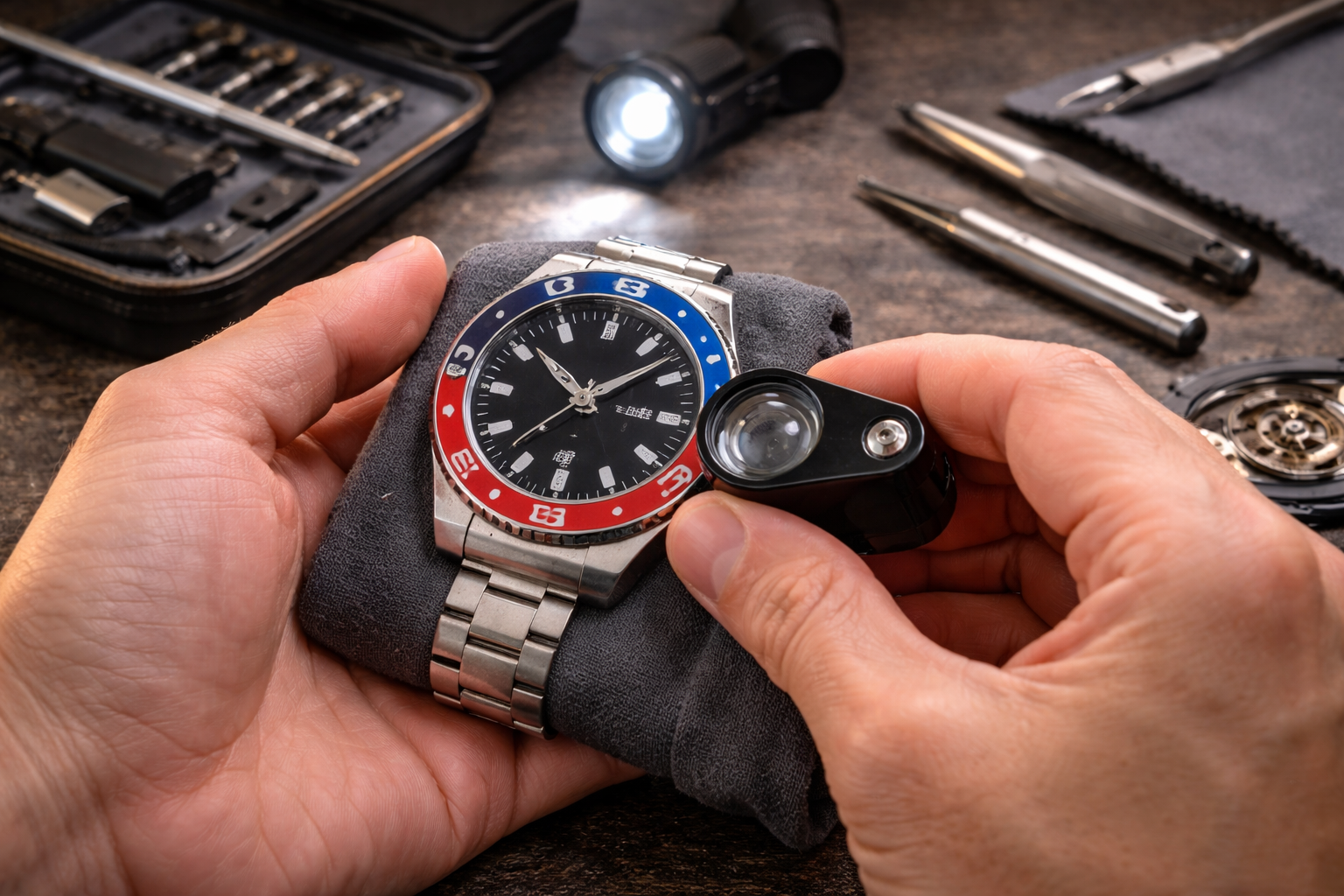
Seeing a used watch in person is better than buying from photos.
But it is only better if you actually know what to look at.
A surprising number of buyers make the same mistake: they meet the seller, feel relieved that the watch is “real,” and then let the whole inspection become emotional instead of useful. The dial looks good, the watch feels substantial, the seller seems friendly, and suddenly the decision is happening before the inspection is finished.
That is how people miss the expensive details.
A used watch does not need to be perfect to be a good buy. It just needs to be honestly represented, mechanically believable, and fairly priced for what it is.
So here is the short answer:
When checking a used watch in person, do not focus only on whether it looks nice. Focus on shape, function, wear pattern, fit, and whether the condition matches the asking price.
This guide gives you a practical 15-point checklist you can use before handing over money.
Who this guide is for
This article is for you if:
- you are meeting a seller face to face,
- you found a used watch locally and want to inspect it properly,
- you are buying from a private seller, dealer, or marketplace meetup,
- or you want a simple in-person checklist that goes beyond “does it look real?”
If you are still in the earlier research stage, Should You Buy a Used Luxury Watch Online? 12 Checks Before You Pay is the better first read. This article begins where that one leaves off: when the watch is now physically in front of you.
The short answer
A used watch is more likely to be a good buy if:
- the case still looks sharp,
- the functions operate correctly,
- the bracelet or strap condition makes sense,
- the wear looks honest rather than hidden,
- and the seller’s story matches the watch in your hand.
A used watch is more likely to be a bad buy if:
- the photos looked better than the real thing,
- the watch feels “off” in small ways the seller cannot explain,
- the case has lost shape from polishing,
- the movement behavior seems vague or inconsistent,
- or you feel rushed into deciding.
In plain English:
Slow inspection beats fast excitement.
Before you even start: control the setting
The first inspection mistake usually happens before you touch the watch.
If possible, check the watch in:
- natural light,
- a calm setting,
- with enough time to look closely,
- and without social pressure from the seller.
Avoid making the whole decision under dim indoor lighting, at a busy café table, or in a rushed parking-lot handoff where you feel awkward asking questions.
A serious seller with nothing to hide should be comfortable with a serious inspection.
What to bring
Bring:
- your phone flashlight,
- a microfiber cloth,
- reading glasses if you need them,
- and enough confidence to slow the process down.
A loupe is helpful, but not essential. Calm attention matters more.
The 15 things to inspect before you buy
1. Check the overall shape before the details
Before you zoom in, take one full look at the watch as a whole.
Ask yourself:
- Does the case look sharp or soft?
- Does the watch feel balanced?
- Does anything look oddly polished, uneven, or tired?
This first impression matters because overworked watches often look wrong before you can explain exactly why.
If you already know how much case shape matters, How to Tell If a Watch Is Overpolished Before You Buy is the perfect companion here.
What you want
A watch that looks coherent. Honest wear is fine. Soft geometry is not.
2. Inspect the lugs carefully
Lugs reveal a lot.
Look at:
- lug thickness,
- outer edges,
- symmetry,
- and whether the tips still look crisp.
Rounded, swollen, or uneven lugs often point to overpolishing or rough refinishing.
A scratched lug is usually less worrying than a soft one.
Practical move
Hold the watch at eye level and rotate it slowly under side light. Sharp edges show themselves. So do softened ones.
3. Look at the brushing and polished surfaces separately
Used watches often hide problems in the transitions.
Check whether:
- brushed surfaces still look straight and deliberate,
- polished surfaces look clean without washing into other areas,
- and the border between finishing styles still makes sense.
Poor refinishing often shows up as muddy transitions, uneven brushing, or surfaces that look too glossy in the wrong places.
That matters more than many buyers realize.
4. Check the bezel for wear, alignment, and edge condition
The bezel tells you a lot about use history.
Inspect:
- scratches,
- chips,
- faded inserts,
- looseness,
- alignment,
- and on dive or tool bezels, the condition of the teeth or grip edge.
A bezel that is visually clean but feels mechanically sloppy is not the same as a bezel that has honest marks but still works properly.
If it rotates
Test it.
You want to feel:
- clean clicks if the watch is supposed to have them,
- no excessive wobble,
- and alignment that does not look obviously off.
5. Check the crystal from multiple angles
Do not just glance at the crystal head-on.
Tilt it.
Look for:
- chips near the edge,
- deep scratches,
- cloudy spots,
- heavy anti-reflective coating wear,
- and whether marks are on the crystal or just on the coating.
This is one place where buyers often overreact or misread what they see. AR Coating Explained: Why Your Watch Crystal Looks Scratched (But Isn’t) and Sapphire vs Mineral vs Acrylic Watch Crystal: Pros, Cons & Scratch Reality help you sort that out before you buy.
Practical move
Use side light, not only overhead light. Edge damage often shows up better that way.
6. Examine the dial without letting it hypnotize you
This is where buyers often get emotionally trapped.
The dial is attractive. It pulls your attention. And while you are admiring it, you can miss the condition issues around it.
Still, the dial matters.
Check for:
- uneven lume aging if relevant,
- dust or marks under the crystal,
- hand alignment,
- printing quality,
- and whether the dial condition matches the rest of the watch.
Sometimes the dial is great and the rest is tired. Sometimes the opposite is true. Neither is automatically wrong, but both affect value.
What should make you pause
A dial that seems much fresher than everything around it may raise originality questions, depending on the watch.
7. Test the crown feel
The crown is one of the most useful “touch checks” on a used watch.
Operate it slowly.
You are looking for:
- normal resistance,
- clean threading on screw-down crowns,
- smooth engagement,
- and no gritty, rough, or uncertain feeling.
A crown that feels tired, cross-threaded, too loose, or awkward to screw down deserves attention.
That is especially important if the watch is sold as a water-capable daily piece. Screw-Down Crown Mistakes: The Fastest Way People Ruin Water Resistance and Watch Water Resistance Test: What a Pressure Test Checks (and How Often to Do It) give the right ownership context here.
8. Set the time and feel the keyless works
This is one of the most important in-person checks because photos cannot do it for you.
Pull the crown gently through its positions and test:
- hand-setting feel,
- date-setting if applicable,
- whether the crown positions feel positive,
- and whether there is any odd looseness, grinding, or hesitation.
A watch can look excellent and still feel mechanically vague when you operate it.
That matters.
Practical rule
You are not expecting the feel of a lab instrument. But you also should not accept something that feels sloppy for the price.
9. Test every complication, not just the time
If the watch has additional functions, use them.
That includes:
- chronograph pushers,
- date change,
- day-date quickset,
- GMT hand adjustment,
- moonphase setting,
- or calendar operation.
Do not let “it works fine” replace your own test.
Related guides that help you know what correct behavior should feel like:
- Chronograph Explained: How to Use It (Plus 10 Common Mistakes to Avoid)
- GMT Watch Explained: How to Set & Use a GMT Hand (2nd & 3rd Time Zone Guide)
- Day-Date & Triple Calendar Setting Guide: Safe Order, Danger Zone & Common Mistakes
- Moonphase Setting Guide: How to Set a Moonphase Watch Safely (Avoid Common Damage)
What you want
Complications that operate cleanly and predictably, not reluctantly.
10. Listen to the watch and observe the seconds hand
This is not about pretending to be a watchmaker. It is about noticing obvious weirdness.
Listen for:
- unusual grinding,
- rotor noise that seems excessive,
- strange rattling,
- or anything that feels looser than it should.
Watch the seconds hand too.
Does it move normally for the movement type?
Does anything seem erratic or visually strange?
This will not tell you everything. But it may tell you enough to stop before making a bad decision.
11. Check bracelet stretch, clasp quality, and actual wear
Bracelet condition can change the value of a used watch fast.
Look at:
- stretch or sag,
- clasp wear,
- looseness,
- sharp edges,
- overbrushing,
- and whether the bracelet feels solid or tired.
Then check whether the number of links included actually works for your wrist.
A lot of buyers focus on the watch head and forget that bracelet replacement or sourcing original links can be expensive and annoying.
If bracelet comfort matters to you, Watch Bracelet Sizing Guide: How Tight Should It Be? (Comfort, Fit Tests & Fixes) helps you think about this before money changes hands.
12. Put the watch on your wrist
This sounds obvious, but some buyers skip it or do it too late.
Wear the watch.
Check:
- visual fit,
- lug overhang,
- thickness feel,
- clasp comfort,
- crown bite,
- and whether the watch feels like the size you imagined from photos.
A watch can be authentic, well-priced, and still wrong for you.
That is why Watch Size Guide: Case Diameter, Lug-to-Lug & Thickness (How to Choose the Perfect Fit) matters even in the used-buying conversation.
Real-world truth
Many “great deals” become bad buys simply because the watch never truly fit the buyer’s wrist or style.
13. Ask about service history while the watch is in your hand
This is the best moment to ask better questions because you can compare the answers against what you are physically seeing.
Ask:
- When was it last serviced?
- By whom?
- What was done?
- Has anything been replaced?
- Has it been polished?
- Has it been pressure-tested recently?
The physical watch often tells you whether the answers feel believable.
For example:
- a “freshly serviced” watch with tired crown feel,
- a “never polished” watch with obviously soft lugs,
- or a “water-ready” watch with vague crown action should all slow you down.
If you need the ownership-cost side of that thinking, How Much Does Watch Servicing Cost? Mechanical vs Quartz vs Chronograph vs GMT belongs next in the chain.
14. Treat water resistance as unproven unless recently tested
This is one of the biggest mistakes in used-watch buying.
Do not assume:
- the original rating still means anything,
- the seller’s confidence equals testing,
- or the watch is “fine in water” just because it looks sealed.
On a used watch, water resistance should be treated as unknown unless there is a recent, credible test behind it.
Practical move
If you buy the watch, pressure-test it before wearing it around water.
That is especially important if the watch is meant to be a daily piece around sinks, rain, or poolside use. Is It OK to Wear a Watch in the Rain? What’s Safe & What to Check First and Can You Swim With a Watch? Pool vs Ocean Water Risks Explained fit naturally after purchase.
15. Decide whether the condition and the price still match
This is the final check, and it is the one buyers most often skip because they are tired by this point.
Now ask the simple question:
Given what I actually saw, is this still the right price?
Not:
- “Do I still want it?”
- “Can I imagine owning it?”
- “Will I regret missing it?”
Just:
Does the real watch still justify the money?
That is the grown-up decision.
A watch with:
- honest wear,
- working functions,
- sharp enough shape,
- believable history,
- and a fair discount for imperfections
can be a great buy.
A watch that looked strong online but is softer, looser, more worn, or more uncertain in person may still be buyable — just not at the same price.
A practical in-person buying example
Let’s say you meet a seller for a used GMT watch.
At first glance, it looks good. The bezel color pops. The dial is clean. The bracelet has enough links. You could easily stop there.
But you slow down and inspect properly.
You notice:
- the lugs are softer than expected,
- the clasp has more wear than the listing suggested,
- the GMT hand works, but the crown feel is not as clean as you hoped,
- and the seller says it was “serviced recently” but cannot say by whom.
Is it automatically a bad watch?
No.
But it is no longer a “full ask, easy yes” watch.
That is the value of inspecting in person: not to prove every watch is bad, but to replace emotion with leverage and clarity.
The 5 biggest mistakes buyers make in person
1. Being too polite to inspect properly
You are not being rude. You are buying a used watch.
2. Letting the dial distract from the case
Beautiful dials sell watches. Soft cases create regret.
3. Skipping functional checks
A complication you did not test is a complication you do not really know.
4. Confusing “real” with “good”
Seeing the watch in person confirms it exists. It does not confirm it is a good buy.
5. Making the decision too early
Do not decide emotionally in the first minute and spend the next ten minutes just justifying it.
A simple 10-minute inspection routine
If you want the fastest usable framework, use this:
Minute 1
Look at the overall case shape.
Minute 2
Inspect lugs, bezel, and crystal.
Minute 3
Check dial, hands, and visual consistency.
Minute 4
Operate the crown and set the time.
Minute 5
Test all complications.
Minute 6
Inspect bracelet, clasp, and links.
Minute 7
Put it on your wrist.
Minute 8
Ask about service, polishing, and pressure testing.
Minute 9
Compare the answers to what you observed.
Minute 10
Decide whether the watch still fits the price.
That is enough to avoid many bad in-person buys.
Bottom line
Checking a used watch in person is not about proving the watch is perfect.
It is about answering three simple questions:
- Is the condition honest?
- Do the functions and feel make sense?
- Does the real watch still justify the price?
If the answer to all three is yes, you may have a very good buy.
If the answer starts turning into “mostly,” “probably,” or “I guess,” slow down. There will always be another watch.
A good in-person inspection does not make you negative.
It makes you accurate.
And accuracy is much cheaper than regret.
FAQ
Is buying a used watch in person safer than buying online?
Usually yes, because you can inspect condition, fit, and function directly. But it is only safer if you actually take the time to inspect properly.
What is the most important thing to check first?
Overall case shape. A watch with honest wear can still be great. A badly softened case is much harder to fix.
Should I test every function before buying?
Yes. Time-setting alone is not enough on a complication watch.
How do I know if the watch was overpolished?
Look at the lugs, chamfers, bezel edges, and finishing transitions. Soft geometry is the biggest clue.
Should I trust the original water-resistance rating on a used watch?
No. Treat water resistance as unverified unless it has been recently pressure-tested.
Can a used watch still be a good buy without service records?
Yes, sometimes. But the price should reflect that uncertainty, and your inspection should become more careful.