How Often Should You Pressure Test a Watch? A Simple Schedule by Watch Type
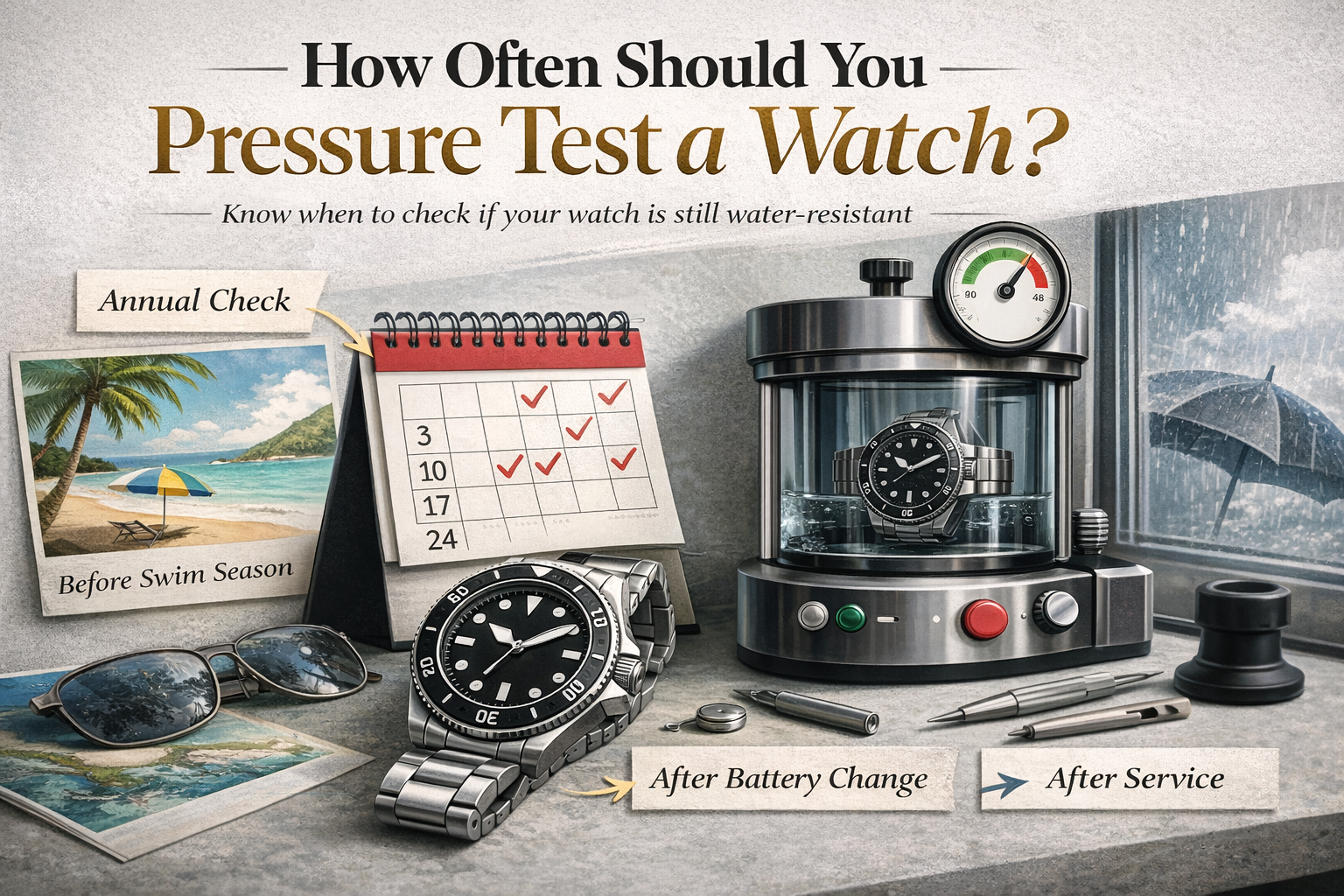
Most watch owners do not pressure test their watches often enough.
Not because they are careless. Usually because no one ever gave them a simple, realistic schedule.
They hear things like:
- “Only test it if there’s a problem.”
- “It’s a dive watch, so it’s probably fine.”
- “It was rated 100m when I bought it.”
- “I never go diving, so I don’t need to think about it.”
That is how people end up trusting water resistance that has not been checked in years.
Here is the honest short answer:
If a watch is worn around water regularly, it should be pressure tested on a schedule—not only after a problem shows up.
Because by the time fogging, moisture, or failure becomes visible, you are no longer doing preventive care. You are doing damage control.
The right test schedule depends on:
- the type of watch,
- how often you expose it to water,
- whether the case has been opened,
- and how much you actually rely on its water resistance in daily life.
That is what this guide is here to simplify.
Who this guide is for
This article is for you if:
- you wear a watch in rain, around sinks, near pools, or during travel,
- you own a sports or dive watch and are not sure how often it should be checked,
- you recently had a battery change or service,
- or you want a practical maintenance schedule instead of vague advice.
If you need the foundational explanation of what a pressure test actually does, start with Watch Water Resistance Test: What a Pressure Test Checks (and How Often to Do It). This article answers the more practical question:
How often should you actually do it?
The short answer
Here is the simple version:
- Everyday water-exposed watches: test about once a year.
- Watches used for swimming or regular water activity: test at least once a year, and sooner if anything changes.
- After battery change, service, crystal work, or case opening: test immediately or as part of the same service.
- Dry-use dress watches: testing can be less frequent, but becomes important again any time the case is opened or the owner expects splash resistance.
- Vintage watches: test only if you genuinely plan to rely on water resistance, but most vintage owners are better off keeping them dry.
In plain English:
The more you rely on water resistance, the more regularly you should verify it.
Why testing on a schedule matters
Water resistance is not a lifetime feature.
It is not something a watch receives once at the factory and then keeps forever without question.
Gaskets age.
Crowns wear.
Casebacks get opened.
Heat, salt, chlorine, and normal use all matter.
And even a watch that “looks fine” can lose sealing performance quietly.
That is why waiting for a visible symptom is the wrong strategy.
By the time you see:
- fogging,
- condensation,
- or visible moisture,
the watch has already crossed out of prevention and into problem territory.
That is where What Happens If Water Gets Inside Your Watch? What To Do Immediately, Water Got Inside Your Watch? What to Do Immediately (First 30 Minutes), and Why Is My Watch Fogging Under the Crystal? Causes & Fixes (What to Do Now) become urgent.
A scheduled pressure test is meant to help you avoid that moment.
A real-world example
Let’s say two people own similar 100m-rated sports watches.
Owner A wears the watch constantly:
- in rain,
- while washing hands,
- on summer trips,
- and occasionally in the pool.
They assume the rating is enough and never test it after buying it.
Owner B uses the watch the same way, but pressure tests it yearly and again after a battery change.
Three years later, one of those owners has confidence based on recent evidence. The other has confidence based on memory.
Those are not the same thing.
The second owner is not “paranoid.”
They are simply treating water resistance as a maintenance issue instead of a printed promise.
That is the better mindset.
The single best rule to remember
If you only remember one thing from this article, make it this:
Pressure-test a watch based on how much you trust it around water now—not based only on what the dial or caseback once said.
That one shift in thinking solves a lot of bad habits.
A simple pressure-test schedule by watch type
Here is the most practical schedule.
1. Daily-wear sports watch
If you wear a sports watch in ordinary life around:
- sinks,
- rain,
- humidity,
- commuting,
- and occasional wet conditions,
test it about once a year.
Why yearly?
Because these watches often see just enough water exposure to make testing worthwhile, but not always enough obvious stress to remind the owner that seals are still aging.
This category includes many of the watches people casually trust every day.
If that sounds like you, Can You Wash Your Hands With a Watch On? What’s Safe & What’s Not and Is It OK to Wear a Watch in the Rain? What’s Safe & What to Check First are directly relevant.
2. Swim-capable or pool-use watch
If you swim with the watch or expect to:
- take it into pools,
- wear it on beach trips,
- or rely on it during vacations,
test it at least once a year, and definitely before heavy-use seasons.
If the watch sat all winter and you are about to take it on a summer beach trip, testing before the season makes a lot of sense.
That becomes even more important once you consider articles like Can You Swim With a Watch? Pool vs Ocean Water Risks Explained, Does Chlorine Damage Watches? What Pool Water Really Does, and Does Salt Water Damage Watches? Ocean Exposure Explained.
3. Dive watch used as an actual water tool
If the watch is regularly exposed to meaningful water use and you genuinely depend on its seal integrity,
yearly testing is the minimum, not the ideal.
And any sign of crown issue, case opening, or hard impact should trigger earlier testing.
The more serious the use, the less sensible it becomes to “just assume” everything is still good.
4. Quartz watch after battery changes
For quartz watches, the schedule is not just calendar-based. It is also event-based.
Pressure test after every battery change if you still rely on the watch’s water resistance.
That matters because the case was opened. Once the case is opened, the relevant question becomes not “how old is the watch?” but “has the sealing system been verified again?”
5. Mechanical watch after service
If the watch has gone in for service and you expect to keep wearing it around water,
pressure test it immediately after service or confirm that the service included testing.
Then return to a yearly schedule if water exposure is part of ownership.
6. Dress watch with little or no water exposure
If the watch is mostly worn:
- indoors,
- in dry conditions,
- and away from water,
you may not need yearly testing in the same way you would for a sports watch.
But if the case gets opened, or if you still expect the watch to handle everyday splash exposure, testing becomes relevant again.
The key question is not whether the watch looks dressy.
It is whether you still expect it to survive real-life moisture.
7. Vintage watch
This is a different category entirely.
For most vintage owners, the safer rule is:
- assume caution,
- avoid relying on water resistance casually,
- and test only if you genuinely intend to treat the watch as water-capable.
In many cases, the smarter answer is not “test more often.”
It is “keep it dry.”
A simple pressure-test schedule by how you use the watch
This is often even more useful than thinking by watch category alone.
Light-use owner
You wear the watch mostly indoors, avoid water, and rarely expose it to weather.
Pressure-test when:
- the case is opened,
- before any trip where you may rely on water resistance,
- or if something feels off.
Moderate-use owner
You wear the watch in rain, around sinks, and through normal daily life.
Pressure-test:
- about once a year,
- plus after any battery change or service.
Heavy-use owner
You swim with the watch, travel with it, use it in hot climates, or expose it to regular water activity.
Pressure-test:
- at least yearly,
- before high-water-use travel or season changes,
- and after any case opening, impact, or crown concern.
That is the simplest usable framework for most real owners.
The 5 events that should trigger a pressure test immediately
This is where schedules become secondary. Some events matter more than the calendar.
1. Battery change
If the case was opened, testing becomes smart immediately.
2. Full service or partial repair
Especially if anything related to the case, crown, crystal, or seals was touched.
3. Crystal replacement
The crystal is part of the sealing system. If it was changed, test.
4. Crown or pusher issue
If something feels wrong, do not wait for the yearly test.
5. Any sign of condensation or moisture history
At that point, this is no longer routine maintenance. It is priority maintenance.
Why owners often wait too long
Most people do not ignore pressure testing because they are reckless.
They wait too long because:
- the watch still looks fine,
- it has not failed yet,
- the rating on paper feels reassuring,
- and water-related problems often stay invisible until they are suddenly not.
That is what makes water resistance tricky.
It can feel normal right up until it isn’t.
And unlike some watch issues, this one can get expensive quickly.
How the environment changes the testing schedule
Where and how you live matters more than most owners realize.
Hot and humid climate
If your watches live in humidity, heat, and frequent moisture exposure, the logic for regular testing gets stronger.
Pool and resort travel
If the watch goes on summer trips, testing before departure is often smarter than trusting memory.
Frequent rain and daily outdoor use
If the watch is regularly exposed to the weather, that is meaningful use, not “basically dry.”
Steam-heavy habits
Even if you do not swim, bad habits around showers and heat can complicate the story. Is It Safe to Wear a Watch in the Shower? The Truth About Water, Steam & Soap and Is It Safe to Wear a Watch in the Sauna or Hot Tub? Heat Damage Explained belong in this discussion for exactly that reason.
Yearly testing vs only after service: which is better?
For dry-use watches, event-based testing may be enough.
For water-relied-upon watches, yearly testing is better.
That is the simplest answer.
If the watch:
- gets opened rarely,
- lives a dry life,
- and is not trusted around water much,
then “after service and after case opening” may cover most of what matters.
But if the watch:
- is part of daily life,
- is trusted in wet conditions,
- or sees swimming and travel,
then waiting only until service intervals is often too passive.
That is why “only after service” is usually too weak a rule for real water-exposed ownership.
A practical yearly schedule most owners can actually follow
If you want something easy to remember, use this:
January to March
If you use the watch year-round in everyday wet conditions, schedule a yearly pressure test during the first quarter.
Before summer travel
If the watch is going near pools, beaches, or resort use, test before the trip.
After any battery change or service
Do not wait until the next yearly test. Treat that as a separate immediate trigger.
After any concern
If the crown feels wrong, the watch fogs, or the case was knocked hard, test early.
That is simple enough for most people to follow without overcomplicating ownership.
What not to do
There are a few very common bad habits here.
1. Rely on the original water-resistance rating for years without testing
That is trust based on age, not condition.
2. Assume a quick battery change means everything was restored properly
Not all battery changes are equal.
3. Wait until fogging happens
That is too late to call it preventive care.
4. Think “I don’t dive” means “I don’t need to test”
Most water problems begin far from diving.
5. Confuse “never had a problem” with “currently verified”
Those are completely different things.
A better way to think about pressure testing
Do not think of pressure testing as something only for divers, specialists, or paranoid enthusiasts.
Think of it as the water-resistance version of routine verification.
If you rely on the watch around water, testing is not dramatic.
It is just part of responsible ownership.
That mindset makes the whole subject easier.
A 6-step decision framework
If you want the shortest usable checklist, use this:
Step 1
Ask whether you wear the watch around real-life moisture.
Step 2
Ask whether the case has been opened recently.
Step 3
Ask whether you are about to increase water exposure, like summer or travel.
Step 4
If yes to any of those, move closer to testing—not farther away from it.
Step 5
If the watch is a dry-use dress watch, be more relaxed but still test after case opening.
Step 6
If the watch is vintage, assume caution first and water confidence second.
That framework covers most owners better than memorizing technical numbers.
Bottom line
There is no single perfect schedule for every watch.
But there is a simple rule that works for almost everyone:
Pressure-test a watch as often as you rely on its water resistance being true.
For most water-exposed daily watches, that means:
- about once a year,
- plus after battery change,
- plus after service,
- plus anytime something seems off.
For dry-use watches, you can be less aggressive.
For vintage watches, you should be more cautious.
For travel, swimming, and everyday wet use, testing matters more than most owners think.
That is the real answer.
Not “only when it fails.”
Not “the factory rating is enough.”
Not “it should still be fine.”
Just this:
If water resistance matters, verify it on a schedule.
FAQ
How often should I pressure test a sports watch?
About once a year if you wear it around everyday moisture or rely on its water resistance.
Should I pressure test after every battery change?
Yes, if you still expect the watch to handle water exposure.
Is yearly pressure testing really necessary?
For many water-exposed watches, yes. For dry-use watches, it may be less urgent unless the case has been opened.
Should I test before going on vacation?
Yes, especially if the watch will be worn near pools, beaches, or humid travel conditions.
What if I never swim with my watch?
You may still want yearly testing if you wear it in rain, around sinks, or in ordinary wet daily life.
Do vintage watches need pressure testing?
Only if you plan to rely on water resistance. Many vintage owners are better off avoiding water altogether.