Can You Trust a 10-Year-Old Dive Watch in Water? What Age Really Means
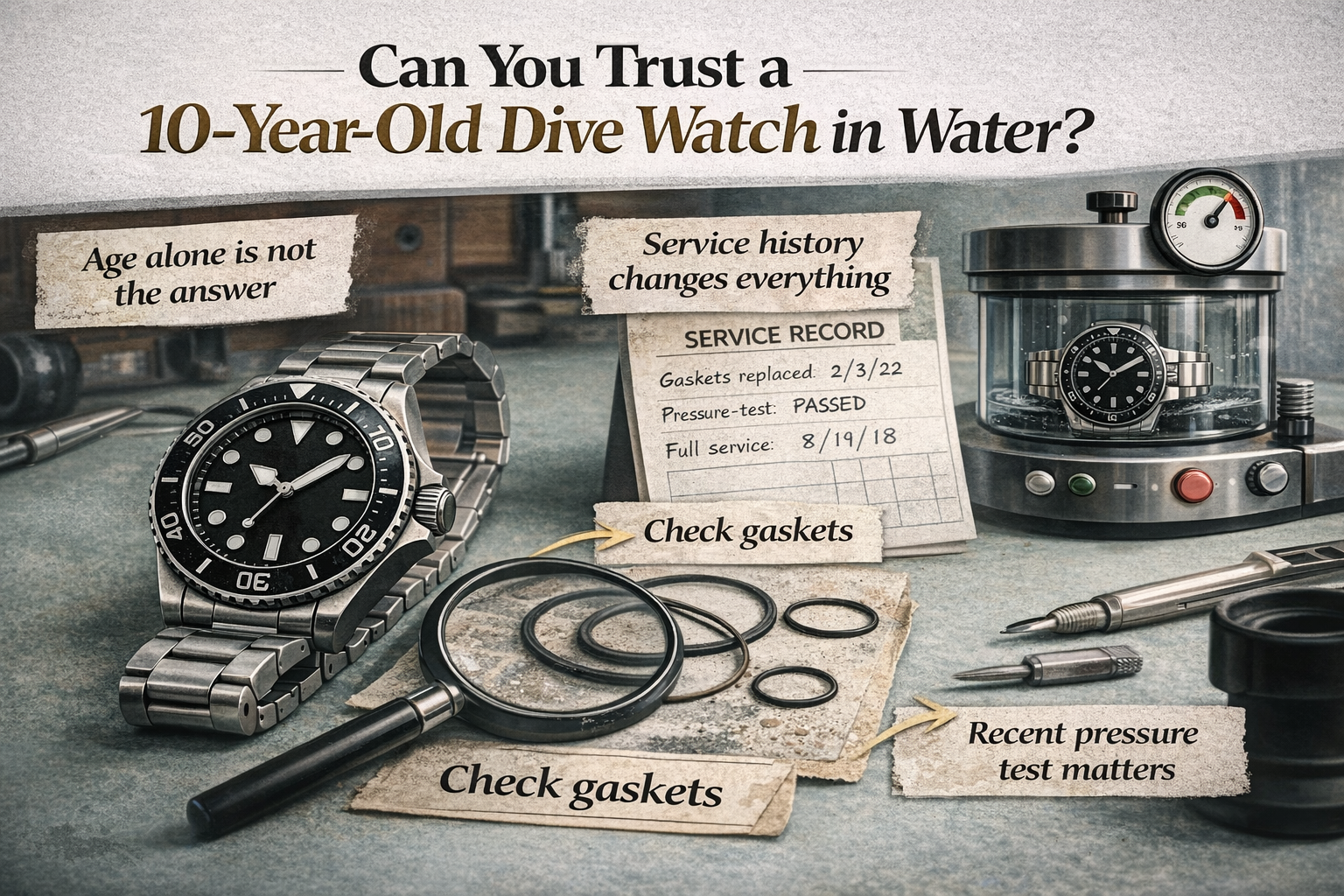
A lot of watch owners assume a dive watch is either “safe” or “unsafe.”
That is not really how it works.
And once a dive watch gets older—especially around the 10-year mark—people start asking the same question:
Can I still trust this watch in water?
Here is the honest short answer:
A 10-year-old dive watch can absolutely still be trusted in water—but only if its current condition supports that trust.
Age alone is not the answer.
The real answer comes from:
- gasket condition,
- crown and case wear,
- service history,
- whether the case has been opened,
- and whether the watch has been pressure-tested recently.
That is what actually matters.
A 10-year-old dive watch is not automatically risky.
But it is no longer young enough to trust casually without evidence.
Who this guide is for
This article is for you if:
- you own an older dive watch and want to know whether it is still water-safe,
- you are buying a used dive watch around 10 years old,
- you are planning to swim or travel with an older sports watch,
- or you want to understand what age really changes in a water-resistant watch.
If you need the broader background first, start with Water Resistance Explained: What Watch Depth Ratings Really Mean, 100m vs 200m Water Resistance: Do You Really Need a Dive Watch?, and Watch Water Resistance Test: What a Pressure Test Checks (and How Often to Do It). This article answers the more specific ownership question:
What does 10 years of age actually mean in real life?
The short answer
You can often trust a 10-year-old dive watch in water if:
- it has been serviced responsibly,
- the gaskets and seals are still in good condition or have been replaced,
- the crown and caseback seal correctly,
- and it has passed a recent pressure test.
You should not trust a 10-year-old dive watch casually if:
- service history is unknown,
- it has not been pressure-tested recently,
- the crown feels rough or questionable,
- the watch has moisture history,
- or you are simply relying on the original depth rating from years ago.
In simple terms:
At 10 years old, the watch’s history matters more than its original specification.
Why age matters—but not in the lazy way people think
Some buyers hear “10 years old” and immediately assume the watch is no longer trustworthy in water.
Others do the opposite. They say:
- “It’s a dive watch.”
- “It was built for this.”
- “These things are tough.”
- “It still looks perfect.”
Both reactions are too simple.
Age matters because time affects:
- gaskets,
- lubrication on seals,
- crown wear,
- caseback sealing surfaces,
- handling history,
- and the odds that the watch has been opened at least once.
But age by itself does not tell you the current condition.
A careful 10-year-old dive watch with documented service and a fresh pressure test may be far more trustworthy than a 3-year-old dive watch that has been abused, knocked around, opened carelessly, and never tested.
That is the key mindset shift:
Age raises the importance of verification. It does not automatically kill trust.
A real-world example
Imagine two 10-year-old dive watches of the same model.
Watch A
- serviced twice,
- crown feels smooth,
- gaskets replaced during service,
- pressure-tested recently,
- no fogging history,
- owner handled it carefully.
Watch B
- unknown service history,
- bought used twice,
- no recent testing,
- crown feels a little rough,
- used in salt water every summer,
- original rating still printed on the caseback.
Same age. Very different level of trust.
That is why the question is not:
“Is a 10-year-old dive watch safe?”
It is:
“What happened to this specific 10-year-old dive watch?”
That is a much better question.
What actually changes in a dive watch over 10 years?
A dive watch does not “expire” at 10 years.
But several things can change enough to matter.
1. Gaskets age
This is the most obvious one.
Gaskets can:
- dry out,
- flatten,
- harden,
- crack,
- or lose the flexibility needed to seal properly.
That does not happen on a perfect timer. But after 10 years, assuming the original gaskets are still ideal without inspection is not smart ownership.
2. Crown wear becomes more relevant
Every screw-down crown is a user interaction point.
Over years of use, the crown and its sealing system may experience:
- repeated opening and closing,
- cross-threading risk,
- grime buildup,
- wear on the sealing surfaces,
- or less confident engagement.
That is why Screw-Down Crown Mistakes: The Fastest Way People Ruin Water Resistance matters even more with older dive watches.
3. The case may have been opened multiple times
Battery changes, services, inspections, repairs, or careless handling all matter because every case opening introduces a new chance for seal-related problems.
A 10-year-old dive watch that has been opened several times but never pressure-tested properly should not be trusted casually.
4. Real-world wear accumulates
Over a decade, watches get:
- knocked,
- dropped,
- over-tightened,
- exposed to heat,
- taken to beaches,
- and sometimes worn in conditions the owner barely remembers.
This history matters because water resistance is not only about visible condition. It is about seal integrity.
Does a dive watch’s original depth rating still matter after 10 years?
Yes—but less than many owners think.
The original rating still tells you what the watch was designed to do.
What it does not tell you is whether the watch can still do that today.
This is where a lot of owners get lazy.
They see “200m” on the dial or caseback and assume that remains practically true for life unless something dramatic happens.
That is not how water resistance works.
A rating is meaningful when:
- the watch is in proper condition,
- the sealing system is healthy,
- and the watch currently performs to that standard.
After 10 years, you should trust current verification more than original printing.
That is why Is 50m Water Resistance Enough? What You Can (and Can’t) Do and 100m vs 200m Water Resistance: Do You Really Need a Dive Watch? are useful—but not enough on their own for older watches.
The 4 things that matter more than age
If you remember nothing else from this article, remember this section.
1. Recent pressure test
This is the single strongest confidence-builder.
A recent pressure test does not make the watch immortal, but it gives you something much more useful than guesswork.
2. Service history
A documented service history with gasket work, crown work, or proper sealing attention matters far more than a vague “it’s always been fine.”
3. Crown and case condition
A crown that feels rough, sloppy, or uncertain should reduce confidence immediately.
4. Moisture history
If the watch has ever fogged, taken on water, or shown signs of condensation, that should change how cautiously you think about it.
If you need the emergency side of that problem, What Happens If Water Gets Inside Your Watch? What To Do Immediately and Water Got Inside Your Watch? What to Do Immediately (First 30 Minutes) are essential follow-ups.
When you can usually trust a 10-year-old dive watch
This is the part owners actually want to know.
A 10-year-old dive watch is usually reasonable to trust in water when:
- it has a known maintenance history,
- it has been pressure-tested recently,
- the crown operation feels healthy,
- the watch has no moisture warning signs,
- and your usage matches the level of confidence the watch has actually earned.
That last point matters.
There is a big difference between:
- wearing a tested older dive watch in rain or for casual swimming,
- and assuming it should now be treated like a freshly serviced professional tool under any condition.
Smart owners do not confuse those two ideas.
When you should not trust it
You should step back if:
- the watch has not been tested in years,
- the seller or owner says “it should be fine” instead of providing evidence,
- service history is unclear,
- the crown feels questionable,
- the case was recently opened and not re-tested,
- or the watch has any fogging or water-incident history.
At that point, the correct answer is not “maybe.”
The correct answer is “test first.”
That is especially true if your next step is swimming, beach travel, or wet daily use. Can You Swim With a Watch? Pool vs Ocean Water Risks Explained belongs directly in this part of the decision.
What service history really tells you
A lot of buyers hear “serviced” and relax too quickly.
You should not.
Because service history only helps if it actually tells you something useful.
Good service history might tell you:
- when the watch was opened,
- whether gaskets were replaced,
- whether crown components were addressed,
- whether water resistance was tested,
- and whether the watch passed.
Weak service history sounds like:
- “I think it was serviced a few years ago.”
- “The previous owner said it was fine.”
- “It got a battery change at some point.”
- “I never had a problem with it.”
Those are not water-resistance records.
Those are comfort statements.
For ownership decisions, you want actual information.
What if the watch was recently pressure-tested?
Then your confidence can rise a lot.
Not blindly. But meaningfully.
A recent passing pressure test tells you much more than:
- age,
- cosmetic cleanliness,
- or seller confidence ever can.
It means that at the time of testing, the watch was still sealing properly enough to pass the test conditions used.
That is powerful information.
Just do not turn that into lazy thinking afterward.
A pass is not a permanent force field. It is current evidence.
That is why the logic in Does a Watch Need a Pressure Test After Battery Change or Service? and Can a Watchmaker Guarantee Water Resistance After Repair? What “Water Resistant” Really Means After Opening the Case matters so much for older dive watches.
A simple trust scale for a 10-year-old dive watch
Here is the easiest way to think about it.
High trust
- recent pressure test,
- known service history,
- no moisture history,
- healthy crown feel,
- sensible owner behavior.
Moderate trust
- some service history,
- no recent test but no warning signs,
- dry or cautious use only until verified.
Low trust
- unknown service history,
- no recent test,
- rough crown feel,
- moisture history,
- seller confidence based only on the original rating.
That framework is much more useful than simply asking whether the watch is “old.”
What owners often do wrong with older dive watches
These are the most common mistakes.
1. Trusting cosmetics too much
A clean case and nice bezel do not prove healthy seals.
2. Trusting the printed rating too much
The number on the watch is not a recent test.
3. Assuming “never had a problem” means “still safe”
That is not evidence. It is just a lack of visible failure so far.
4. Ignoring crown feel
The crown tells you more than many buyers realize.
5. Going straight into pool or ocean use after purchase
If the watch is older and newly acquired, verify before using it in water.
That is especially true once chlorine and salt enter the picture:
- Does Chlorine Damage Watches? What Pool Water Really Does
- Does Salt Water Damage Watches? Ocean Exposure Explained
- After Swimming With a Watch: The 7-Step Rinse & Dry Routine (Pool vs Ocean)
Should you pressure-test before buying a 10-year-old dive watch?
If water use matters to you, yes.
At minimum, you should either:
- see evidence of a recent test,
- or budget to test it immediately after purchase before trusting it around water.
This is one of the smartest used-watch habits you can have.
Because with older dive watches, the real risk is often not buying the wrong watch. It is buying the right watch and trusting it too quickly.
A practical ownership example
Let’s say you buy a 10-year-old 200m dive watch from a reputable private seller.
The watch looks excellent.
The bezel is clean.
The bracelet is solid.
The seller says it was “well cared for.”
Should you swim with it next weekend?
Not yet.
The correct next question is:
When was it last pressure-tested?
If the answer is recent and documented, good.
If the answer is vague, test it first.
That is not overthinking.
That is what sensible ownership looks like.
What if you only use it in rain and daily life?
Then the risk is lower than full swim use—but not zero.
A lot of water problems happen in normal daily use:
- hand washing,
- rain,
- humidity,
- accidental submersion,
- and casual assumptions.
That is why older dive watches still deserve verification even if you are “not a diver.” Can You Wash Your Hands With a Watch On? What’s Safe & What’s Not and Is It OK to Wear a Watch in the Rain? What’s Safe & What to Check First are directly relevant here.
A 6-step checklist before trusting a 10-year-old dive watch in water
Step 1
Ask when it was last pressure-tested.
Step 2
Ask what service history exists, especially gasket or crown work.
Step 3
Check the crown feel and screw-down action carefully.
Step 4
Look for any history of fogging or moisture.
Step 5
Think honestly about how you will use it: rain, pool, ocean, vacation, daily splash?
Step 6
If the answers are vague, test first and trust later.
That is the whole game.
Bottom line
Yes, you can trust a 10-year-old dive watch in water.
But you should not trust it because it is a dive watch.
And you should not trust it because it used to be rated 200m.
And you definitely should not trust it because it still looks nice.
You should trust it because the current evidence supports trust.
That means:
- healthy seals,
- sensible service history,
- good crown condition,
- and ideally a recent pressure test.
So the real answer is simple:
A 10-year-old dive watch is not too old for water. It is too old for assumptions.
FAQ
Can a 10-year-old dive watch still be water resistant?
Yes, absolutely—but only if its current condition supports that, ideally with recent testing.
Is age alone a reason not to swim with a dive watch?
No. Age alone is not the deciding factor. Current seal condition and test history matter more.
Should I pressure-test an older dive watch before swimming?
Yes. That is the smart move, especially if service history is unclear.
Do dive watch gaskets go bad over time?
Yes. They can dry, flatten, harden, or lose sealing performance over time.
Is a recently serviced 10-year-old dive watch safe in water?
Potentially yes, especially if it was pressure-tested after service. “Serviced” alone is not enough without knowing what was done.
What is the biggest mistake people make with older dive watches?
Trusting the original depth rating and appearance instead of current evidence.