- Home
- Can You Swim or Shower With a Replica Watch? Water Resistance, Crown Use and Pressure Testing Explai
Can You Swim or Shower With a Replica Watch? Water Resistance, Crown Use and Pressure Testing Explai
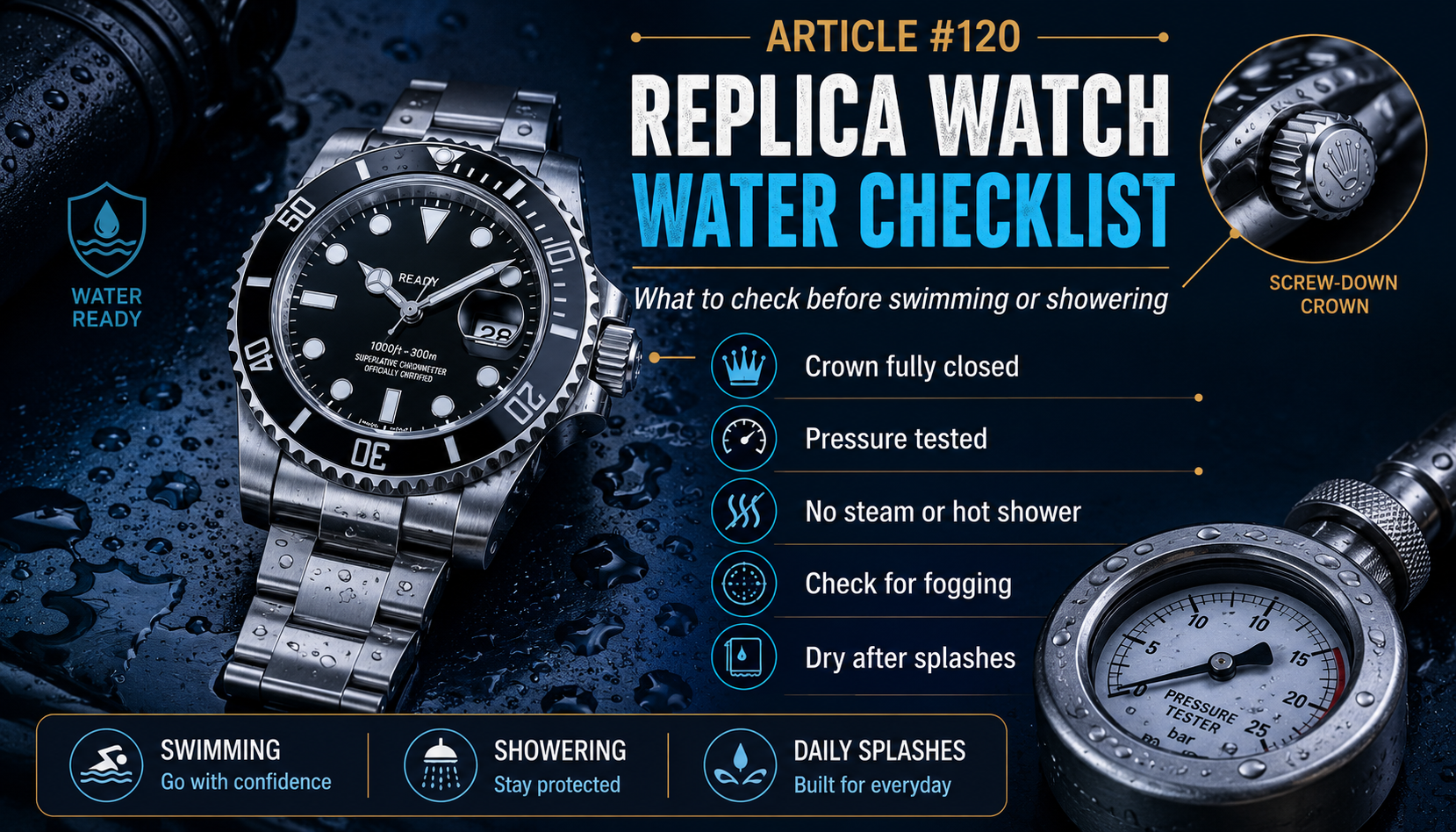
One of the most common questions replica watch buyers ask is simple:
Can I swim or shower with it?
The answer is not always simple, because water resistance depends on more than the design of the watch. A replica Rolex Submariner-style watch may look like a dive watch. A replica Omega Seamaster-style watch may have a screw-down crown. A replica luxury sports watch may have water resistance text on the dial or caseback. But none of that automatically tells you what the exact watch can handle in real life.
The smarter question is not “Does this watch look waterproof?”
The smarter question is: Has this exact watch been tested, sealed, and checked for real water exposure?
This guide explains how water resistance works for replica watches, whether you should shower or swim with one, what a screw-down crown actually does, why pressure testing matters, and how to avoid common mistakes before spending money or wearing the watch daily.
If you want broader ownership advice first, read our Replica Watch Maintenance Guide. If your watch has a screw-down crown, you should also read Screw-Down Crown Mistakes That Can Damage Your Watch.
Quick Answer: Can You Swim or Shower With a Replica Watch?
You should not swim or shower with a replica watch unless the exact watch has been pressure tested and confirmed for water use.
A watch may look water-ready, but real water resistance depends on case sealing, crown condition, caseback gasket, crystal gasket, pusher design if applicable, assembly quality, and whether the watch has been tested after production or service.
For daily life, light splashes may be fine if the crown is fully closed and the watch is properly built. But swimming, showering, hot tubs, steam rooms, saltwater, and long water exposure are different situations.
The safest rule is simple:
No pressure test, no serious water use.
Why Water Resistance Is Confusing
Water resistance is confusing because many buyers judge it visually.
They see a dive bezel and assume the watch can dive.
They see a screw-down crown and assume the watch is sealed.
They see “water resistant” text and assume it is ready for swimming.
They see a luxury sports design and assume it can handle daily water.
But watch water resistance is not based on appearance. It is based on sealing and testing.
A proper water-resistant watch needs several parts working together:
The crown gasket must seal correctly.
The caseback gasket must sit properly.
The crystal gasket must be secure.
The crown tube must be in good condition.
The case must be assembled tightly.
The watch must pass pressure testing.
If one part is weak, water can enter.
This is true for genuine watches too, especially older or pre-owned watches. But for replica watches, the buyer should be even more practical because testing standards and seller quality control can vary.
Water Resistant Does Not Mean Waterproof
The word “waterproof” is often used casually, but in watch buying, it can create the wrong expectation.
A watch is better understood as water resistant, not completely waterproof. Water resistance is a condition that depends on seals, age, use, temperature, pressure, and maintenance.
A watch that handles light rain may not handle swimming.
A watch that survives swimming once may not be ready for repeated pool use.
A watch that passes a basic test may still need care around hot water or steam.
This is why experienced watch owners think in terms of risk, not guarantees.
For a replica watch buyer, the goal is not to be afraid of wearing the watch. The goal is to understand the difference between everyday moisture and serious water exposure.
Showering With a Replica Watch: Usually Not Worth It
Many buyers ask about showering because it feels like a normal daily activity. But showering is one of the most avoidable risks.
A shower combines water, heat, soap, shampoo, pressure changes, and steam. These conditions are different from a small splash at the sink.
Heat can affect gaskets.
Soap can reduce sealing performance over time.
Steam can enter places liquid water may not enter as easily.
Shampoo and body wash can leave residue around the crown and bracelet.
Even if the watch survives, there is usually no real benefit to wearing it in the shower.
The practical advice is simple:
Take the watch off before showering.
This applies to many genuine watches too, especially if they have not been recently tested. For replica watches, it is even more sensible.
Swimming With a Replica Watch: Only After Testing
Swimming is possible only if the watch has been properly pressure tested and confirmed suitable.
A replica dive-style watch may look perfect for the pool, but appearance is not enough. Before swimming, you want confidence that the crown, caseback, crystal, and seals are doing their job.
Pool water also contains chemicals. Saltwater is even more demanding. After water exposure, a watch should be rinsed carefully with fresh water and dried, but that advice only applies if the watch is already confirmed water-safe.
If you want a replica watch mainly for swimming, choose carefully before buying. Ask the seller directly whether the exact watch has been pressure tested. If the answer is vague, assume it has not been tested.
This matters especially for Submariner-style and Seamaster-style watches. These designs are popular because they look sporty and capable, but real water use should still be confirmed.
For model-specific buying decisions, read Replica Rolex Submariner vs Real and Replica Omega Seamaster vs Real.
Practical Case 1: The Buyer Who Trusted the Look
A buyer named Ryan purchased a Submariner-style replica because he loved the classic black dial, rotating bezel, and steel bracelet. The watch looked strong and sporty, so he wore it to the pool during a weekend trip.
After swimming, everything seemed fine. But the next morning, he noticed fog under the crystal.
The issue was not that the watch looked wrong. The issue was that Ryan never confirmed whether that exact watch had passed a pressure test. The crown looked closed, but the internal sealing was not verified.
The repair became more complicated than the original decision. Moisture inside a watch can affect the dial, hands, movement, and date mechanism.
The lesson is simple: water damage often starts with confidence based on appearance instead of testing.
Practical Case 2: The Buyer Who Tested First
Another buyer, Jason, purchased a Seamaster-style replica. He liked the watch for travel and summer outfits, but he wanted to use it around water.
Before swimming, he asked for a pressure test. He also had a local watch shop inspect the crown and caseback gasket. The watch passed a basic water resistance test suitable for his intended use.
Jason still avoided hot showers and steam rooms. After pool use, he rinsed the bracelet area carefully and dried the watch. He checked the crown before every water exposure.
His experience was much better because he treated water resistance as something to confirm, not something to assume.
This is the difference between risky use and practical use.
What a Screw-Down Crown Actually Does
A screw-down crown helps improve sealing by tightening the crown against the case and gasket system. It is an important feature on many sports watches and dive-style watches.
But a screw-down crown is not magic.
It only helps if the crown tube, threads, and gasket are in good condition. It also only works when the crown is fully closed and correctly screwed down.
Common mistakes include:
Leaving the crown slightly open.
Forcing the crown and damaging the thread.
Cross-threading the crown.
Opening the crown when the watch is wet.
Assuming a screw-down crown means swimming is automatically safe.
Before water exposure, always check that the crown is secure. But do not overtighten it. Gentle and firm is enough.
If you feel resistance while closing the crown, stop and reset the thread. Forcing it can damage the crown tube.
For more detail, read Screw-Down Crown Mistakes That Can Damage Your Watch.
What About Watches With Pushers?
Chronograph-style watches need extra caution because pushers can create additional water-entry points.
For example, Daytona-style watches and other chronograph designs may have pushers on the case side. Even if they look sealed, you should be careful around water unless the watch has been properly tested.
Never press chronograph pushers underwater unless the watch is specifically designed and confirmed for that use. For most buyers, it is better to avoid water exposure with chronograph-style replica watches.
If you like chronograph style, focus on normal daily wear instead of swimming use. We discuss chronograph-style buying in Replica Rolex Daytona vs Real.
Pressure Testing: What It Means
Pressure testing checks whether a watch can resist water under controlled conditions. A watchmaker or seller may use dry testing or wet testing equipment.
The purpose is to find sealing problems before the watch is exposed to real water.
A pressure test can help identify issues with:
Crown seal
Caseback gasket
Crystal seal
Pusher seal
Case assembly
General leakage risk
For replica watches, pressure testing is useful because two watches that look identical may not perform identically in water. One may be sealed well. Another may need gasket adjustment.
Ask whether the test was done on the exact watch being shipped, not just the model type.
A general claim like “this model is water resistant” is less useful than proof that your exact watch was tested.
Can You Trust Factory Water Resistance Claims?
Factory claims can be a starting point, but they should not be treated as final proof.
The real question is not only what the design is supposed to handle. The question is what your exact unit can handle today.
Small differences in assembly, gasket placement, crown tube quality, or caseback tightness can change the result.
This is why careful buyers ask for testing, especially if they plan to swim.
If the seller cannot provide a test, that does not automatically mean the watch is unusable. It simply means you should treat it as not confirmed for serious water exposure.
Daily Water Exposure: What Is Usually Fine?
Daily water exposure means normal situations like light rain, small splashes while washing hands, or moisture from regular life.
For many replica watches, this level may be acceptable if the crown is closed and the watch is properly assembled. But you should still avoid soaking the watch.
After light splash exposure, wipe the watch dry. Pay attention around the crown, bezel, bracelet links, and clasp.
If the watch has a leather strap, be more careful. Leather does not like water, even if the watch case itself is sealed.
Steel bracelets, rubber straps, and some fabric straps handle moisture better, but the watch head still needs proper sealing.
What to Do If Water Gets Inside
If you see fog, droplets, or moisture under the crystal, act quickly.
Do not keep wearing the watch as if nothing happened.
Do not wind it repeatedly.
Do not press pushers.
Do not open the case yourself unless you know what you are doing.
Do not place it under extreme heat.
The best move is to take it to a watchmaker as soon as possible. Moisture can affect the movement, dial, hands, and internal parts.
If the watch uses a common movement, repair or movement replacement may be possible. If it uses a more specialized movement, options may depend on parts and watchmaker skill.
A small moisture issue can become a larger problem if ignored.
Water Resistance and Movement Health
Water does not only affect the outside of the watch. It can also affect timekeeping and movement function.
Moisture can lead to corrosion, poor lubrication, stuck parts, rough winding, date problems, and accuracy changes. If a watch starts running fast, slow, or inconsistently after water exposure, the timing issue may be related to internal moisture.
If your watch is running poorly but has not been exposed to water, there may be other causes such as magnetism, impact, low power reserve, or regulation needs. We explain those issues in Watch Running Fast or Slow: Causes and Fixes.
Water Resistance by Watch Type
Different replica watch styles create different expectations.
Dive-Style Replica Watches
Submariner-style and Seamaster-style watches look most water-ready. They often have rotating bezels, screw-down crowns, steel bracelets, and sporty cases.
These are the best candidates for water use, but only after testing.
Dress-Style Replica Watches
Cartier Tank-style and slim dress-style watches should usually stay away from water. They are designed more for elegance than water activity.
If you like Cartier-style pieces, read Replica Cartier Tank vs Real and Replica Cartier Santos vs Real.
Luxury Sports Replica Watches
Aqua Terra-style, Nautilus-style, Datejust-style, and similar watches may handle daily moisture if built well, but they should not automatically be treated as swim watches.
For everyday luxury sports options, read Replica Omega Aqua Terra vs Real and Replica Rolex Datejust vs Real.
Chronograph Replica Watches
Chronographs need caution around water because pushers add complexity. Unless tested and specifically confirmed, avoid water use.
Buyer Checklist Before Water Use
Before you swim, shower, or expose a replica watch to serious water, ask these questions:
Has this exact watch been pressure tested?
Is the crown fully closed or screwed down?
Are there pushers that create extra risk?
Is the caseback properly sealed?
Is the strap suitable for water?
Has the watch been opened recently?
Is there any fog or moisture already visible?
Do you actually need to wear it in water?
The last question is important. Many water risks are unnecessary. Taking the watch off before showering or swimming is often the easiest protection.
What to Ask the Seller Before Buying
If water resistance matters to you, ask before paying.
Useful questions include:
Has the exact watch been pressure tested?
What test result can you provide?
Was the crown and caseback checked?
Can the watch handle swimming, or only daily splashes?
Is the watch safe for showering?
What happens if water enters after normal use?
Can you provide real photos of the crown and caseback?
Has the watch been opened after testing?
Clear answers are a good sign. Vague answers mean you should lower your expectations for water use.
Do not ask only “Is it waterproof?” That question is too broad. Ask specifically about pressure testing and intended use.
Should You Pay Extra for Water Resistance Testing?
If you plan to use the watch around water, yes, paying extra for testing can be worth it.
A pressure test is usually cheaper than repairing water damage. It also gives you more confidence about how to use the watch.
If you do not plan to swim or expose the watch to water, testing may be less urgent. You can simply treat the watch as a daily style piece and avoid water.
The decision depends on your lifestyle.
If you live near the beach, travel often, or want a summer watch, testing matters more. If you wear the watch mostly in the office, water resistance may be less important.
Can You Improve Water Resistance After Buying?
Sometimes, yes.
A watchmaker may be able to inspect or replace gaskets, tighten the caseback, check the crown, and pressure test the watch. This can improve confidence for daily water exposure.
However, not every replica watch can be made suitable for swimming. Case construction, crown tube quality, crystal fit, and pusher design all matter.
Do not assume every watch can be upgraded into a real dive-ready piece. Some watches are better kept away from water.
After Water Exposure: What to Do
If your watch has been tested and you wear it around water, follow a simple routine.
After pool or saltwater exposure, rinse the bracelet area gently with fresh water if the watch is confirmed water-safe. Dry it with a soft cloth. Make sure no moisture remains around the crown, clasp, or bracelet links.
Do not use hot air.
Do not place the watch in direct strong heat.
Do not open the crown while wet.
Do not store it in a closed box while damp.
Let the watch dry fully before storage.
For general daily care, follow the routine in our Replica Watch Maintenance Guide.
Real vs Replica Water Resistance Expectations
A genuine luxury watch usually has clearer specifications, brand testing, and service support. But even genuine watches need maintenance and pressure testing over time.
A replica watch can be enjoyable and practical, but water resistance should be treated as unit-specific. Instead of assuming based on the model, check the exact watch.
This is the fair way to think about it:
A real dive watch gives stronger official confidence.
A replica dive-style watch can be practical if tested.
An untested watch should stay away from serious water.
That does not make one purchase right or wrong. It simply helps buyers use each watch appropriately.
Final Advice: Do Not Let Water Ruin a Good Watch
A replica watch can be a great daily style piece. It can work well for office wear, travel outfits, weekends, and casual luxury styling. But water exposure should be handled carefully.
Do not shower with it just because it seems convenient.
Do not swim with it just because it looks like a diver.
Do not trust dial text without testing.
Do not force the crown.
Do not ignore fog under the crystal.
If you want water use, get the exact watch pressure tested. If you do not want to test it, keep it dry and enjoy it as a daily style watch.
The smartest watch owners are not the ones who take the biggest risks. They are the ones who know what their watch can actually handle.
FAQ
Can I wash my hands while wearing a replica watch?
Light splashes may be fine if the crown is fully closed and the watch is properly built. Still, avoid soaking the watch and dry it after exposure.
Can I shower with a replica watch?
It is better not to. Showering involves heat, steam, soap, and pressure changes. These create unnecessary risk, even for many watches that seem water-resistant.
Can I swim with a replica Submariner-style watch?
Only if the exact watch has been pressure tested and confirmed for swimming. A dive-style appearance is not enough.
Does a screw-down crown mean the watch is waterproof?
No. A screw-down crown helps sealing, but it does not guarantee full water resistance. The crown, gaskets, caseback, crystal, and whole case assembly still matter.
What should I do if my watch crystal fogs up?
Stop wearing it and take it to a watchmaker quickly. Moisture inside the case can affect the movement, dial, hands, and date mechanism.
Is pressure testing worth it?
Yes, if you plan to expose the watch to water. A pressure test is usually much cheaper than repairing water damage.
Are replica dive watches better for water use than dress watches?
Generally, dive-style watches are better candidates for water use, but only after testing. Dress-style watches should usually be kept away from water.