Can a Watchmaker Guarantee Water Resistance After Repair?
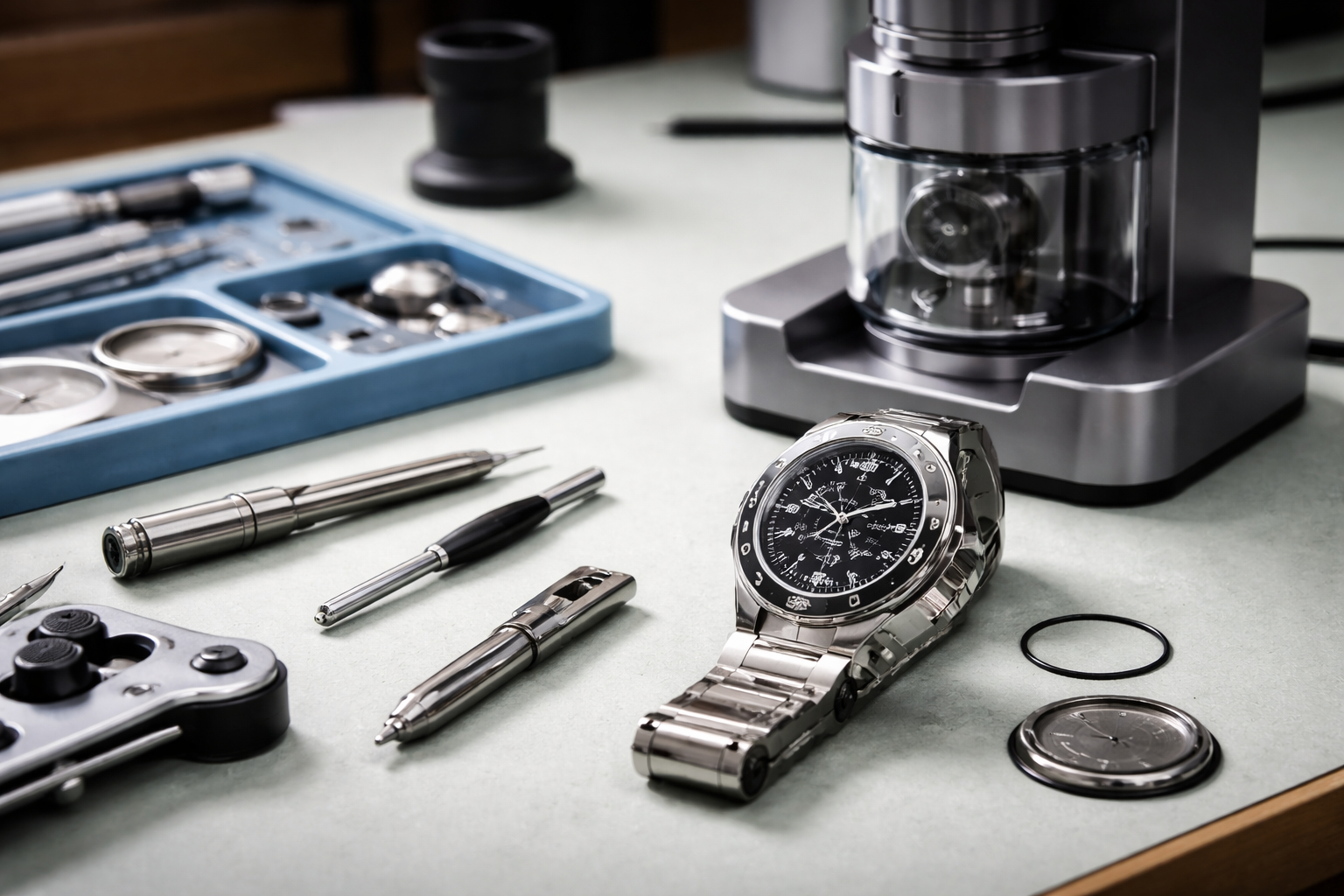
A lot of watch owners hear the phrase “water resistant” and think it means certainty.
It does not.
And that misunderstanding gets even more dangerous after a watch has been opened for repair, service, battery change, crystal work, crown work, or gasket replacement.
That is when people start asking:
Can a watchmaker guarantee water resistance after repair?
Here is the honest short answer:
A good watchmaker can test, assess, and restore water resistance to a meaningful standard—but no serious watchmaker should promise absolute real-world certainty in every future condition.
That is not a dodge.
That is the truth.
Because water resistance is not just about whether the watch passed a test once. It is also about:
- the current condition of the seals,
- the quality of the repair,
- the design of the watch,
- the way the watch is used afterward,
- and whether the owner treats “water resistant” like a lab result or a lifestyle permission slip.
Those are not the same thing.
Who this guide is for
This article is for you if:
- your watch was recently repaired or serviced,
- you want to know whether it is “safe” around water again,
- a watchmaker told you the watch is water resistant and you want to understand what that actually means,
- or you are trying to decide how much trust to place in a repaired watch before rain, hand washing, swimming, or travel.
If your first question is whether the watch should be pressure-tested after being opened, start with Does a Watch Need a Pressure Test After Battery Change or Service?. This article goes one step further and answers the harder ownership question:
What does a passing result really mean—and what does it not mean?
The short answer
A watchmaker can usually:
- inspect the case and sealing system,
- replace or lubricate gaskets where appropriate,
- reassemble the watch correctly,
- and perform pressure testing to see whether the watch meets a stated standard at the time of testing.
A watchmaker cannot honestly guarantee:
- that the watch will remain water resistant indefinitely,
- that future misuse will not compromise it,
- or that every real-world scenario will match controlled test conditions.
In simple terms:
A passing pressure test is strong evidence. It is not a lifetime promise.
Why the word “guarantee” is the problem
The word sounds reassuring, but it creates the wrong expectation.
Owners hear “guaranteed water resistance” and often translate it into:
- shower-safe forever,
- swim-safe no matter what,
- safe after any impact,
- safe even if the crown is mishandled,
- or safe until the next service no matter what happens.
That is not how this works.
Water resistance is a condition, not a permanent identity.
A watch is not “water resistant” in some abstract eternal sense. It is water resistant as long as the sealing system is currently doing its job.
And after repair, that job depends on multiple variables.
What a watchmaker can actually do after opening the case
When a watch is opened, the sealing system is no longer just a factory assumption.
Now it depends on workmanship and current parts condition.
A competent watchmaker can do several things that meaningfully improve confidence:
1. Inspect the seals
That includes the caseback gasket, crown-related seals, pushers if applicable, and other sealing points depending on the watch design.
2. Replace worn gaskets where needed
A dry, cracked, flattened, or tired gasket should not be treated as trustworthy just because it still physically exists.
3. Reassemble the case correctly
Even a good gasket can fail if it is pinched, poorly seated, dry, damaged during closure, or installed into a dirty seating surface.
4. Pressure-test the watch
This is the most important step, because it replaces assumption with evidence.
That is why Watch Water Resistance Test: What a Pressure Test Checks (and How Often to Do It) matters so much in this conversation.
What a good watchmaker gives you is not magic.
It is a professionally verified moment in time.
That is already valuable.
It just is not the same as a lifetime guarantee.
A real-world example
Let’s say a quartz sports watch goes in for a battery change and gasket replacement.
The watchmaker:
- opens the case,
- replaces the battery,
- inspects the old gasket,
- installs a fresh gasket,
- closes the case correctly,
- and pressure-tests the watch successfully.
Can they now say the watch passed the test and is back to a meaningful water-resistance standard?
Yes.
Can they honestly promise the owner that nothing the owner does over the next six months could compromise that?
No.
Because after the watch leaves the bench, a lot can happen:
- the crown can be mishandled,
- the watch can take a hard knock,
- the case can be opened again elsewhere,
- heat exposure can become part of the owner’s routine,
- or the owner can start treating the rating like it means “safe in all water situations.”
That last mistake is extremely common.
Which is why articles like Water Resistance Explained: What Watch Depth Ratings Really Mean, Is It Safe to Wear a Watch in the Shower? The Truth About Water, Steam & Soap, and Is It Safe to Wear a Watch in the Sauna or Hot Tub? Heat Damage Explained belong in the same ownership conversation.
What a passing pressure test really means
This is the key point many owners never fully understand.
A passing pressure test usually means:
At the time of testing, under the test conditions used, the watch case appeared to seal to the specified standard.
That is a strong and useful result.
But it does not mean:
- the watch is immune to future seal damage,
- all real-world water exposure is now safe,
- steam and hot water are harmless,
- the crown can be treated casually,
- or the watch should now be trusted without thought for months or years.
A pressure test is evidence of current sealing performance.
It is not permission to stop thinking.
Why real life is harder than the test bench
This is another place where expectations go wrong.
A watch may pass a dry or wet pressure test in controlled conditions. But real life adds things the bench does not always replicate in the same way:
- temperature changes,
- sudden movement,
- soap,
- steam,
- chlorinated water,
- salt exposure,
- crown handling mistakes,
- and impacts.
That is why a watchmaker can confidently say the watch passed testing, but still be careful about making broad promises about “all water use.”
They are not being vague.
They are being responsible.
If you want to see how quickly ordinary situations complicate the water-resistance story, these articles connect directly to that reality:
- Can You Wash Your Hands With a Watch On? What’s Safe & What’s Not
- Is It OK to Wear a Watch in the Rain? What’s Safe & What to Check First
- Can You Swim With a Watch? Pool vs Ocean Water Risks Explained
- Does Chlorine Damage Watches? What Pool Water Really Does
- Does Salt Water Damage Watches? Ocean Exposure Explained
When a watchmaker’s confidence should carry real weight
Not every reassuring statement means the same thing.
You should give more weight to a watchmaker’s reassurance when:
- the watch was pressure-tested after repair,
- the result was clearly explained,
- relevant seals were inspected or replaced,
- the watch type matches the claimed use,
- and the watchmaker speaks precisely rather than casually.
For example, this is meaningful:
“We replaced the caseback gasket, checked the crown seal, and the watch passed pressure testing to its stated level.”
This is much less useful:
“Should be fine.”
One is professional information.
The other is conversational comfort.
Only one of those should influence your decisions around water.
When you should be more cautious, even after repair
There are situations where passing reassurance should still be taken with more caution.
1. The watch is older
Older watches may pass testing today and still deserve more careful real-world use than a newer equivalent.
2. The watch is vintage
Vintage ownership usually calls for more restraint, regardless of what the original rating once suggested.
3. The watch has complicated case architecture
Pushers, crowns, aged crystals, or more complex sealing systems can raise the stakes.
4. The watch has unknown prior history
A recently repaired watch with a long unclear life behind it is different from a newer watch with a fully documented service path.
5. The watch passed, but the owner’s planned use is aggressive
A pass before light daily wear is one thing. A pass before regular hot-tub use, showering, or careless vacation use is another.
That is why even a successful repair should lead to smarter habits, not looser ones.
What “water resistant” should mean to the owner after repair
Here is the practical mindset to adopt:
If your watchmaker says the watch passed testing after repair, treat that as:
- real positive evidence,
- a good sign,
- and a meaningful restoration of confidence.
But do not treat it as:
- immunity,
- permanent certainty,
- or permission to ignore common sense.
A smarter owner hears “water resistant after repair” and translates it like this:
The watch has been checked and currently performs as it should—but I still need to wear it intelligently.
That is the right mindset.
Common owner mistakes after repair
These are the mistakes that turn a good repair outcome into a bad ownership outcome.
1. Assuming “passed test” means “safe forever”
It does not.
2. Going straight from repair to aggressive water use
A tested watch may still deserve sensible real-world caution.
3. Ignoring crown habits
A poorly screwed crown can defeat all the careful repair work in seconds. That is why Screw-Down Crown Mistakes: The Fastest Way People Ruin Water Resistance matters so much after service.
4. Treating showers and steam like light water exposure
They are not the same thing.
5. Forgetting that seals age
A passing result today does not freeze the watch in that state forever.
Can a watchmaker guarantee water resistance on a vintage watch?
This is where the answer becomes even more careful.
With vintage watches, a serious watchmaker is even less likely to make an absolute guarantee, and that is usually a good sign.
Why?
Because vintage watches bring extra uncertainty:
- aged components,
- changed tolerances,
- old crowns,
- old crystal interfaces,
- previous unknown repairs,
- and metal wear from decades of use.
A vintage watch may still be improved, tested, and in some cases restored to a useful sealing level. But the word “guarantee” becomes even less appropriate there.
For many vintage owners, the smarter approach is:
- keep it dry,
- enjoy it carefully,
- and view any positive test result as helpful information, not as a reason to start treating it like a modern dive tool.
Can a watchmaker guarantee water resistance after battery change?
This is the version of the question many quartz owners ask.
And the answer follows the same logic:
After a battery change, a good watchmaker can:
- inspect the gasket,
- replace it if needed,
- close the case properly,
- and pressure-test the watch.
That can give you real confidence.
But no serious professional should promise that the watch is now permanently immune to future water-related risk.
The better question is not:
“Can you guarantee it?”
It is:
“Was the watch properly sealed and tested after the battery change?”
That is the more useful question, and it leads to a more useful answer.
What to ask your watchmaker after repair
If you want clarity, ask clear questions.
Here are the best ones:
- Was the watch pressure-tested after repair?
- Did it pass?
- Were the gaskets inspected or replaced?
- Does the result support normal daily splash use, swimming, or only cautious dry wear?
- Are there any limitations I should know about after this repair?
Those questions matter far more than asking, “It’s water resistant now, right?”
Because that question is too broad.
It invites vague reassurance instead of precise information.
A simple practical example
Imagine two owners picking up repaired watches.
Owner A asks:
It’s all good now?
The watchmaker says:
Yes, should be fine.
Owner A leaves feeling reassured, but actually learns very little.
Owner B asks:
Was it pressure-tested after the case was opened? Did the seals need replacement, and what level of use would you personally be comfortable with now?
Now the answer becomes more useful.
Owner B may hear:
- yes, it passed,
- the caseback gasket was replaced,
- daily water use is fine,
- but hot water and steam should still be avoided.
That is a much better ownership outcome.
What if the watchmaker refuses to “guarantee” water resistance?
That is not automatically a bad sign.
In fact, it can be a sign that they are speaking responsibly.
A careful professional may prefer language like:
- passed pressure test,
- restored sealing,
- water resistance verified to test standard,
- or suitable for normal use based on test result.
That language is more honest than a blanket guarantee.
What matters is not whether they say the magic word.
What matters is whether they can explain what was done and what was verified.
Bottom line
A watchmaker can absolutely give you meaningful confidence after repair.
They can inspect the seals, restore the sealing system, perform pressure testing, and tell you whether the watch currently meets a real standard.
What they cannot honestly give you is a permanent, universal, future-proof guarantee against all water-related risk.
Because water resistance after repair is not about slogans.
It is about current condition, verified testing, and sensible use afterward.
So the smartest takeaway is this:
Trust the test. Respect the limits. Keep the habits smart.
That is what “water resistant after repair” should really mean.
FAQ
Can a watchmaker guarantee water resistance after repair?
Not in an absolute, permanent sense. A good watchmaker can verify current performance through testing, but future use and seal condition still matter.
Does a passing pressure test mean my watch is safe forever?
No. It means the watch passed at the time of testing under the conditions used.
Is “water resistant” after repair the same as factory-new water resistance?
Not necessarily. It may be restored to a useful standard, but the watch’s age, condition, and design still matter.
Should I still avoid hot showers and saunas after a successful test?
Yes. Steam, heat, and hot water introduce risks that owners often underestimate.
Is it a bad sign if the watchmaker will not say “guaranteed”?
No. It can actually be a sign of professional honesty.
What should I ask instead of “Can you guarantee it?”
Ask whether the watch was pressure-tested, whether the seals were inspected or replaced, and what kind of water exposure the watchmaker would personally consider reasonable afterward.