Should You Buy a Used Luxury Watch Online? 12 Checks Before You Pay
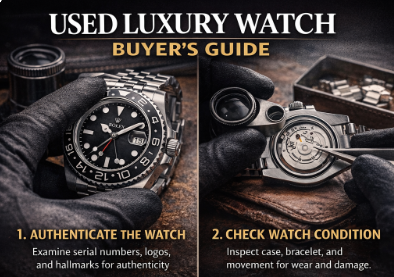
Buying a used luxury watch online can be a smart move. In many cases, it is the best way to get more watch for your money, find a discontinued reference you actually want, or avoid the steepest part of first-owner depreciation.
But it is only a good deal if you know what you are looking at.
That is where people get hurt. Not always by obvious fakes, either. More often, they get burned by overpolished cases, replaced parts, vague service history, hidden bracelet wear, moisture risk, or a “great price” that turns expensive the moment the watch arrives.
So here is the honest answer:
Yes, you can absolutely buy a used luxury watch online. But you should never buy one with only excitement and trust. You need a process.
This guide gives you that process.
Who this guide is for
This article is for you if:
- you are thinking about buying a pre-owned luxury watch from a marketplace, dealer, forum seller, or social platform,
- you want a better deal than buying new,
- you are not fully confident evaluating listing photos and seller claims,
- or you already found a watch and want to know what to check before sending money.
If you are buying your very first serious watch and mostly care about simple daily ownership, it is also worth reading Quartz vs Automatic for Daily Wear: Total Cost, Accuracy, Convenience & Maintenance before you commit to a used mechanical piece.
The short answer
A used luxury watch online is usually worth buying if:
- the seller is credible,
- the watch condition matches the asking price,
- the reference and parts look correct,
- the movement is behaving as expected,
- and you are comfortable with the service risk.
It is usually not worth buying if:
- the seller avoids basic questions,
- the photos are weak or selective,
- the price is suspiciously low,
- the watch shows signs of hidden damage or bad polishing,
- or you are stretching your budget so far that a post-purchase service would hurt.
A real-world example
Let’s say you find a used GMT watch online for what looks like a great price.
The listing says:
- “Excellent condition”
- “Keeps great time”
- “Only minor wear”
- “No box, no papers”
- “Priced to sell”
The photos look clean at first glance. The bezel is sharp, the dial is attractive, and the seller has a decent profile picture. It feels like the kind of listing you need to move on fast.
But once you slow down and inspect it properly, a different story appears:
- the case edges look soft from polishing,
- the bracelet has more stretch than the photos first suggested,
- the GMT hand alignment is slightly off,
- the seller cannot explain the service history,
- and the crown threads look tired in the close-up video.
Suddenly that “great deal” is not so great.
This is why buying used online is less about speed and more about discipline.
Before the 12 checks: understand what you are really buying
When you buy used, you are not only buying a watch.
You are buying some combination of:
- the watch itself,
- its current condition,
- the honesty of the description,
- the maintenance history,
- the risk of future cost,
- and the seller’s willingness to stand behind the deal.
That is why two watches with the same model name can be wildly different purchases.
Now let’s get into the 12 checks that matter most.
1. Verify the exact reference before you fall in love with the photos
Start with the reference, not the emotion.
A surprising number of buyers get locked onto a dial color or bezel combination and only later realize they were comparing the wrong model, the wrong size, or the wrong generation.
Before you think about price, make sure you know:
- the exact reference number,
- the case size,
- the movement type,
- the bracelet or strap configuration,
- and what the correct dial, hands, bezel, and clasp should look like for that reference.
This matters even more if you have not decided what size works for you. A watch can be authentic and still be the wrong buy if it wears badly on your wrist. That is why Watch Size Guide: Case Diameter, Lug-to-Lug & Thickness (How to Choose the Perfect Fit) should be part of your buying process, not something you read after the package arrives.
Practical move:
Ask the seller to confirm the exact reference in writing and send a clear photo of the reference area or caseback if appropriate.
2. Make sure the seller is selling a watch—not just a story
Some listings are built on mood, not facts.
Beautiful desk photo. Nice lighting. Strong caption. Maybe even a sentence like “worn with care.” None of that tells you what you actually need to know.
A trustworthy seller should be able to answer basic questions directly:
- How long have you owned it?
- Where did you buy it?
- When was it last serviced?
- What has been replaced?
- Are all functions working correctly?
- Is there any moisture history, crown issue, or timing issue?
- Are there scratches, dents, bracelet stretch, or clasp looseness not visible in the photos?
If the seller gets vague, defensive, or overly emotional, take that seriously.
A clean answer does not guarantee a clean watch.
But poor answers usually point to a poor buying experience.
Practical move:
If the seller cannot answer simple condition questions in one message, do not send money just because the watch looks good in the main photo.
3. If the price feels unusually low, treat that as a problem to solve
A low price is not always a win. Sometimes it is the biggest warning sign in the listing.
That does not mean every bargain is fake. Some sellers need fast cash. Some do not know the market well. Some simply price aggressively.
But when a used luxury watch is clearly below what similar examples are trading for, you should not think, “I got lucky.”
You should think, “What am I missing?”
The missing piece is often one of these:
- poor service history,
- replaced or incorrect parts,
- heavy polishing,
- bracelet wear,
- moisture risk,
- questionable originality,
- or simply a seller who knows buyers move faster when greed takes over.
Practical move:
Compare the asking price against at least several similar listings in similar condition. Then mentally add a possible service bill before deciding whether it is still a deal. If you need help thinking through that part, How Much Does Watch Servicing Cost? Mechanical vs Quartz vs Chronograph vs GMT is the right companion read.
4. Check the case for overpolishing, not just scratches
New buyers often obsess over scratches and ignore the more important issue: shape.
A used luxury watch with honest wear can still be a great buy.
A heavily polished watch with soft lines often cannot be undone.
Look closely at:
- lug edges,
- bezel teeth,
- crown guards,
- chamfers,
- brushed surfaces,
- and how crisp the transitions look between polished and brushed areas.
Sharp, original geometry usually matters more than a few desk-diving marks.
Real example
A buyer finds two similar used sports watches online. One has visible small scratches but crisp factory lines. The other looks “cleaner” at first glance, but the lugs are rounded, the bezel edges are soft, and the case has lost some of its original character.
Many first-time buyers choose the second watch.
Experienced buyers usually choose the first.
Practical move:
Ask for side profile shots, lug close-ups, clasp close-ups, and a straight-on bezel shot in natural light. Not studio light. Natural light.
5. Look hard at the crystal, AR coating, and bezel condition
Crystal condition is one of those details that looks minor in a listing and annoying in real life.
A small mark can be fine.
But chips, edge damage, heavy coating wear, or bezel insert damage can change the feel of the watch fast.
This is especially true when a scratched anti-reflective layer makes buyers think the crystal itself is damaged. Before you panic, it helps to understand the difference, which is exactly what AR Coating Explained: Why Your Watch Crystal Looks Scratched (But Isn’t) is about.
And if you are not sure what the crystal material means for durability and replacement cost, read Sapphire vs Mineral vs Acrylic Watch Crystal: Pros, Cons & Scratch Reality.
Practical move:
Ask for crystal photos from multiple angles, including one under side light and one straight-on. Small flaws often disappear in glamour photography and show up immediately in simple daylight.
6. Check bracelet stretch, missing links, and actual fit risk
Bracelet condition can quietly turn a good-looking used watch into an expensive mistake.
Photos taken flat on a table often hide:
- stretch,
- sag,
- clasp looseness,
- overbrushed surfaces,
- replacement screws or pins,
- and missing links.
Also, never assume a used bracelet will fit you just because the watch originally came on bracelet.
You need to know:
- current wrist size setup,
- how many links are included,
- whether extra links are original,
- and whether the clasp still closes with healthy tension.
This matters more than buyers think because bracelet replacement or sourcing original links is not always cheap.
To understand how the watch should actually sit once it arrives, Watch Bracelet Sizing Guide: How Tight Should It Be? (Comfort, Fit Tests & Fixes) is worth reading before you buy, not after.
Practical move:
Ask the seller, “What wrist size is it currently sized for, and how many extra links are included?” If they cannot answer clearly, assume you may have extra cost ahead.
7. Understand the movement risk, not just the movement type
“Automatic” is not enough information. Neither is “quartz.” Neither is “chronograph.”
You need to understand what kind of ownership risk the movement brings.
For example:
- a basic quartz watch is usually lower-maintenance,
- a standard automatic adds more service risk over time,
- a chronograph raises complexity and cost,
- and a GMT or calendar model may be more expensive to correct if something is not right.
If you are still deciding what kind of watch suits your daily life, Quartz vs Automatic for Daily Wear: Total Cost, Accuracy, Convenience & Maintenance is useful before you go any further.
And if you are looking at a complication-heavy used watch just because it seems like “more for the money,” slow down. More features usually mean more potential cost, more things to inspect, and more ways for the seller to say “it works” when the reality is more complicated.
Practical move:
Ask the seller exactly what functions have been tested recently and whether anything feels stiff, inconsistent, misaligned, or intermittent.
8. Ask how it runs—and ask for proof, not adjectives
“Keeps good time” is one of the least useful phrases in used watch listings.
Good compared to what?
Ten seconds a day? Thirty? Two minutes?
Was that on wrist? Off wrist? Over one day? One week?
If the watch is mechanical, ask for something concrete:
- daily gain/loss estimate,
- power reserve estimate,
- whether the watch was tested in multiple positions,
- and ideally a timegrapher screenshot if the seller has one.
You do not need the seller to be a watchmaker. But you do need more than marketing language.
If you are not sure how to read those numbers, Timegrapher Readings Explained: Amplitude, Beat Error & What’s Normal will help you understand what is normal and what deserves caution. And if the seller mentions positional differences, Positional Variance Explained: Dial Up vs Crown Down (Improve Watch Accuracy Overnight) gives useful context.
Practical move:
A simple message works well:
“Could you tell me roughly how the watch is running per day, and send a short video of it running or a timegrapher screenshot if available?”
9. Test every complication on video if the watch has one
Used complication watches deserve extra skepticism.
If you are buying a GMT, chronograph, moonphase, day-date, or triple calendar watch online, the seller should be willing to show the functions working on video.
Not just one pusher press.
Not just one crown pull.
A proper demonstration.
Why? Because many watches can look fine in static photos while hiding expensive functional issues.
Relevant examples:
- A GMT hand that sets awkwardly or drifts
- A chronograph hand that fails to reset precisely
- A calendar that changes late or inconsistently
- A moonphase that is visually correct but mechanically rough to adjust
These articles are helpful if you want to know what “normal” function should feel like:
- GMT Watch Explained: How to Set & Use a GMT Hand (2nd & 3rd Time Zone Guide)
- Chronograph Explained: How to Use It (Plus 10 Common Mistakes to Avoid)
- Day-Date & Triple Calendar Setting Guide: Safe Order, Danger Zone & Common Mistakes
- Moonphase Setting Guide: How to Set a Moonphase Watch Safely (Avoid Common Damage)
Practical move:
Ask for one continuous video showing time-setting, date or complication adjustment, and reset behavior if applicable.
10. Be realistic about water resistance on a used watch
This is one of the biggest online buying mistakes.
Buyers see “100m water resistance” on the dial or caseback and assume that still means something in practice. On a used watch, that assumption can cost you.
Seals age. Crowns wear. Service history matters. Cases get opened. Pressure testing gets skipped.
A used watch may still be excellent. But unless it has been recently pressure-tested by someone credible, you should treat its water resistance as unverified.
That is especially important if the listing says things like:
- “Never pressure tested”
- “I haven’t swum with it”
- “Should be fine”
- or “It’s a dive watch”
None of those statements is a test.
If water use matters to you, read Watch Water Resistance Test: What a Pressure Test Checks (and How Often to Do It), Screw-Down Crown Mistakes: The Fastest Way People Ruin Water Resistance, and Is It OK to Wear a Watch in the Rain? What’s Safe & What to Check First.
Practical move:
Ask directly:
“Has the watch been pressure-tested recently? If yes, when and by whom?”
If the answer is no, budget accordingly and avoid water until tested.
11. Demand a better photo set than the listing gives you
You are not being difficult. You are doing due diligence.
A serious seller should be able to provide a full inspection set. At minimum, ask for:
- dial straight-on,
- dial at an angle,
- both case sides,
- caseback,
- crown close-up,
- clasp close-up,
- bracelet stretch or drape photo,
- bezel close-up,
- lug close-ups,
- and a wrist shot or size reference if case size is part of your decision.
One of the simplest tells in online buying is whether the seller becomes helpful or irritated at this stage.
Helpful usually means they have nothing to hide.
Irritated usually means the deal gets worse after payment, not better.
Practical move:
Do not rely on edited listing images alone. Ask for quick phone photos in daylight. They are often more revealing than polished sales shots.
12. Protect the payment, shipping, and return side like it matters—because it does
A great watch can still become a bad deal if the transaction structure is weak.
Before you pay, understand:
- who is paying shipping,
- whether the shipment is fully insured,
- whether signature is required,
- whether there is a return period,
- how quickly you must report problems,
- and what payment method gives you real protection.
This is not the glamorous part of watch buying, but it is the part that saves people when something goes wrong.
If the seller wants you to move off-platform instantly, rush payment, or avoid protected payment methods “to save fees,” that is not a minor detail. That is part of the risk profile.
Practical move:
Never treat payment protection like an optional extra when buying a used luxury watch online.
The 5 biggest red flags that should make you walk away
Sometimes you do not need more analysis. You just need to leave.
Walk away if you see these:
1. The seller refuses fresh photos or video
Not “can’t today.”
Refuses.
2. The story changes
The watch was “just serviced,” then later becomes “I think it was serviced a few years ago.”
3. The price is weirdly low and the explanation is weak
“Need money fast” is not enough on its own.
4. The watch looks too clean in some areas and too worn in others
This often points to selective photography or condition storytelling.
5. You feel rushed
Pressure is one of the oldest tools in bad selling.
Good watches keep coming.
Bad deals often arrive dressed as urgency.
A simple message template you can send a seller
Here is a practical message you can copy and adapt:
Hi, I’m interested in the watch. Before payment, could you please confirm the exact reference, service history if known, current daily running performance, wrist size it’s currently sized for, and whether all functions work correctly?
Could you also send a few fresh daylight photos of the dial, case sides, clasp, crown, caseback, and bracelet stretch, plus a short video showing time-setting and any complications working?
Also, has the watch been pressure-tested recently, and are all original links/accessories included? Thanks.
A good seller will not be offended by this.
A good seller will expect it.
What to do when the watch arrives
Your job is not over when the parcel lands.
When the watch arrives:
- Open the package carefully and record video if possible.
- Compare the watch against the listing photos immediately.
- Check the crystal, bezel, lugs, clasp, bracelet stretch, and crown feel.
- Test time-setting and all complications.
- Do not assume water resistance.
- If anything feels off, raise it quickly while your payment protection or return window is active.
This is the moment where calm buyers outperform excited buyers.
Bottom line
Buying a used luxury watch online is not inherently risky.
Buying one casually is.
The best used-watch buyers are not always the biggest experts. They are the most disciplined. They check the reference, challenge the photos, verify the seller, price in service risk, test the functions, and protect the transaction.
That is how you turn a used luxury watch into a smart buy instead of an expensive lesson.
So yes—buy used online if the watch, the seller, and the numbers all make sense.
Just do not pay before you do the work.
FAQ
Is it safe to buy a used luxury watch online?
Yes, if you verify the seller, inspect the watch properly, and use protected payment methods. It is unsafe when buyers skip those steps.
What is the biggest risk when buying a used watch online?
Not always a fake. Often it is undisclosed condition issues, poor service history, or paying too much for a watch that will need immediate work.
Should I buy a used watch without box and papers?
Sometimes yes. Box and papers are nice, but they should not distract you from the bigger question: is the watch itself correct, healthy, and fairly priced?
How do I know if a used watch is overpriced?
Compare it with similar listings in similar condition and then add likely service risk. A “cheap” watch can become overpriced very quickly if it needs work.
Should I pressure-test a used watch after buying it?
Yes, especially if you plan to wear it around water. A used watch’s original depth rating should never be treated as confirmed unless it has been tested recently.
Is a scratched used luxury watch a bad buy?
Not necessarily. Honest wear is often better than a heavily polished case that has lost its original shape.