Best Watch Travel Case for 1, 2, or 3 Watches: What Actually Protects Your Watch on the Move
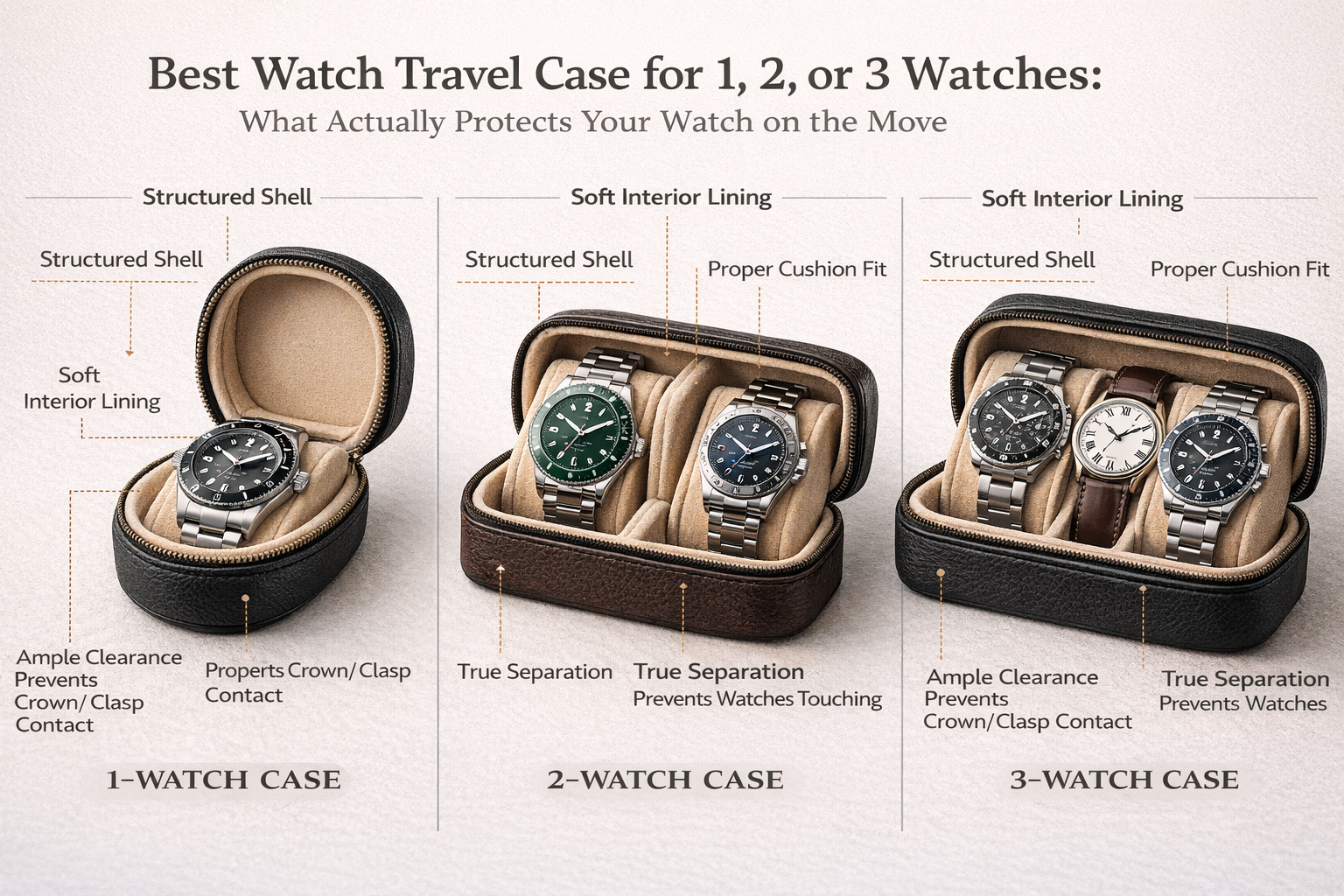
A good watch travel case is not just a nice accessory.
It is one of those small purchases that feels optional right up until the moment a clasp rubs a case flank, a crown presses against leather, or two watches spend a flight quietly grinding against each other inside a bag.
That is when people realize they were not really “storing” their watches.
They were just transporting risk.
So here is the short answer:
If you travel with watches, a proper travel case is worth buying.
And the right one depends less on luxury branding than on three practical things:
- how many watches you actually carry,
- how much structure and separation they need,
- and whether the case protects the watch from pressure, rubbing, and movement inside your bag.
That last part matters the most.
Because a bad travel case can look premium and still do a poor job of protecting a watch.
Who this guide is for
This article is for you if:
- you travel with one or more watches,
- you rotate straps or bracelet setups while away,
- you want something better than wrapping a watch in a sock,
- or you are buying your first proper travel case and want to get it right once.
It is also useful if you already care about how a watch wears and how it is stored when not on the wrist. If so, How to Store Watches Properly When Not Wearing Them is the natural companion to this guide.
The short answer
Here is the most practical recommendation:
- For 1 watch: buy a compact, structured single-watch case with a firm shell and a properly sized cushion.
- For 2 watches: buy a case with true separation between compartments, not just a soft divider pretending to do the job.
- For 3 watches: choose a structured roll or travel case only if each watch sits securely and does not press into the others when closed.
A good travel case should protect against:
- case-to-case contact,
- clasp rubbing,
- crown pressure,
- loose movement inside the case,
- and compression inside luggage.
A bad travel case often fails in one of these areas:
- too soft,
- too loose,
- too tight for larger watches,
- fake suede but poor structure,
- or attractive design with weak real-world protection.
Why most people buy the wrong travel case
People usually shop for travel cases the same way they shop for wallets or desk accessories.
They look for:
- nice leather,
- good color,
- luxury-style stitching,
- a premium feel,
- and maybe a pleasing photo next to a weekender bag.
What they should be shopping for is much less glamorous:
- compression resistance,
- interior clearance,
- watch-to-watch separation,
- cushion fit,
- and whether the case stays protective when tossed into a backpack, carry-on, or hotel drawer.
That is the real job.
A travel case is not there to impress you when empty.
It is there to protect the watch when your luggage is not being gentle.
A real-world example
Let’s say you take two watches on a four-day work trip.
One is a daily sports watch on bracelet.
The other is a slimmer watch on leather for dinners or meetings.
You toss them into a soft watch roll because it looks elegant online. It has nice leather, soft lining, and “room for three watches.”
But in real use:
- the bracelet watch shifts more than expected,
- the center links rub the case wall,
- the slimmer watch sits loose on the cushion,
- and once the roll is packed tightly between shoes and chargers, the structure collapses more than you thought it would.
When you arrive, nothing is catastrophic.
But you notice fresh rubbing near the clasp and light marks you know were not there before.
This is exactly how bad travel cases disappoint.
Not with drama.
With preventable little losses.
What actually protects a watch while traveling?
This is the most important part of the article, because it helps separate marketing from real protection.
A good travel case protects a watch through four layers of defense:
1. Structure
The outer body needs enough firmness to resist pressure from other items in your bag.
For one-watch travel, this often matters more than “luxury” leather. A modest hard-shell case can protect better than a soft premium roll if the bag gets compressed.
2. Fit
If the cushion is too small, the watch slides.
If it is too big, the bracelet or strap gets forced unnaturally tight.
Neither is good.
3. Separation
When carrying more than one watch, true separation matters more than soft lining. Soft lining reduces surface friction. It does not stop hard metal parts from touching if the interior is poorly designed.
4. Interior clearance
A thicker watch, tall bezel, domed crystal, or prominent crown needs enough room to sit without pressure points when the case closes.
If you are not sure how much watch dimensions affect real-world fit, Watch Size Guide: Case Diameter, Lug-to-Lug & Thickness (How to Choose the Perfect Fit) is more relevant to travel-case shopping than many buyers realize.
Best travel case for 1 watch
If you travel with one watch, do not overcomplicate it.
The best one-watch travel case is usually:
- compact,
- structured,
- easy to pack,
- and secure enough that the watch does not shift around inside.
What to look for
A good single-watch case should have:
- a semi-rigid or rigid shell,
- soft interior lining,
- a cushion that actually fits your watch,
- enough room for the watch head and clasp without strain,
- and a closure that does not feel flimsy.
Best for
This style is ideal for:
- business travel,
- gym-to-office carry,
- carrying a second watch in a backpack,
- or protecting one watch while another is on your wrist.
What to avoid
Avoid single-watch cases that are:
- too soft,
- too shallow for thicker sports watches,
- too narrow for bracelet watches,
- or built around decorative leather with almost no crush resistance.
Practical example
If you usually wear one watch while traveling but want one backup option for evenings, a one-watch case is often the smartest answer. It takes little space and gives much better protection than improvised storage.
If you frequently swap straps while away, it also helps to read Spring Bar Tool Guide: Which One to Buy & How to Change a Strap Without Scratching Lugs before your next trip.
Best travel case for 2 watches
Two-watch travel is where shopping gets more serious.
Why?
Because one-watch cases are mostly about shell protection.
Two-watch cases are about shell protection and separation.
That means the wrong case becomes risky much faster.
What to look for
A good two-watch case should offer:
- two clearly defined compartments,
- no watch-to-watch contact when closed,
- enough structure that the case does not collapse inward,
- cushions that fit both watches securely,
- and enough spacing for mixed sizes or different case thicknesses.
Best for
A two-watch case is ideal if you usually travel with:
- one sports watch and one dressier option,
- one watch on bracelet and one on strap,
- or one daily watch plus one occasion watch.
What to avoid
Avoid designs where:
- the divider feels too soft,
- the watches sit face-to-face with minimal padding,
- the crowns sit toward each other,
- or the interior only works if both watches are almost exactly the same size.
Real-world advice
If one watch is larger, put the larger piece in the slot with more clearance and check how the crowns sit relative to the divider. Crown pressure is one of those small issues buyers ignore until it leaves a mark or creates unnecessary strain.
Best travel case for 3 watches
Three-watch travel cases are the most attractive online and the easiest to get wrong in real life.
They look versatile.
They promise options.
They feel collector-friendly.
And sometimes they are excellent.
But a three-watch case only makes sense if you actually use it — and if it protects each watch properly when full, not just when photographed.
What to look for
A good three-watch case needs:
- real separation between all three slots,
- consistent support across the whole roll or shell,
- enough room for mixed watches,
- strong closure without crushing the end watches,
- and a shape that stays stable when packed vertically or horizontally.
Best for
A three-watch case works well if you are:
- taking a weekend trip with options,
- traveling for a wedding or event,
- mixing sports, dress, and casual watches,
- or shooting content while away.
What to avoid
Avoid three-watch cases that:
- look elegant but collapse when squeezed,
- force all watches into the same cushion size,
- create crown-to-case contact,
- or become bulky enough that you stop using them.
A simple reality check
If you rarely wear three watches on a trip, do not buy a three-watch case just because it feels more complete. Empty slots do not create value. Right-sized protection does.
Watch roll vs hard case: which one is better?
This is one of the most common buying questions, and the answer depends on how you travel.
Choose a watch roll if:
- you care about compact packing,
- your luggage is generally controlled and organized,
- you want flexibility for straps and varied travel,
- and the roll has real internal structure, not just soft leather.
Choose a hard or semi-hard case if:
- you throw bags into cars, overhead bins, or backpacks,
- you want better crush resistance,
- you carry chunkier sports watches,
- or you care more about protection than classic leather aesthetics.
The honest answer
A good watch roll is better than a bad hard case.
A good hard case is better than a decorative soft roll.
So do not shop by category alone. Shop by actual protective design.
What materials matter most?
Material matters, but not in the way many buyers think.
The outer leather or fabric is less important than:
- interior softness,
- structural support,
- closure quality,
- and whether metal parts inside the case can rub against the watch.
That said, materials still influence how a case behaves in travel.
Leather
Looks great, ages well, feels premium. But soft leather alone is not protection. It needs structure underneath.
Synthetic shell / molded case
Often more practical than it looks. Usually better for impact and compression resistance.
Soft suede-style lining
Nice for reducing surface friction, but it does not solve loose fit by itself.
Rigid inserts or divider walls
These matter more than marketing copy. Good internal support is one of the biggest differences between “luxury-looking” and “actually protective.”
If you want to think more clearly about how watch surfaces react to friction, knocks, and wear, Watch Case Materials Explained: Steel vs Titanium vs Ceramic vs Bronze (Pros & Cons) is useful background reading.
How to choose the right travel case by your travel style
Here is the simplest decision framework.
You are a light traveler
You usually take one watch and want a backup only sometimes.
Best choice:
A compact single-watch hard or semi-hard case.
You are a work traveler
You want one daily watch and one smarter option.
Best choice:
A properly separated two-watch case.
You are a collector on the move
You like options and actually rotate watches while traveling.
Best choice:
A structured three-watch case or roll with strong interior support.
You are a casual buyer
You think you might travel with several watches, but mostly do not.
Best choice:
Do not overbuy. Get the one-watch or two-watch case you will actually use.
The 7 things to check before buying a watch travel case
This is the part most buyers should screenshot mentally.
Before buying, check these:
1. Is the shell actually protective?
Press the product photos mentally. If the case looks like it would fold under backpack pressure, that is not ideal.
2. Are the cushions realistic for your watches?
A cushion that only works for tiny wrists or ultra-flexible straps is not versatile.
3. Does the case accommodate thicker watches?
A thin dress watch and a thick diver do not need the same interior depth.
4. Can metal touch metal inside?
Bracelet clasps, crowns, and case flanks should not be able to rub each other in normal transport.
5. Is the closure secure?
Weak snaps, loose zips, or awkward roll ties create avoidable problems.
6. Is it easy to pack?
A “beautiful” case that is too bulky for how you travel gets left at home.
7. Does it fit your actual watch count?
Do not buy a three-watch case because it feels more premium if you always travel with one.
What most people should avoid
There are a few very common bad buys in this category.
1. The ultra-soft leather roll with almost no structure
Looks expensive. Protects poorly.
2. The cheap multi-watch case with oversized loose cushions
Watches shift more than expected, especially on bracelet.
3. The case designed only for slim watches
Many sport watches sit too high, too tight, or under crown pressure.
4. The oversized collector case for short trips
It becomes luggage clutter, then stops being used.
5. The stylish case with metal hardware placed badly inside
Looks fine in product photos. Risky in real life.
A practical packing routine that actually protects your watch
Even a good case works better if you pack intelligently.
Step 1: Clean the watch before travel
A quick wipe removes dust, sweat, and grime that could rub during transport.
This is one of those habits that takes seconds and pays off later. It fits naturally with Weekly Watch Care Routine: A Simple 10-Minute System to Extend Your Watch’s Life.
Step 2: Loosen the bracelet or strap slightly if needed
Do not force a bracelet too tight around a cushion that is too large. That creates unnecessary stress.
Step 3: Position the watch thoughtfully
If there are multiple watches, make sure crowns, clasps, and bulky sides are not facing each other aggressively.
Step 4: Place the case where it will not be crushed
Even a solid travel case is not meant to sit under a laptop, shoes, and a toiletry kit all at once.
Step 5: Re-check after arrival
When you get to the hotel, inspect the watch briefly. A good case should mean nothing changed.
One-watch, two-watch, or three-watch: what should you actually buy?
Here is the honest version.
Buy a 1-watch case if:
- you mostly wear one watch on the trip,
- want a backup occasionally,
- travel light,
- or care most about compact protection.
Buy a 2-watch case if:
- you regularly want a daily and a dress option,
- actually switch watches while traveling,
- and want the best balance of utility and size.
Buy a 3-watch case if:
- you know you will use all three slots,
- take longer trips,
- or genuinely enjoy wardrobe-style watch rotation away from home.
For most people, 2 watches is the sweet spot.
It gives flexibility without turning the case into luggage furniture.
A note on straps, bracelets, and fit while traveling
Travel is often when people realize one strap does not do everything well.
A bracelet may feel right for flying and daily wear.
Leather may be better for dinner or meetings.
Rubber may be smarter in hot or humid destinations.
Nylon can be great for comfort and casual use.
That is why travel-case buying often overlaps with strap planning. If you are still deciding what actually works for your trip style, Watch Strap Materials Guide: Bracelet vs Leather vs Rubber vs Nylon (What to Choose) is worth reading before you pack.
Bottom line
The best watch travel case is not the one that looks the most luxurious online.
It is the one that:
- fits your real watch count,
- protects against movement and compression,
- keeps watches separated,
- and is practical enough that you actually use it every time you travel.
For most people:
- 1 watch: compact hard or semi-hard case
- 2 watches: structured case with real separation
- 3 watches: only if each slot is truly protective and you actually use all three
That is what actually protects a watch on the move.
Not marketing language.
Not decorative leather.
Not a nice product photo on a hotel desk.
Real protection comes from structure, fit, separation, and honest buying.
FAQ
What is the best watch travel case for one watch?
A compact, structured single-watch case with a firm shell and a properly fitting cushion is usually the best choice.
Are watch rolls safe for travel?
Yes, if they have enough structure and separation. A soft roll with little internal support is less protective than many buyers assume.
Is a hard watch case better than a leather roll?
Often yes for crush resistance, but a well-designed structured roll can also work well. Design matters more than category alone.
Should watches touch each other inside a travel case?
No. A good multi-watch case should prevent case-to-case and clasp-to-case contact during normal transport.
How many watches should I travel with?
For most people, one or two is enough. Three only makes sense if you genuinely rotate them and have a case that protects all of them properly.
Can I just wrap my watch in a pouch or cloth?
You can, but it is much less protective than a proper travel case. Improvised solutions often fail when bags get compressed or jostled.