Annual Calendar vs Perpetual Calendar: Differences, Maintenance & What to Buy
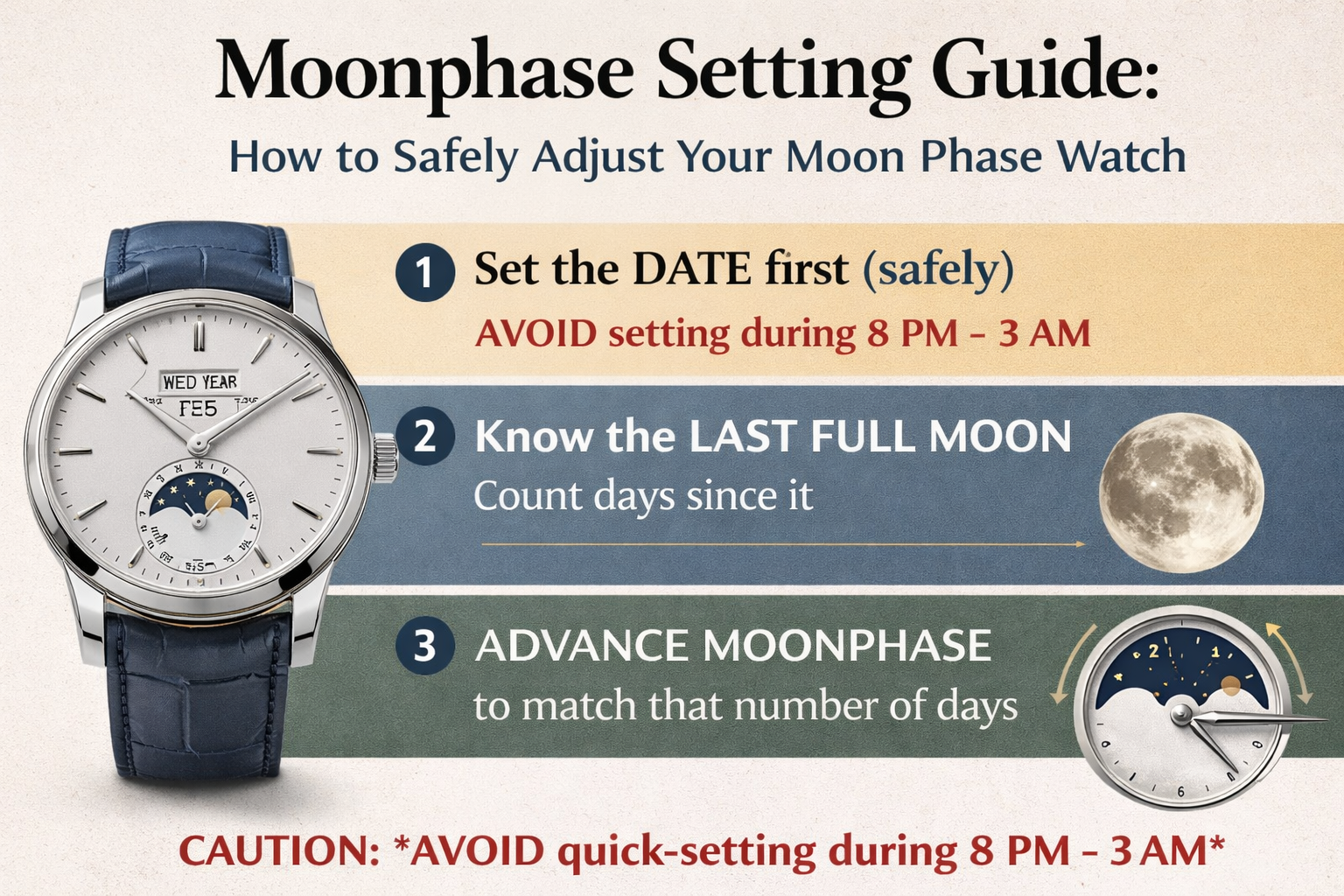 An annual calendar correctly tracks months with 30 or 31 days, but it still needs one manual correction per year (usually at the end of February). A perpetual calendar automatically accounts for February and leap years, often needing no manual correction for many years—as long as it keeps running and is set correctly. Perpetual calendars are more complex and expensive to service, but they’re also one of the most impressive complications in watchmaking.
What does “calendar complication” mean?
A calendar complication displays the date (and sometimes day, month, year, moonphase). The difference between annual and perpetual calendars is how intelligently the watch “knows” the length of each month.
Annual Calendar: how it works (simple)
An annual calendar “remembers” that months are usually 30 or 31 days, so it auto-corrects most month changes.
-
✅ Corrects 30/31-day months automatically
-
❌ Does not fully handle February
-
🔧 Needs one correction per year (after Feb 28 or Feb 29 depending on leap year)
Who it’s for:
People who want a practical high complication but don’t want the price/service burden of a perpetual.
Perpetual Calendar: how it works (simple)
A perpetual calendar uses a mechanical “program” (a cam system) to track:
-
month lengths
-
February
-
leap years
Some can track centuries (depending on design), but the key is: it’s built to know the leap-year cycle. -
✅ Handles February and leap years automatically
-
✅ Usually needs no manual correction for years (if kept running and set properly)
-
⚠️ More complex, more expensive, more sensitive to incorrect setting
Who it’s for:
Collectors who love mechanical complexity, and people who want “set it and forget it” (with caveats).
The practical differences (what matters in real life)
1) Corrections you’ll do
-
Annual calendar: 1 correction / year
-
Perpetual calendar: ideally 0 corrections, but only if it keeps running and stays set correctly
2) Cost, complexity, servicing
Perpetual calendars are typically:
-
more expensive to buy
-
more expensive to service
-
more time-consuming to repair if something is set incorrectly
Service baseline reference (general mechanical servicing):
→ How Often Should You Service a Mechanical Watch? A Practical Maintenance Timeline
3) “If it stops” problem
If a perpetual calendar stops and you don’t know how to reset it, it can be intimidating. Many owners use a watch winder (depends on usage), or simply learn correct setting steps.
Storage/keeping watches when not wearing:
→ How to Store Watches Properly When Not Wearing Them
Setting rules (the biggest mistake people make)
Even though this is not water-related, calendar watches have a classic “do not do this” rule:
Don’t change the date during the danger window
Many watches should not be quick-set during roughly 8 PM – 3 AM (varies by movement), because the calendar mechanism may be engaged.
If you want a broader “avoid doing dumb damage” guide:
→ Weekly Watch Care Routine: A Simple 10‑Minute System to Extend Your Watch’s Life
Which one should you choose?
Choose an annual calendar if:
-
you want the calendar experience with less cost/complexity
-
you don’t mind one yearly correction
-
you prefer a “daily wearable” complication
Choose a perpetual calendar if:
-
you value mechanical artistry and complication prestige
-
you want leap-year tracking
-
you’re okay with higher servicing cost and careful setting habits
FAQ
1) What’s the simplest definition of annual vs perpetual calendar?
Annual: needs one correction per year.
Perpetual: handles leap years automatically.
2) Does a perpetual calendar really never need correction?
In theory it can run for many years correctly, but if it stops or is set incorrectly, you may need to reset it carefully.
3) Why are perpetual calendars so expensive?
They have more parts, tighter tolerances, and require more skilled assembly and servicing.
4) Can I damage my calendar watch by setting the date at night?
Yes, many movements have a “danger zone” when gears are engaged. Avoid quick-set changes during late evening/early morning.
5) How often should I service an annual/perpetual calendar?
Depends on use, but because they’re complex, follow a conservative maintenance plan and use a reputable watchmaker.
→ How Often Should You Service a Mechanical Watch? A Practical Maintenance Timeline
6) Is a moonphase usually paired with these calendars?
Often yes (especially perpetual calendars):
→ Celestial Ballet on the Wrist: The Poetic Mechanics of the Moon Phase Complication