Does Salt Water Damage Watches? Ocean Exposure Explained
In this guide, we explain how salt water affects metal, seals, and movement components — and what you should always do after swimming in the ocean.
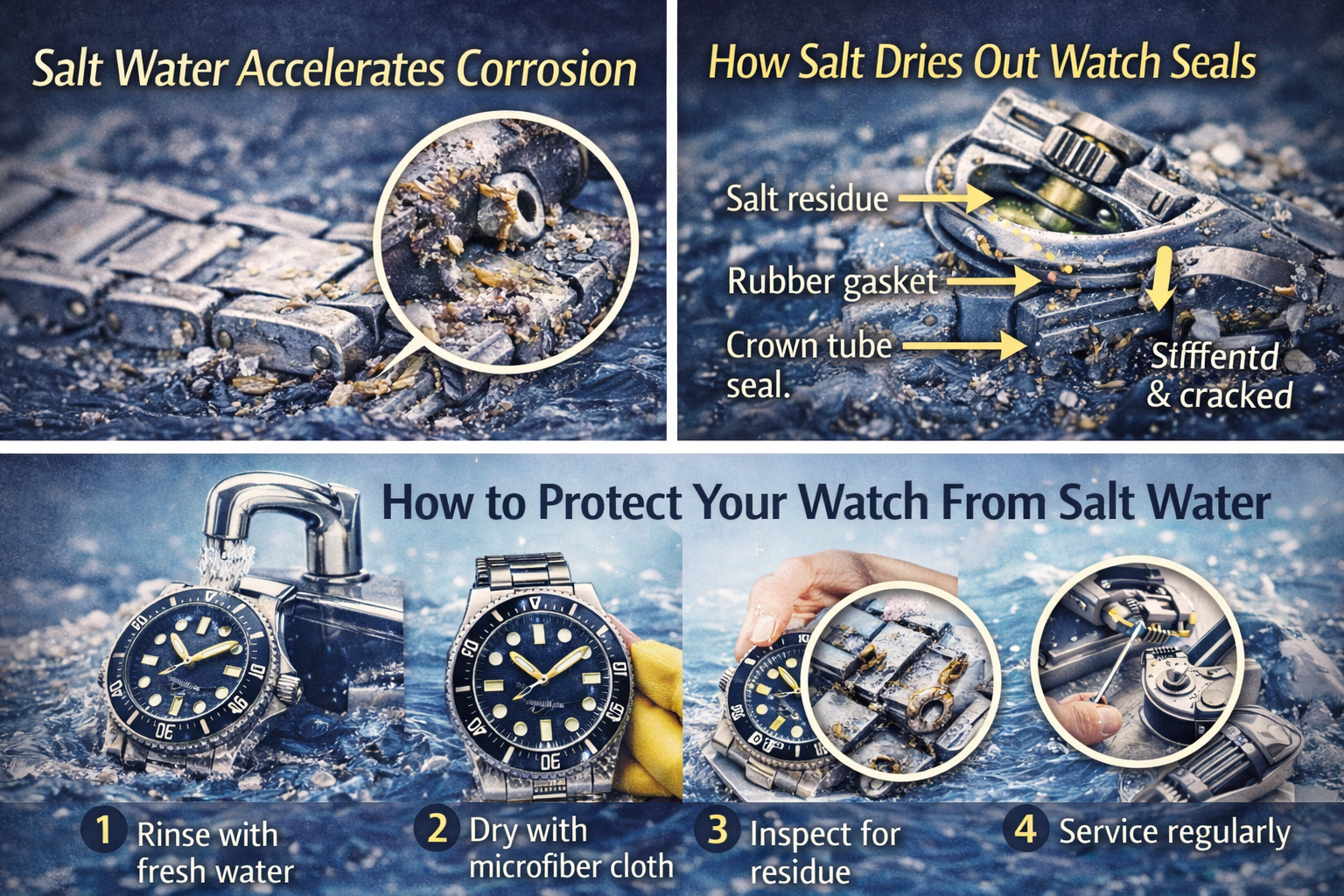 Short Answer: Yes, Salt Water Can Damage Watches
Salt water does not usually destroy a watch instantly.
However, repeated exposure without proper rinsing can:
-
Accelerate corrosion
-
Trap salt crystals in bracelet links
-
Dry out rubber gaskets
-
Reduce long-term water resistance
Understanding how water resistance ratings work helps clarify the limits.
👉 Read our full guide on watch water resistance explained.
Why Salt Water Is More Aggressive Than Pool Water
Saltwater contains minerals that remain behind after evaporation.
This leads to:
-
Crystallized residue
-
Metal surface pitting
-
Increased friction in moving parts
Unlike chlorine, which mainly affects seals, salt primarily affects metal components.
For comparison with pool exposure, see:
👉 Does Chlorine Damage Watches?
Does Salt Water Damage Stainless Steel?
High-grade stainless steel is corrosion-resistant — not corrosion-proof.
Over time, salt exposure can:
-
Cause micro-corrosion
-
Build residue between bracelet links
-
Damage spring bars
Even dive watches require proper post-swim care.
If you’re unsure whether swimming is safe for your watch rating, read:
👉 Can You Swim With a Watch?
Is 100m Enough for Ocean Swimming?
A 100m rating is generally safe for surface ocean swimming.
However:
-
Jumping into waves increases pressure impact
-
Heat reduces seal effectiveness
-
Salt accelerates gasket wear
If you’re comparing ratings, see:
👉 100m vs 200m Water Resistance
Higher ratings provide margin — but maintenance matters more.
How Salt Affects Watch Gaskets
Salt residue can:
-
Dry rubber seals
-
Reduce flexibility
-
Shorten water-resistance lifespan
Over time, even a 200m-rated watch can lose effective protection if not serviced.
Learn when to check your seals here:
👉 How Often Should You Service a Mechanical Watch?
What Happens If You Don’t Rinse After Ocean Swimming?
If salt dries on the watch:
-
Corrosion accelerates
-
Bracelet stiffness increases
-
Crown threads may wear prematurely
This is one of the most common
👉 watch care mistakes among frequent swimmers.
Proper After-Ocean Care Routine
Immediately after swimming:
-
Rinse thoroughly with fresh water
-
Gently dry with microfiber cloth
-
Avoid adjusting crown until fully dry
-
Inspect for salt residue
These steps dramatically reduce long-term damage risk.
Signs Salt Water Has Caused Damage
Watch for:
-
Rust near lugs or spring bars
-
Crown stiffness
-
Fogging under crystal
-
Bracelet discoloration
If you notice condensation, review what to do in
👉 What Happens If Water Gets Inside Your Watch? (upcoming guide).
Conclusion
Salt water does not instantly destroy watches — but neglect does.
Rinsing after ocean swimming is essential.
Even high water-resistance ratings cannot compensate for repeated salt exposure without maintenance.
Ocean use is safe when combined with proper care and servicing.